
Aluminum and Truck Wheel Polishing Machines: What the Fixture Decides
"Wheel" in this article means the automotive wheel — the forged aluminum rim, the cast passenger car wheel, and the heavy-duty truck disc — not the abrasive polishing wheel mounted on a bench spindle or ceramic polishing wheels used as hand-tool consumables. The two are completely different purchases, and when you are finishing automotive or commercial truck rims, the engineering component that actually decides your surface result is the fixture, not the base machine.
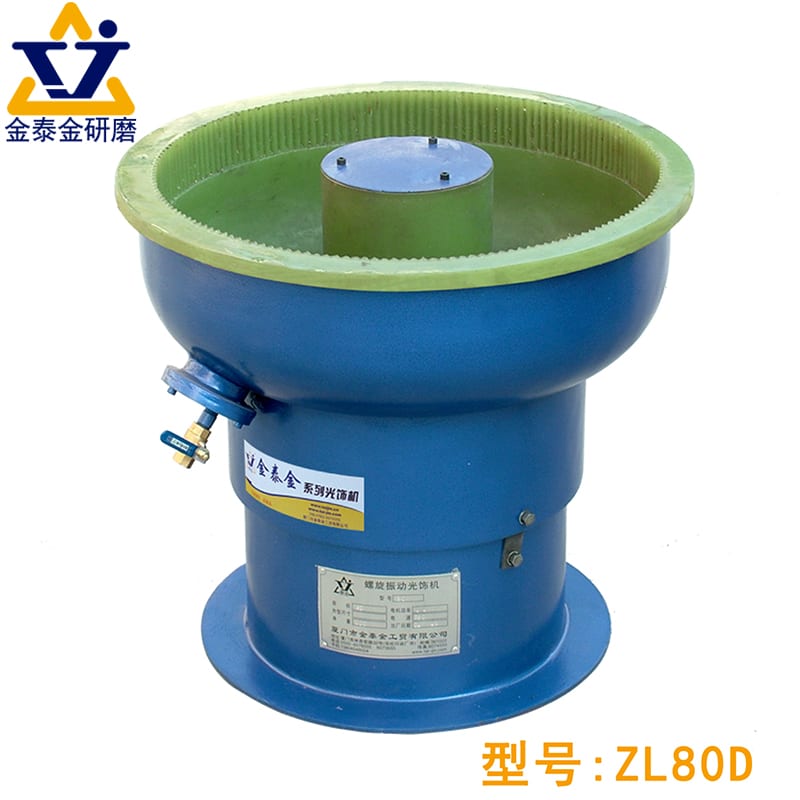
Buyers searching for an aluminum wheel polishing machine or a truck wheel polishing machine often assume they are looking for a purpose-built, standalone category of equipment. On the shop floor, the reality is far simpler and much more critical for your purchasing specification: a mass-finishing wheel polisher is a standard vibratory finishing machine equipped with a mechanical clamping fixture that holds the rim stationary or indexes it inside the processing channel. We build the vibratory finishing machine — the heavy-duty welded tub, the eccentric drive shaft, and the polyurethane-lined chamber. The fixture that secures your specific rim diameter, bolt pattern, and offset is an engineered tooling assembly tailored to the workpiece. Understanding where the standard machine ends and where custom fixturing begins is the single most important step in specifying equipment that actually works on your production floor.
Why a Wheel Cannot Be Tumbled Loose
In conventional mass finishing, stamped brackets, forged gears, or cast valve bodies are loaded into a vibratory bowl or rotary barrel tumbling machine where they circulate freely within a rolling mass of abrasive media. As long as the media-to-part ratio is high enough, the media forms a protective cushion between individual workpieces. That free-tumbling physics breaks down completely as soon as you introduce an automotive or commercial truck wheel into the tub.
The part-on-part problem (25-45 kg of forged aluminium against itself)
A forged aluminum truck wheel or a large passenger rim brings a severe combination of high mass, thin structural cross-sections at the spoke edges, and high-visibility cosmetic faces. A heavy-duty commercial truck wheel typically weighs between 25 kg and 45 kg, while even a standard passenger car casting carries substantial momentum when agitated by twin vibratory motors. If two rims — or even a single loose rim rebounding off the tub wall — make direct metal-to-metal contact inside a vibrant media bed, the kinetic energy immediately causes deep gouges, bruised rim lips, and nicked spoke edges.
Aluminum alloys used in wheels are relatively soft and ductile compared to hardened steel components. Once part-on-part impingement dents an outer rim flange or scores the machined mounting pad, no reasonable cycle time with fine polishing media will blend that defect out without destroying the surrounding geometry. Furthermore, a loose wheel will naturally orient itself flat or wedge diagonally across the channel, blocking media circulation, starving the lower spokes of abrasive flow, and overloading the polyurethane lining in a single concentrated zone.
What the fixture actually does (hold, index, present the face)
To eliminate impingement and control media flow, the wheel must be mechanically restrained throughout the entire cycle. In a fixtured vibratory system, the wheel is clamped either through its center bore and lug nut pattern on a rigid spindle or gripped around the outer tire bead seat by a three-point or four-point retaining ring.
The fixture performs three distinct mechanical jobs inside the vibratory chamber:
- Spatial isolation: It locks the wheel in a known position relative to the tub walls and adjacent stations, making part-on-part collision physically impossible.
- Flow presentation: A stationary wheel placed blindly into a moving media stream will experience uneven wear — the upstream side of the spokes takes heavy erosion while the downstream side sits in a dead zone. A well-engineered fixture either sets the wheel at an angle that matches the toroidal spiral of the vibratory mass or slowly rotates the wheel spindle so every spoke window and ventilation hole passes through the high-pressure zone equally.
- Datum protection: Critical functional surfaces — such as the hub pilot bore, the back mounting pad, and the lug seat tapers — can be masked or shielded by the clamping plates themselves, ensuring that aggressive cutting media only acts on the visible cosmetic face and spoke windows.
For a deeper technical breakdown of how clamping geometry interacts with rotational symmetry, read our dedicated engineering guide on wheel workpiece polishing, roundness, and fixturing.
The Machine Under the Fixture Is a Standard Vibratory Finisher
When you strip away the marketing names used by boutique wheel-refinishing vendors, the base unit generating the cutting action is a heavy-duty vibratory finisher. For factories evaluating wider shop floor layouts, our overview of wheel polishing equipment forms and line integration explains how vibratory systems compare against robotic buffing cells and rotary tables. Within the vibratory category itself, you are choosing between two structural formats: circular bowls and rectangular tubs.
Bowl, tub, and what each one can carry
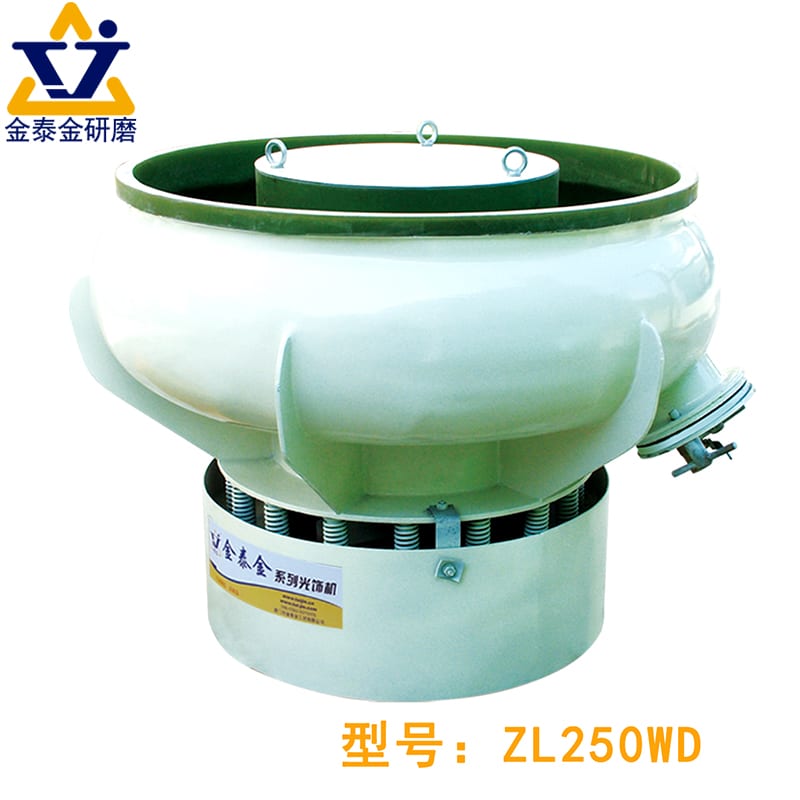
A circular bowl vibrator moves media in a continuous helical path around a center dome. When adapted for wheels, the center dome is typically modified or minimized so a single wheel can be mounted horizontally or at a slight tilt in the middle of the annular channel, or clamped to an overhead bridge that lowers the rim into the stream.
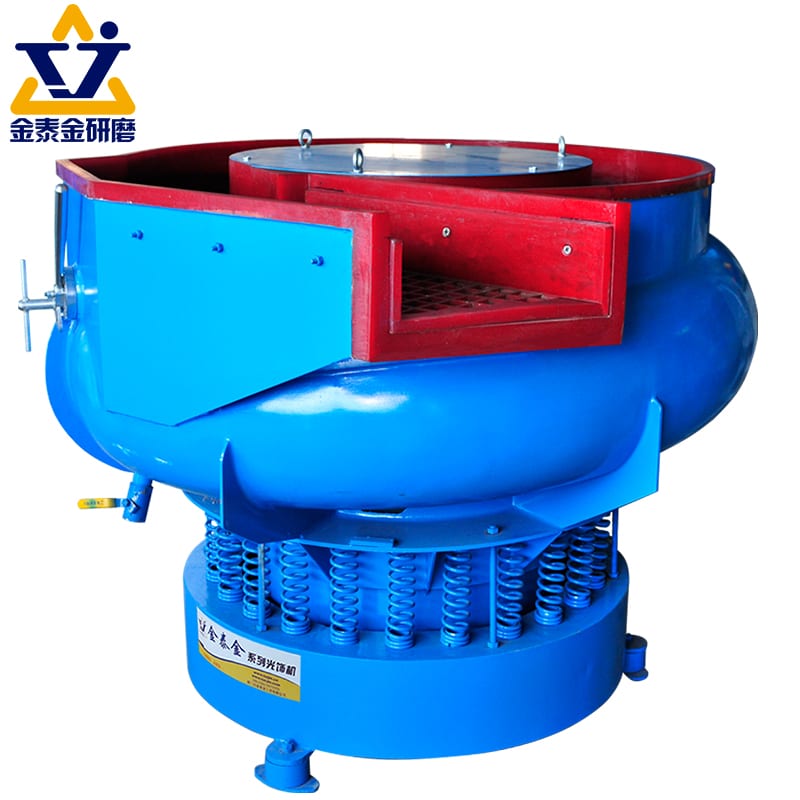
A rectangular tub vibrator (trough machine), by contrast, uses an open, U-shaped cross-section driven by dual eccentric motor shafts mounted along the bottom or sides of the vessel. Because a rectangular trough does not have an internal center dome interrupting its width, it offers an unobstructed span across both the length and width of the chamber. Long tubs can be divided by removable urethane partitions into multiple independent compartments, allowing an operator to fixture two or three wheels side by side along the length of the machine, or to run a rough-cut media grade in one chamber and a pre-polish plastic media in the next.
| Comparison Dimension | Circular Bowl Vibrator (Fixtured) | Rectangular Tub Vibrator (L-Series Trough) |
|---|---|---|
| Chamber Geometry | Annular ring around a center dome | Open U-shaped rectangular trough |
| Typical Wheel Layout | Single wheel per bowl (center or bridge mount) | Single large truck wheel or multi-station compartmentalized line |
| Media Flow Pattern | Helical spiral around the ring | Continuous roll across the trough width |
| Changeover Flexibility | Fixed ring width limits maximum rim diameter | Adjustable partition plates adapt to varying wheel widths |
| Best Application Fit | Dedicated single-wheel aftermarket refinish bays | Wide commercial truck rims, multi-wheel batch shops, OEM cells |
Why the tub machine suits large wheels and the bowl suits repolish work
For retail tire shops or small refurbishment garages processing one passenger car rim at a time, a modified circular bowl is compact and straightforward. However, when you move to heavy commercial truck wheels, agricultural rims, or multi-wheel industrial production, the rectangular tub vibrator is structurally far more adaptable. A large dual-motor trough provides the wide cross-sectional clearance needed so media can roll freely over a deep-dish truck rim without pinching between the tire flange and the polyurethane wall.
Our standard heavy-duty trough lineup illustrates the physical envelope and drive power required to agitate dense ceramic or plastic media charges around large fixtured castings:
| Model | Nominal Trough Capacity (L) | Overall Dimensions L×W×H (mm) | Motor Power (kW) |
|---|---|---|---|
| L1300 | 1200 | 2700 × 1300 × 1400 | 5.0 × 2 |
| L1500 | 1500 | 3340 × 1290 × 1440 | 5.5 × 2 |
| L1800 | 1800 | 2800 × 1700 × 2000 | 7.5 × 2 |
Engineering note on ratings: Nominal trough capacity (such as 1200 L, 1500 L, or 1800 L) is the catalogue rating for the empty tub. The actual media load, usable clearance, and number of wheel stations depend on wheel size, fixture envelope, and media charge, and must be confirmed by sample trial. Likewise, the maximum wheel diameter the fixture can carry is a fixture design parameter, not a fixed machine rating; confirm against the actual wheel drawing or sample before quoting.
Founded in Xiamen in 1992, our manufacturing operation builds these vibratory platforms under ISO 9001 certification (certificate 00726Q01571R001, valid 2026-06-03 to 2029-06-02), with CE compliance covering 21 machine platforms across vertical (M.2023.206.C88121) and horizontal (M.2023.206.C88120) lines valid through 2028-07-24. Backed by 24 granted Chinese IP rights — including 1 invention patent and 17 utility model patents that support our mechanical structural and clamping engineering — we have validated vibratory finishing processes across 48 distinct industrial workpiece categories, ranging from heavy cast fan wheels and gears to die-castings and stamped hardware. While high-speed centrifugal disc finishing machines and magnetic polishers (such as our OBD-30, OBD-60, and OBD-100 series) excel at small precision hardware, only heavy dual-motor vibratory troughs and bowls provide the physical volume and controlled low-impact energy required for fixtured wheel work.
Four Questions That Decide the Specification
When requesting a quote for a wheel polishing system, asking "How much is your wheel machine?" leads to guesswork. Because the base vibrator and the custom fixture must work as a single mechanical system, four specific engineering inputs decide the specification.
Question 1 — Wheel diameter and mass (what the fixture must carry)
You must define both the largest and smallest rim diameter, the maximum rim width (bead-to-bead), and the unmounted weight of the heaviest wheel in your mix. A fixture submerged in vibrating ceramic media experiences continuous multi-directional hydraulic and mechanical drag from thousands of moving stones. If the clamping arbor is under-sized for a heavy forged truck wheel, the vibration of the tub will induce harmonic flexing in the fixture arm, leading to fretting wear at the mounting bore or loosened clamps mid-cycle. Furthermore, the tub width — such as the 1700 mm exterior span of the L1800 versus the 1300 mm span of the L1300 — must leave sufficient radial clearance around the outer rim lip so media flows smoothly over the flange rather than packing into a tight gap.
Question 2 — Finish requirement (what media and compound stage)
Are you stripping heavy CNC machining lines off a raw forging to prepare it for powder coating, or are you trying to bring an oxidized fleet truck wheel back to a bright, reflective showroom appearance? A pre-paint preparation or casting deflashing job typically requires a single-stage cut using ceramic media. A high-luster bright finish on bare aluminum requires a multi-stage sequence: an initial cut to level machining peaks, a smoothing step with fine plastic media to erase micro-scratches, and often a final dry or wet burnishing pass. Your required target appearance dictates whether you need a single tub with media swap capability or a multi-machine cell dedicated to separate stages. Target surface appearance is always defined by your engineering drawing or visual master sample and verified through trial processing.
Question 3 — Throughput (how many wheels per shift)
Vibratory mass finishing of aluminum rims is a batch process measured in tens of minutes or hours per wheel, not seconds. Cycle time is never a fixed catalogue number; it depends entirely on the incoming surface roughness, alloy hardness, and target finish determined during sample testing. If your shop needs to turn around two refurbished rims a day, a single-station unit where the operator manually changes media between roughing and polishing stages may suffice. If you are running an industrial fleet reconditioning line or an OEM manufacturing cell targeting dozens of wheels per shift, swapping hundreds of kilograms of media in and out of one tub every hour will destroy your labor efficiency. High-throughput lines require dedicated machines for each media stage or long, multi-compartment troughs like the L1500 or L1800 that run several fixtures simultaneously.
Question 4 — Condition of the incoming wheel (bent? corroded? painted?)
A vibratory finisher is a uniform surface-refinement tool, not a geometric correction lathe. Before specifying a machine, audit what actually arrives on your receiving dock:
- Raw machined forgings or castings: Ideal candidates. The geometry is consistent, clean of road grime, and exhibits predictable tool marks.
- Heavily pitted or salt-corroded truck wheels: Deep corrosion pits require aggressive stock removal. If you try to remove deep pitting solely inside a vibratory tub, the cycle time becomes excessively long, and the media will round over crisp spoke edges before the bottom of the pit clears. Heavily pitted rims usually need localized sanding or lathe skimming before entering the vibratory tub.
- Greasy or brake-dust-caked rims: Oils and road tar immediately contaminate liquid compounds and consumables, glazing the pores of ceramic media and turning the tub into a grey sludge bath. Incoming used wheels must pass through a degreasing wash prior to fixturing.
Media and Compound for Aluminium — Why Wheel Work Differs From Steel
Polishing an aluminum wheel rim is metallurgically very different from deburring hardened steel gears. Aluminum is reactive, gummy, and easily bruised by sharp impacts. Selecting the wrong grinding media or chemical formulation will leave the wheel looking darker and rougher than when it went into the tub.
Media shape and why angular media marks a soft rim
When deburring steel stampings, aggressive angular media shapes are popular because their sharp points shear off heavy burrs quickly. On a soft aluminum rim, sharp angular ceramic triangles driven by high vibratory amplitude act like tiny hammers, leaving thousands of microscopic dimples ("orange peel" or peening marks) across the flat face of the wheel. Once an aluminum surface is heavily peened by oversized or overly sharp media, subsequent polishing stages struggle to close those craters.
For wheel work, media geometry must balance reach with surface contact area. Cones, rounded cylinders, spheres, and smooth-radius triangles in high-alumina ceramic are preferred for initial cutting and machining-line removal, followed by pre-shaped resin-bonded plastic cones or pyramids for surface smoothing. Because plastic media has a lower bulk density and softer matrix than ceramic, it cushions the impact against the aluminum face, refining scratch patterns down to a smooth, pre-bright matte finish without peening the metal. For a comprehensive breakdown of how geometry prevents wedging in narrow slots, consult our tumbling media selection guide. For final dry luster stages on fully prepped rims, organic media such as walnut shell grit or cob meal can also be deployed in dedicated dry tubs.
The compound stages (cut then colour) and when one is enough
Running aluminum wheels with plain water and abrasive media is a recipe for a dull, grey, oxidized surface. As fresh aluminum is abraded, fine metallic fines suspend in the water and re-deposit onto the soft rim while the bare metal reacts with the water bath. Proper liquid dosing flushes away abraded swarf, lubricates the media contact zone, and chemically brightens the alloy.
In a structured wheel-finishing sequence using our formulated compounds:
- Stage 1 (Cut and Level): During the ceramic or fast-cutting plastic stage, a dedicated metal roughing compound such as compound-JTJ25 (metal rough polishing) or compound-LC10 (deburring) keeps the media cutting cleanly, suspends aluminum fines so they drain out through the wastewater ports, and prevents metallic loading on the stones.
- Stage 2 (Smooth and Brighten / Colour): Once the surface profile is leveled, the process switches to a fine plastic or high-density non-abrasive stage dosed with compound-JTJ60 (metal fine polishing) or compound-HM3 (polishing/brightening). These formulations form a slick lubricating film between the media and the wheel face, minimizing friction heat and producing a clean, high-luster metallic reflection.
When is a single stage enough? If your production goal is simply to break sharp edges on cast ventilation windows and create a uniform matte anchor profile prior to clear powder coating or painting, a single cutting stage with compound-JTJ25 is sufficient. If the wheel is sold as a bare polished aluminum rim, the two-stage cut-and-colour chemistry is mandatory. Exact dosing ratios and flow rates are always established according to the technical data sheet and confirmed during sample trials.
Where a Wheel Polishing Machine Is the Wrong Purchase
Competitor brochures routinely claim their wheel machines can restore any rim in minutes. On the factory floor, buying a vibratory wheel system for the wrong application wastes capital and floor space. There are three specific scenarios where a vibratory wheel polishing machine is the wrong purchase.
Bent or previously welded wheels
A vibratory machine relies on dynamic load transfer from the vibrating tub through the rigid fixture and into the wheel. If an aftermarket rim has suffered curb impact, has a bent flange, or carries structural crack repairs from TIG welding, clamping it into a high-energy vibratory trough introduces two hazards. First, an out-of-round rim cannot be clamped concentrically without putting uneven mechanical stress on the fixture arms. Second, welded repair zones on cast or forged aluminum have a different grain structure and hardness (the heat-affected zone) than the parent metal. Vibratory media will erode the softer heat-affected zone at a different rate than the surrounding rim, leaving a visible halo or depression right where the weld was blended. Bent wheels belong on a hydraulic straightening press and a CNC lathe, not in a vibratory tub.
Painted or clear-coated faces (polishing removes the coating)
Many modern automotive wheels feature a "machined face" with painted pockets, or a fully powder-coated clear layer over polished aluminum. Vibratory mass finishing is an immersion process — the abrasive media contacts every exposed surface inside the tub. You cannot selectively polish a clear-coated scratch without the media stripping, dulling, and frosting the surrounding clear coat and painted spoke pockets. Conversely, if you put a heavily powder-coated wheel into a vibratory finisher hoping the ceramic media will strip the old paint, the gummy polyurethane or epoxy coating will smear across the abrasive stones, glaze the media bed, and require hours of cycle time. Coated wheels must be chemically stripped or blasted in a dedicated stripping system before they ever touch a vibratory polishing machine.
Very low volume where a subcontracted refinish is cheaper
A fixtured vibratory system requires floor space, three-phase industrial power (ranging from 10 kW to 15 kW across our L1300 to L1800 platforms), a clean water supply, an effluent settling tank for wastewater discharge, and inventory of multiple media grades. If your shop only refinishes two or three specialty wheels per week, the setup time required to hoist the wheel, bolt it into the fixture, and manage media changeovers outweighs the labor savings. At very low volumes, manual stand buffing or subcontracting to a regional wheel remanufacturer is far more economical.
Troubleshooting: Four Failures Blamed on the Machine
When a finished wheel comes out of the tub looking dull, damaged, or stained, operators almost always blame the vibratory machine. In practice, the machine is simply oscillating at its set frequency; nearly every quality failure traces back to compound chemistry, media sizing, cycle duration, or post-process drying.
| Observed Symptom | Root Cause | Shop-Floor Check | Corrective Adjustment |
|---|---|---|---|
| Grey or cloudy face after the cycle | Media glazing from oil contamination, insufficient compound dosing, or abrasive breakdown leaving embedded grit. | Rub a clean white cloth across the wet media bed; if it streaks black/grey, swarf is re-depositing on the wheel. | Flush the tub thoroughly, run a media cleaning cycle, and verify steady flow of compound-JTJ60 or compound-HM3 with fresh water rinse. |
| Media lodging in the spoke windows | Media nominal size sits too close to the narrowest spoke slot width, or worn stones have crossed into the wedging zone. | Measure the narrowest slot or lug recess on the wheel and compare against the sieve distribution of the working media mix. | Screen out undersized worn stones immediately; switch to a media size that is either well below 1/3 of the slot width or larger than the opening. |
| Rim edge rounded over (over-polished) | Excessive cycle duration, excessive vibratory amplitude, or wheel positioned too close to the high-pressure tub wall. | Inspect the outer bead flange and spoke corners; compare edge radius against an unpolished reference wheel. | Shorten the rough-cut cycle time, adjust the motor eccentric weights to reduce amplitude, or shift the fixture toward the center of the channel. |
| Flash rust or white water spotting within hours | Slow evaporative drying in ambient air; trapped rinse water inside lug holes or mounting pads reacting with metal. | Check unloaded wheels 2 hours after processing for white aluminum hydroxide spots or rust rings on steel hub inserts. | Eliminate ambient air drying; blow out blind holes immediately and transfer parts to a heated centrifugal dryer or hot-air drying station. |
Grey or cloudy face after the cycle
Aluminum oxidizes rapidly and sheds fine dark particulate during cutting. In closed-loop water systems where dirty water is recirculated without proper filtration or flocculation, microscopic metallic fines get hammered back into the soft aluminum surface by the media. Always ensure the drain plugs are clear, fresh solution is flushing the work zone, and the transition from roughing (compound-JTJ25) to burnishing (compound-JTJ60) includes a thorough washdown of both the wheel and the fixture so coarse abrasive grit does not carry over into the polishing stage.
Media lodging in the spoke windows
Few things slow down a wheel shop faster than an operator spending twenty minutes with a hammer and punch knocking jammed ceramic triangles out of decorative spoke cutouts or lug bolt holes. Lodging happens when media wears down over weeks of operation until its cross-section matches the slot dimension. Implement a routine screening schedule to purge worn media, and use dummy plugs or fixture shielding plates over bolt holes whenever the hole diameter falls into a high-risk wedging range.
Rim edge rounded over (over-polished)
In a vibratory trough, media velocity and pressure are highest near the outer walls and bottom radius, and gentler near the upper center of the roll. If a fixture holds a wheel too close to the rising wall of the tub, the outer rim flange absorbs disproportionate cutting energy while the center hub recess barely gets touched. By the time the center hub looks bright, the crisp machined angles on the spokes are washed out and rounded. Adjusting the fixture height and spindle angle balances erosion across the entire face.
Flash rust within hours of unloading
While aluminum does not red-rust like steel truck rims, wet aluminum left sitting on a pallet develops unsightly white water stains, dark oxidation streaks, and galvanic corrosion around steel valve stem inserts or hub rings. Steel truck wheels will flash-rust in minutes if left wet after an acidic or neutral compound wash. Rapid moisture removal is essential after unloading. For detachable fixture components, center caps, lug hardware, and smaller wheel assemblies that fit within standard basket envelopes, our heated centrifugal spin dryers (Model 35 with 30 kg capacity and φ400×300 mm basket; Model 70 with 50 kg capacity and φ500×400 mm basket; Model 70A with 60 kg capacity and φ480×290 mm basket, each equipped with 3 kW heating) strip surface water via centrifugal force and warm air. For full-size truck rims that exceed spin-dryer basket diameters, integrate a dedicated hot-air blow-off hood and warm deionized water rinse immediately adjacent to the vibratory tub.
FAQ
1. Are a wheel polishing machine and a vibratory finishing machine two different types of machines?
No. A mass-finishing wheel polishing machine is a standard vibratory finishing machine (either a circular bowl or a rectangular tub vibrator) equipped with a mechanical clamping fixture. The vibratory machine generates the media flow, while the custom-engineered fixture holds the wheel stationary or rotates it slowly inside the abrasive bed.
2. Can I put an aluminum or truck wheel directly into a vibratory machine without a fixture?
No. Tossing a heavy wheel loose into a vibratory tub causes severe part-on-part impingement and wall collisions, which immediately gouge the soft aluminum face, dent the rim flange, and damage the mounting pad. A loose wheel also disrupts the rolling circulation of the media bed. Every wheel must be mechanically clamped during processing.
3. Do aluminum wheels and steel truck wheels use the same polishing parameters?
No. Aluminum is much softer and more ductile than steel; it requires smoother media shapes (such as plastic cones or radiused ceramics) and carefully controlled vibratory amplitude to avoid surface peening or rounding over crisp spoke edges. Steel truck wheels require higher cutting force, more aggressive ceramic media, and strict post-process rust inhibition and hot drying to prevent immediate flash rusting.
4. Why do finished wheels develop cloudy spots, white stains, or rust shortly after unloading?
Post-process staining and oxidation happen when contaminated rinse water dries slowly on the bare metal surface, or when residual cutting compound remains trapped in lug holes and hub recesses. Switching to a clean final rinse, maintaining proper brightening chemistry (compound-JTJ60 or compound-HM3), and immediately drying the wheel with heated air or centrifugal drying equipment eliminates water spotting and flash corrosion.
5. What wheel size or production volume justifies investing in a fixtured vibratory system?
There is no single fixed wheel diameter or daily piece count that applies to every shop. The decision depends on your labor cost for manual stand buffing, the consistency required across complex spoke geometries, and whether your floor layout can accommodate dedicated roughing and polishing stages. Fixture envelope and tub sizing (such as choosing between an L1300, L1500, or L1800 trough) are always engineered around your actual rim dimensions and verified through sample trials.
6. Under what conditions should I NOT buy a vibratory wheel polishing machine?
Do not buy a vibratory system if your primary incoming work consists of bent or heavily weld-repaired rims (which require mechanical straightening and machining), wheels with intact paint or clear coats that must be preserved (vibratory media will abrade and frost coatings indiscriminately), or very low weekly volumes where manual buffing or subcontracted refinishing costs far less than operating an industrial three-phase mass-finishing cell.
Specify Your Vibratory Machine and Fixture Requirement
If you are evaluating mass finishing for aluminum castings, commercial truck rims, or industrial wheel components, start with the workpiece drawing rather than a generic catalogue model. Browse our complete range of industrial finishing machines or contact our engineering team with your wheel dimensions, alloy type, incoming surface condition, and target daily throughput to discuss tub sizing and custom fixturing options.
 +86-592-2381506


 IPv6 network supported
