Best Way to Automate Deburring Aluminum Die Cast Automotive Parts: Continuous Vibratory Lines & Resin Media
Finding the best way to automate deburring aluminum die cast automotive parts starts with replacing manual die-grinder benches with continuous, cushioned mass finishing cells. Automotive transmission housings, inverter covers, steering knuckles, and bracket castings leave high-pressure die-casting dies with razor-sharp parting-line flash, gate stubs, and brittle ejector-pin fins. SurfacePolish (Xiamen Jin Tai Jin Grinding Technology Co.,Ltd.) draws on 200,000+ verified finishing trials to configure automated vibratory finishing machine lines—combining ZXL and ZL bowls, pneumatic separating gates, resin-bonded plastic media, and closed-loop LC10 or HM3 compound dosing—ready for upstream powder coating or e-coat lines.

Why Automotive Aluminum Die Castings Demand Automated Mass Finishing
Manual hand filing and belt sanding create inconsistent edge radii, leave hidden flash inside cooling fins, and expose Tier-1 suppliers to ergonomic injuries and warranty claims. Automated vibratory cells deliver uniform isotropic edge break across every complex casting contour simultaneously.
Parting-Line Flash, Gate Witness & Ejector-Pin Burrs on Castings
High-pressure aluminum alloys (A380, ADC12, AlSi9Cu3) squeeze thin metallic flash into die parting seams and ejector sleeves as tooling wears across long production runs. Unremoved flash flakes off during engine assembly or lifts thin powder-coat films at sharp edges. Automated vibratory shear folds and breaks brittle die flash cleanly while blending gate trim scars into surrounding cast skins.
Preventing Surface Peening & Orange-Peel Dimples on Soft Aluminum
Running heavy aluminum-oxide stones against ductile die-cast aluminum batters flat sealing flanges and creates rough orange-peel craters that telegraph through glossy black e-coat. Using lightweight resin-bonded plastic media inside a cushioned polyurethane-lined bowl preserves cast flatness while shearing parting-line flash smoothly.
Preparing Castings for Powder Coating, E-Coat & Chromate Conversion
Downstream automotive coating lines fail rapidly when die-release silicone, dark aluminum smut, or loose abrasive grit remains trapped in bolt bosses. Combining flow-through HM3 or JTJ60 brightening chemistry with clean rinsing and 35A/70A centrifugal drying produces an oxide-free, uniform matte surface with strong paint adhesion.
| Die-Cast Automotive Component | Primary Casting Defect | Recommended SurfacePolish Line | Media & Compound Pairing | Downstream Readiness |
|---|---|---|---|---|
| Inverter & EV motor housings | Deep parting flash & cooling-fin burrs | ZXL straight-wall or L1500 trough |
Resin plastic media cones + LC10 / HM3 |
Clean matte ready for powder coat |
| Transmission valve-body covers | Thin edge rollover & cross-hole burrs | ZL vibratory bowl + pneumatic gate |
Fine plastic media pyramids + HM3 |
Burr-free sealing lands & clean bores |
| Structural brackets & sensor mounts | Gate trim stubs & die-scale haze | ZL bowl + 35A/70A dryer |
Medium plastic media + JTJ60 |
Uniform edge break & dry finish |
| Small die-cast latches & inserts | Blind-hole flash & tight slot burrs | LLB50 disc + OBD-60 magnetic unit |
Cones (HM3) then stainless pins |
Bright internal recesses, zero wedging |
| Oil-contaminated CNC re-machined castings | Cutting coolant + milled thread burrs | Ultrasonic cleaner + ZL bowl |
Pre-degrease then plastic media + HM3 |
Oil-free bed & spotless threads |
Selecting ZXL Straight-Wall Bowls, ZL Bowls & L1300–L1800 Troughs
Matching chamber architecture to casting envelope and takt time is the core engineering decision when designing the best way to automate deburring aluminum die cast automotive parts. Undersized bowls cause casting-on-casting bruising, while poorly matched screens slow automated unloading.

ZXL Straight-Wall & ZL Curved Bowls for Automated Unloading
Curved-wall ZL bowls and straight-wall ZXL platforms from our vibratory finishing machine catalog integrate spiral rising ramps and pneumatic separating gates directly into the work tub. When a cycle finishes, an operator or PLC triggers the air cylinder gate, lifting castings automatically onto the perforated screen deck while resin cones drop straight back into the bowl.
L1300 / L1500 / L1800 Straight Troughs with Divided Lanes for Large Castings
Large EV battery brackets, multi-port pump housings, and wide transmission cases cannot turn safely around a curved bowl dome without colliding. Straight-tub L1300, L1500, and L1800 vibratory machines accept removable polyurethane lane dividers so heavy castings finish side-by-side in isolated lanes without touching each other.
Integrating LLB50 Centrifugal Discs & OBD Units for Compact Castings
For high-volume small die-cast sensor housings, mirror mounts, or zinc-aluminum (Zamak) latch hardware, an LLB50 centrifugal finishing machine compresses cycle times dramatically compared to standard vibration, while an OBD-60 or OBD-100 magnetic polishing machine clears internal blind-hole flash that preformed media cannot enter.
Resin Plastic Media Geometry & Non-Lodging Sizing for Castings
Even the finest automated bowl fails if triangular stones wedge inside cored mounting bosses or cooling channels, forcing operators to pry stones out by hand. Selecting the right plastic media shape and size keeps automated separation completely hands-free.
Why Resin-Bonded Cones & Pyramids Outperform Ceramic on Aluminum
Resin-bonded aluminum-oxide and silicon-carbide plastic media weighs roughly half as much as dense ceramic media, cushioning impact momentum while maintaining sharp micro-abrasive cutting action. Cones reach cleanly into stepped casting fillets and rib intersections, whereas pyramids excel on broad flat mounting faces.
Applying Non-Lodging Media Rules to Cored Holes & Cooling Fins
Before locking your automated line recipe, verify every cast slot, cored hole, and fin spacing against proven non-lodging media sizing geometry. Choosing cone diameters comfortably larger than narrow cored slots—or noticeably smaller than wide drainage openings—eliminates manual stone picking at the separation deck.
Using Dry Corncob & Walnut Shell (8#-80#) Only for Post-Dry Luster
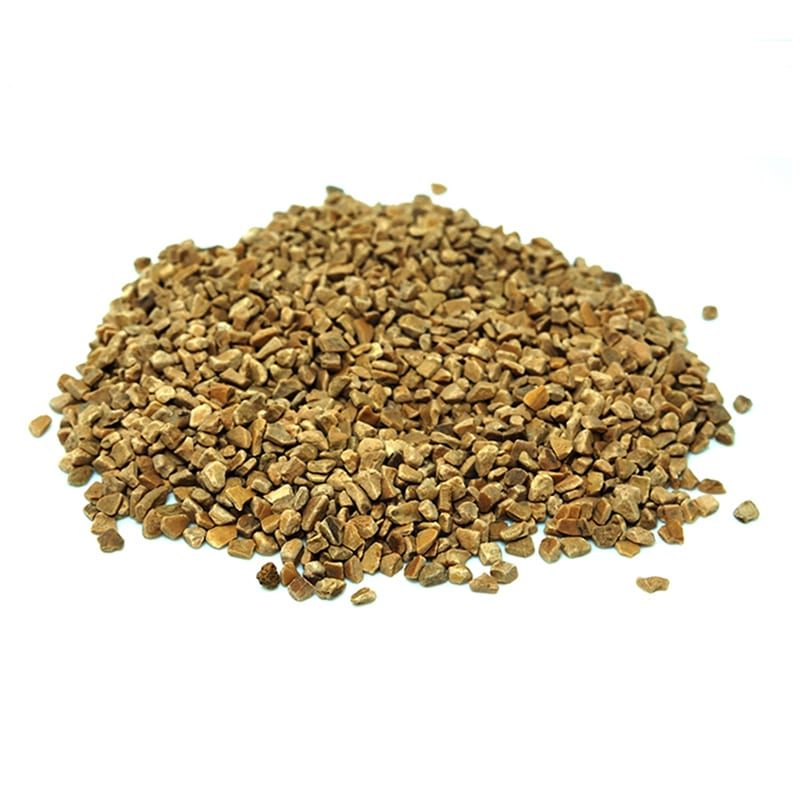
Never load dry corncob or walnut shell (8#-80#) expecting to shear solid metallic die-cast parting flash; organic media lacks the cutting density to break metal burrs. Reserve dry organic beds strictly for moisture absorption or light cosmetic buffing after wet plastic media deburring and 35A/70A drying.
Closed-Loop Compound Dosing, Pre-Wash & Flash-Rust Prevention
Automotive die-cast finishing lines run continuously across multiple shifts, making automated tumbling compounds dosing and water management critical for stable finish quality.

Upstream Ultrasonic Cleaner Degreasing After CNC Post-Machining
Many aluminum die castings receive CNC drilling, tapping, or face milling between trimming and mass finishing. Loading coolant-soaked castings straight into a vibratory bowl contaminates resin media beds and causes gummy aluminum smut. Routing machined castings through an ultrasonic cleaner bath first keeps plastic media clean and sharp.
Peristaltic LC10 & HM3 Dosing with Flow-Through Water Control
Recirculating dirty aluminum slurry embeds dark gray oxide fines into porous die-cast skins, causing blistering during high-temperature powder curing. Calibrated peristaltic pumps metering LC10 (for crisp flash cut) or HM3 / JTJ60 (for bright, clean aluminum finish) into a steady flow-through rinse—paired with monitored water hardness in mass finishing—flush suspended aluminum fines continuously out of the bowl.
Rapid 35A / 70A Centrifugal Drying to Prevent White Oxide Staining
Wet aluminum castings stacked in wire baskets develop chalky white hydroxide water stains inside bolt recesses as droplets air-dry slowly. Discharging parts from the separation deck straight into a heated 35A or 70A centrifugal dryer flashes rinse water off evenly in seconds, preserving bright, coat-ready surfaces.
Designing an Automated Vibratory Cell: Feeding, Separation & Handling
Automating the full material-handling loop turns standalone tubs into continuous Tier-1 automotive finishing cells requiring minimal operator intervention.

Pneumatic Separating Gates & Multi-Deck Screening Units
In an automated ZL or ZXL cell, pneumatic cylinder gates actuate cleanly on timer signals, raising finished castings onto a custom polyurethane or nylon separation screen. Undersized worn media fragments can even drop through a secondary scalping deck while full-size cones return straight to the work bowl.
Conveyorized Transfer Between Bowl Discharge & 35A/70A Dryers
Linking the bowl separation chute via cleated polyurethane belts or cushioned transfer totes directly into a 35A/70A centrifugal dryer—or a continuous heated cob-drying trough—eliminates rough manual dumping that nicks soft aluminum sealing faces.
Slurry Settling Tanks & Media Replenishment Automation
Flow-through compound runoff carrying fine aluminum hydroxide and resin dust should pass through multi-baffle settling tanks before municipal drain discharge. Meanwhile, regular media screening and replenishment keeps bowl fill volume steady so cycle times never drift mid-week.
| Automation Sub-System | Engineering Control Target | Operational Benefit on Automotive Line | Maintenance Check Interval |
|---|---|---|---|
| Pneumatic separating gate | Crisp full-stroke seal against bowl wall | Zero media carryover into dry totes | Weekly seal & air-pressure check |
| Peristaltic dosing pump | Steady LC10/HM3 flow rate |
Prevents aluminum smut & foam stall | Weekly squeeze-tube inspection |
| Separation screen deck | Aperture matched to min part & worn stone | Eliminates manual media picking | Daily end-of-shift screen rinse |
35A/70A dryer basket |
Clean perforations & steady heat airflow | Prevents white water stains on aluminum | Weekly lint & heater check |
Quality Control, Alloy Segregation & Cost Reduction Metrics
Measuring automated die-cast finishing performance goes beyond visual appearance to encompass edge uniformity, surface roughness consistency, and downstream coating yield.
Segregating Aluminum Castings from Ferrous Stampings
Never run carbon steel brackets inside the same ZL bowl or 35A dryer basket used for aluminum automotive housings. Residual iron dust embeds into soft A380 aluminum surfaces, triggering galvanic pinholes and premature corrosion under salt-spray testing.
Auditing Edge Radii & Roughness Against Coating Specs
Verify first-article castings from every die cavity against surface finish conversion chart targets and sealed master coupons, confirming that parting-line flash is completely severed without rounding critical gasket grooves or dowel bores.
Eliminating Manual Bench Grinding Bottlenecks & Scrap
Replacing rows of handheld rotary tools with an automated ZXL or ZL vibratory line slashes per-part labor cost, eliminates operator-to-operator edge variance, and stabilizes upstream Takt-time flow into automated powder-coat or e-coat conveyors.
Scaling Multi-Stage Lines for Hybrid Cast-and-Machined Components
Modern automotive powertrains and EV thermal manifolds combine raw die-cast cooling fins with precision-machined sealing ports, requiring tailored multi-stage workflows.
Handling Thin Fins Alongside Heavy Mounting Flanges
High-pressure castings with fragile heat-sink fins alongside thick mounting bosses benefit from gentle-amplitude ZXL vibratory cycles using fine resin plastic media cones that cushion thin ribs while smoothing heavy parting seams evenly.
Integrating Rotary Barrel Tumbler Cells for Ultra-Delicate Brackets
Where thin-walled die-cast covers or zinc trim pieces risk distortion under high-frequency vibration, slow-speed rotary barrel tumbler lines provide cushioned cascading motion; compare barrel finishing process and isotropic finishing trade-offs when designing mixed-alloy automotive cells.
Standardizing PLC Recipes Across Die Cavity Revisions
As casting dies age and parting-line flash thickens slightly between tool refurbishments, storing adjustable timer and compound recipes lets supervisors step up deburring duration cleanly without changing media beds or hardware.
Balancing Bowl Amplitude & Separation Gate Timing for Takt-Time Alignment
Synchronizing automated ZXL or ZL bowl discharge with upstream die-casting trim presses prevents work-in-process piles beside the finishing cell. Setting controlled eccentric weight amplitude keeps plastic media cones gliding smoothly across fragile cooling fins without bruising sealing bosses, while pneumatic gate timers ensure clean unloading before the next basket enters. Regular checks of polyurethane bowl ribs and separation screen fasteners preserve consistent cycle output across multi-shift automotive lines.
Implementing First-Article Edge & Cleanliness Audits on Die-Cast Lots
Before releasing a freshly tuned die-cast deburring recipe to continuous production, inspect sample housings from every cavity under oblique lighting for residual flash, embedded media dust, and uniform matte smoothness. Comparing outgoing parts against surface finish conversion chart targets and verifying bone-dry 35A/70A centrifugal exit prevents downstream powder-coat pinholes and assembly rejections.
Managing Consumable Replenishment & Settling-Tank Slurry Control
High-volume aluminum casting lines shed fine resin binder and aluminum hydroxide continuously during flow-through rinsing. Routing bowl discharge through multi-baffle settling tanks traps suspended sediment cleanly before municipal drainage, while scheduled media screening and replenishment keeps media-to-part volume ratio high enough to cushion heavy castings across every shift.
Training Operators on Alloy Segregation & Quick-Swap Recipe Cards
Maintaining strict visual recipe cards beside every ZXL bowl and 35A/70A dryer eliminates guesswork during shift handoffs. Operators verify plastic media fill height, LC10 or HM3 peristaltic pump flow, and dedicated aluminum-only dryer baskets before starting each run, ensuring consistent coating-ready castings without manual rework.
Planning Preventive Liner, Gate Seal & Dosing-Tube Maintenance
Scheduling brief weekly inspections of pneumatic separating gate seals, peristaltic pump squeeze tubing, and polyurethane liner wear prevents unexpected mid-week line stops. Keeping spare nylon separation decks and fresh plastic media hoppers staged beside the finishing cell sustains continuous automotive delivery schedules.
Troubleshooting Flash Carryover, Surface Darkening & Coating Failures
Even a well-engineered automated die-cast line can drift when alloy lots change or dosing pumps wear down. Catching early visual defects keeps powder-coating and e-coat yields consistently high across automotive shifts.
Fixing Residual Parting-Line Flash Inside Deep Casting Pockets
When sharp die flash survives inside recessed alternator pockets or cooling channels, the culprit is usually oversized plastic media cones bridging over the recess rather than insufficient cycle time. Stepping down to smaller resin pyramids or adding a small ratio of fine cones lets media scrub tight fillets cleanly without lodging in bolt holes.
Eliminating Dark Aluminum Smut Before Powder Coating
If die-cast housings exit the ZXL bowl looking dull charcoal instead of clean satin aluminum, dirty recirculated slurry or over-aged HM3 chemistry is redepositing metallic fines into casting pores. Increase clean flow-through water turnover, verify peristaltic pump calibration, and run a brief JTJ60 brightening pass before 35A/70A centrifugal drying.
Preventing Crescent Impact Nicks on Sealing Flanges
Crescent dings along machined thermostat or inverter gasket faces indicate that parts are striking each other inside an under-filled media bed. Raise the media-to-part volume ratio, trim batch part weight slightly, or switch to an L1500 straight trough with divided polyurethane lanes so heavy castings remain isolated throughout the cycle.
Avoiding Blistering During High-Temperature Paint Curing
Trapped moisture inside porous casting bosses turns to steam inside powder-coat curing ovens, causing pinholes and blisters. Never air-dry aluminum die castings after wet deburring; discharge every batch straight from the pneumatic separation deck into a heated 35A or 70A centrifugal dryer for spotless, bone-dry exit.
Coordinating Multi-Cavity Die Maintenance with Vibratory Cycle Adjustments
As high-pressure aluminum casting dies wear across tens of thousands of shots, parting-line flash thickness gradually increases around ejector pins, slide cores, and overflow gates. Rather than waiting for manual trim presses to fall behind or for powder-coat lines to reject rough edges, finishing engineers should coordinate periodic cavity audits directly with ZXL vibratory line supervisors. Adjusting peristaltic LC10 dosing slightly upward, verifying media-to-part volume ratio before each shift, and inspecting polyurethane separation screens keeps automated edge break uniform even as raw casting flash fluctuates across tool life.
Benchmarking Automated Line ROI Against Manual Die-Grinding Cells
Calculating the true payback of an automated aluminum die-cast deburring cell requires looking beyond hourly bench-grinder labor alone. Eliminating hand-tool vibration fatigue, reducing abrasive belt and carbide burr consumption, cutting scrap from accidental grinder gouges on sealing lands, and feeding powder-coat hangers with consistently clean, dry, 35A/70A-processed housings typically compress payback dramatically across high-volume automotive suppliers. Standardizing ZXL bowls, pneumatic separating gates, and closed-loop HM3 rinsing turns surface preparation from an unpredictable bottleneck into a measurable, steady manufacturing asset.
Validating Powder-Coat & E-Coat Adhesion After Vibratory Finishing
Even when die-cast automotive brackets emerge smooth and burr-free from a ZXL bowl, upstream surface chemistry dictates whether downstream powder coat passes cross-hatch adhesion and salt-spray tests. Pairing clean flow-through HM3 rinsing with prompt 35A/70A centrifugal drying eliminates residual surfactant films and hydroxide bloom, giving pretreatment washers a clean, uniform substrate ready for conversion coating.
Scaling Automated Cells for Electric Vehicle Thermal & Housing Programs
Rapid growth in EV battery enclosures, inverter cases, and motor end-shields has pushed Tier-1 die casters toward modular multi-bowl lines. Starting with one automated ZXL separator bowl and a 70A spin dryer lets suppliers prove cycle repeatability quickly while reserving adjacent floor space for an L1800 straight trough as larger structural castings enter production.
Documenting Batch Load Limits & Separation Gate Calibration
Keeping automotive aluminum die-cast deburring lines repeatable across shifts depends on clear operator load charts and verified pneumatic gate timing. Recording exact plastic media fill heights, LC10 or HM3 pump flow rates, and 35A/70A dryer settings beside every ZXL bowl prevents guesswork and protects delicate sealing flanges from accidental bruising.
SurfacePolish Factory Capabilities & Automotive Line Trials
SurfacePolish (Xiamen Jin Tai Jin Grinding Technology Co.,Ltd.) designs complete automated aluminum die-cast deburring lines across 21 machine platforms—including ZXL and ZL vibratory bowls, L1300/L1500/L1800 straight troughs, LLB50/LLF120 centrifugal systems, OBD-30 to OBD-100 magnetic polishers, rotary barrel tumbler lines, 35A/70A centrifugal dryers, and ultrasonic cleaner stations—backed by 200,000+ practical finishing solutions.
Certified Manufacturing Quality & Single-Source Media Supply
All equipment is built under ISO 00726Q01571R001 quality management alongside CE M.2023.206.C88121 and CE M.2023.206.C88120 certifications and 24 granted Chinese IP rights. Sourcing matched vibratory bowls, pneumatic separators, plastic media, ceramic media, corncob/walnut shell (8#-80#), and LC10/MC8/HM3/JTJ50/JTJ60 compounds from one factory guarantees seamless line integration.
Send Raw Die-Cast Automotive Samples for Free Line Validation
Ship your raw trimmed or CNC-machined aluminum castings to our test laboratory for complimentary automated deburring trials. We document exact ZXL/ZL or L1300–L1800 sizing, non-lodging plastic media selection, compound dosing, and drying specs before you invest.
 +86-592-2381506


 IPv6 network supported