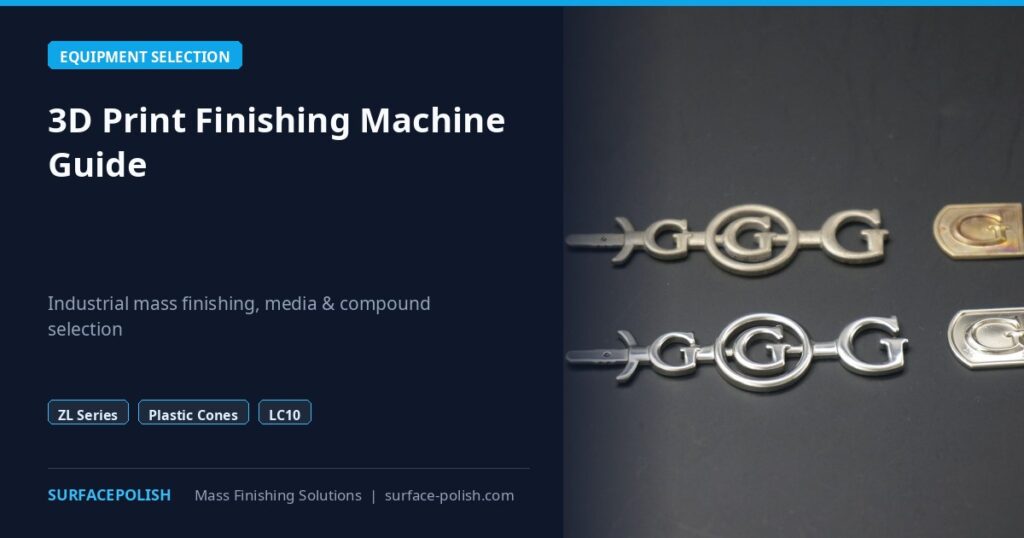
3D Print Finishing Machine Guide: Selecting Vibratory, Centrifugal & Magnetic Systems for Additive Parts

Choosing the right 3d print finishing machine determines whether additive manufacturing stays stuck in slow manual bench sanding or scales into repeatable production batches. Raw SLS polymer housings, DMLS metal brackets, and SLA/DLP resin prototypes leave the build chamber with staircase layer lines, sintered powder cake, support-removal nubs, and sharp edge burrs. SurfacePolish (Xiamen Jin Tai Jin Grinding Technology Co.,Ltd.) draws on 200,000+ verified finishing trials to match ZL vibratory bowls, LLB50 centrifugal disc machines, and OBD magnetic pin units to additive geometries without washing out thin walls or fine bosses.

Why Additive Parts Demand Purpose-Matched Finishing Kinematics
Unlike CNC billets or stamped blanks, printed parts combine directional layer stepping, porous sintered skins, and delicate lattice or thin-rib zones inside the same workpiece. Dropping fragile additive parts into an oversized stone-filled tumbler either batters unsupported ribs or leaves deep pockets untouched. Selecting a dedicated 3D print finishing machine starts with understanding how each mass finishing motion interacts with layer orientation and alloy or polymer ductility.
Staircase Layer Lines vs. Support Scars on Printed Surfaces
Build-plate orientation creates distinct surface defects across neighboring faces of the same printed part. Upward-facing curves show stepped terraces, while downward-facing overhangs carry rough support witness marks that resist light buffing. A controlled 3d print finishing machine uses continuous multi-directional media shear to level both terraces and support nubs simultaneously instead of chasing each contour by hand.
Protecting Thin Walls, Snap Fits & Living Hinges
Additive brackets frequently include snap-fit tabs, cooling fins, and thin sensor shrouds designed specifically for weight reduction. Aggressive heavy ceramic stones generate excessive point-impact energy that cracks brittle resin or peens soft aluminum lattices. Matching lighter resin-bonded plastic media cones or fine stainless magnetic pins keeps impact forces gentle while still erasing surface roughness evenly.
Removing Sintered Powder Cake Inside Internal Channels
Powder-bed fusion processes (SLS nylon and DMLS titanium or stainless steel) trap semi-sintered powder granules inside cross-holes, fluid manifolds, and blind pockets even after depowdering cabinets. Flowing LC10 or HM3 compound solution inside a circulating wet finishing chamber flushes trapped grit cleanly out of recesses while smoothing external faces in a single cycle.
| Additive Process & Material | Primary Surface Defect | Recommended SurfacePolish Machine | Media & Compound Pairing | Target Surface Outcome |
|---|---|---|---|---|
SLS / MJF Nylon (PA12, PA11) |
Granular powder skin & layer steps | ZL vibratory bowl / LLB50 disc |
Resin plastic media cones + HM3 |
Sealed, smooth matte-satin housing |
DMLS Stainless & Titanium |
Rough sintered texture & support stubs | ZL / ZXL vibratory or LLF120 |
High-cut then fine ceramic media + LC10 |
Deburred edges & isotropic satin |
DMLS Aluminum (AlSi10Mg) |
Support witness marks & soft skin | ZL vibratory bowl / LLB50 disc |
Resin plastic media + JTJ60 / HM3 |
Even satin without peening dimples |
| Printed Brass / Jewelry Wax Castings | Micro-porosity & support pips | OBD-60 / OBD-100 magnetic unit |
Fine stainless pins + HM3 + 35A dry |
Bright internal recesses & clean details |
Rigid SLA / DLP Engineering Resins |
Layer striations & support nibs | ZL light-duty bowl / rotary barrel |
Fine resin plastic media pyramids + HM3 |
Uniform matte ready for priming |
Matching ZL Vibratory Bowls, LLB50 Discs & OBD Magnetic Units
No single finishing platform covers every printed batch size, alloy hardness, and internal recess geometry. Evaluating the kinematics of vibratory finishing machine bowls, centrifugal finishing machine discs, and magnetic polishing machine tanks lets additive labs scale cleanly from prototype cells to full production lines.

ZL & ZXL Vibratory Bowls for Medium-to-Large Printed Batches
Curved-wall ZL and straight-wall ZXL vibratory bowls excel when processing housings, drone frames, manifold blocks, and multi-part nested builds together. Helical toroidal roll gently suspends parts inside a cushioned bed of plastic media or ceramic media, preventing heavy part-on-part collisions. Integrated separation decks allow clean batch unloading without manual media sorting.
LLB50 Centrifugal Disc & LLF120 Barrel Units for Fast Cycle Compression
When small printed brackets, dental attachments, or dense DMLS hardware require faster cut rates than standard vibration delivers, LLB50 high-speed centrifugal disc systems multiply media-to-part shear velocity cleanly. For ultra-small batches or heavy sintered steel cuts, LLF120 turbine and OBD-LX100B centrifugal barrel platforms compress deburring cycles dramatically while maintaining uniform corner break across every piece.
OBD Magnetic Pin Polishers for Lattice Pockets & Blind Holes
Printed hydraulic manifolds, cooling channels, and precision switch housings often contain deep blind bores where preformed stones cannot reach or would permanently wedge. An OBD-30, OBD-60, or OBD-100 magnetic tumbler drives fine stainless steel pins along high-frequency magnetic field lines directly into tight internal slots, burnishing support stubs and micro-burrs inside complex additive cavities without altering outer tolerances.
Slow Rotary Barrel Tumbler Lines for Fragile Resin & Thin Brackets
Highly brittle photopolymers and ultra-thin laser-sintered clips sometimes fracture under high-frequency vibration if unsupported. A slow-speed hexagonal or octagonal rotary barrel tumbler cascades parts gently inside a cushioned wet media slurry, softening support scars steadily while preserving thin-section integrity.
Media Selection: Plastic Cones, Ceramic Media & Organic Polishing Beds
Selecting the wrong abrasive media inside a capable 3d print finishing machine either stalls surface leveling or destroys fine printed text and snap features. Always match abrasive binder hardness and particle geometry directly to your substrate material and minimum slot width.

Resin-Bonded Plastic Media Cones & Pyramids for SLS Nylon & Aluminum
Resin-bonded plastic media provides the lightweight, cushioned cutting action essential for SLS nylon, MJF polymers, and printed AlSi10Mg aluminum. Cones and pyramids shear away coarse staircase ridges and support witness marks without hammering flat surfaces into orange-peel craters. Pairing cone geometry with HM3 compound keeps nylon pores clean and ready for dyeing or sealing.
Aluminum-Oxide Ceramic Media & High-Alumina for DMLS Steel & Titanium
Hard 316 stainless steel, 17-4PH, Inconel, and Ti-6Al-4V printed parts resist soft resin abrasives and demand dense ceramic media to cut stubborn sintered skins. Start with fast-cut ceramic triangles or angle-cut cylinders paired with LC10 deburring compound to level laser-sintered roughness, then step into fine high-alumina spheres or cylinders when pre-plate smoothness is required. Follow strict non-lodging media sizing rules so ceramic stones bridge cleanly across cooling slots and tapped ports.
Walnut Shell & Corncob (8#-80#) for Dry Luster & Moisture Absorption
Dry organic walnut shell (8#-80#) and corncob beds cannot level coarse DMLS sintering marks or heavy SLS layer steps on their own. Instead, reserve dry organic tumbling for final luster enhancement on already smoothed polymer or metal prints, or for absorbing residual moisture after wet finishing. Combining organic polishing beds with heated centrifugal drying ensures spotless, residue-free parts.
Compound Chemistry, Water Flow & Post-Cycle Drying
Wet mass finishing chemistry does far more than lubricate stone contact; it suspends abraded polymer dust and metallic fines so media cutting faces never glaze over. Consistent tumbling compounds dosing separates repeatable industrial additive finishing from unpredictable trial runs.

Flow-Through LC10 & HM3 Dosing for Clean Polymer & Metal Suspension
Recirculating muddy slurry inside a closed vibratory bowl embeds dark sintered dust directly into porous SLS nylon surfaces, ruining color uniformity before dyeing. Continuous flow-through water paired with calibrated peristaltic dosing of LC10 (for metal deburring) or HM3 (for polymer and multi-alloy brightening) flushes abraded fines continuously down the drain while maintaining clean media shear.
Descaling Printed Steel Oxide & Heat Tint with MC8 & JTJ50
Stress-relieved DMLS steel and stainless builds frequently carry dark thermal scale that slows down neutral abrasive cutting. Running an initial MC8 descaling pass strips stubborn oxide films rapidly so ceramic stones cut directly into clean base metal, followed by JTJ50 or JTJ60 brightening to restore crisp metallic luster across every face.
Rapid 35A / 70A Centrifugal Drying Without Warping Polymers
Porous SLS polymers and tight DMLS lattice pockets trap rinse water that causes flash rust on carbon-alloy prints or stains during subsequent painting and vapor-seal steps. Spinning finished batches inside a 35A or 70A centrifugal dryer removes trapped moisture rapidly through heated airflow while preserving dimensional stability on heat-sensitive engineering thermoplastics.
Step-by-Step Workflow: From Build Plate to Finished Additive Batch
Standardizing your post-printing line turns additive finishing into a predictable, operator-independent sequence. Integrating depowdering, support knock-off, wet mass leveling, and centrifugal drying eliminates bottlenecks downstream of your printers.

Stage 1: Support Removal, Depowdering & Pre-Wash Degreasing
Before loading any 3d print finishing machine, knock off coarse metallic or resin support trees and blow loose powder out of internal channels. Oily machining touch-ups or uncured photopolymer residue must be cleared in an ultrasonic cleaner bath so foreign oils do not contaminate the vibratory media bed.
Stage 2: Rough Leveling & Edge Break in ZL / LLB50 Chambers
Load the pre-cleaned batch at a high media-to-part ratio so parts remain cushioned from each other throughout the cycle. Run ceramic media (LC10) for hard printed alloys or coarse resin plastic media (HM3) for printed polymers until staircase ridges and support witness stubs blend evenly into the surrounding surface.
Stage 3: Brightening, Internal Recess Polish & 35A/70A Drying
For parts needing bright internal channels or higher specular sheen, transfer batches to an OBD magnetic pin finisher with HM3 or step down to fine JTJ50/JTJ60 polishing chemistry inside a secondary bowl. Finish every wet cycle with a clean water rinse and immediate 35A/70A centrifugal drying so parts exit ready for inspection, dyeing, anodizing, or assembly.
| Additive Finishing Stage | Primary Process Objective | Critical Control Check | Common Mistake to Avoid |
|---|---|---|---|
| Pre-finish prep | Clear loose powder & support trees | Inspect blind ports & clean oils | Loading uncured resin or heavy oil |
| Primary leveling | Erase layer lines & support stubs | Verify non-lodging media sizing | Under-filling media causing part dings |
| Secondary brightening | Refine sheen & internal bores | Monitor water clarity & pH | Recirculating dirty polymer slurry |
| Post-cycle drying | Remove trapped moisture cleanly | Spin in 35A/70A dryer promptly |
Air-drying steel or porous nylon |
Avoiding Common Pitfalls in Additive Mass Finishing
Even robust hardware underperforms when media maintenance or water quality slips between shifts. Catching early warning signs keeps surface finish targets consistent from the first prototype tray to full multi-shift runs.
Preventing Media Lodging in Lattice Windows & Cooling Slots
Printed heat exchangers, bracket lightening pockets, and threaded bosses act as traps for undersized triangles or worn-down ceramic slivers. Enforce scheduled media screening and replenishment to cull fractured stones before they wedge inside expensive additive builds, and audit slot clearances before switching media shapes.
Eliminating Dark Smut & Porosity Staining on SLS Nylon
When SLS parts emerge dull gray instead of crisp white or uniform dark gray, spent compound foam and ground nylon dust are redepositing into open surface pores. Check water hardness in mass finishing stability and increase fresh flow-through water turnover so suspended fines exit the chamber continuously.
Stopping Edge Rollover on Precision Datum Pads & Snap Fits
Over-running a high-energy LLB50 or coarse ceramic cycle rounds crisp mating edges and weakens snap-fit retention lips. Log exact cycle recipes per part number after first-article validation, and check surface finish conversion chart targets alongside dimensional drawings so cosmetic smoothing never compromises mechanical fit.
Quality Control, Metrology & Factory Trial Validation
Verifying additive surface quality requires looking beyond flat-plate stylus checks to inspect internal channels, edge radii, and downstream coating adhesion. Establishing clear first-article standards keeps both internal QA and customer receiving labs aligned.
Multi-Zone Inspection on Curved & Overhanging Printed Faces
Always check upward-facing skins, vertical walls, and downward support zones separately on first-article prints, because build orientation changes how fast layer lines level out. Pair tactile and visual master coupons with calibrated roughness traces across critical sealing lands and fluid-flow surfaces.
Validating Paint, Dye & Anodizing Readiness After Mass Finishing
Mass-finished SLS housings absorb immersion dyes far more evenly when staircase porosity is uniformly sealed by plastic media smoothing, while DMLS stainless and titanium components achieve superior passivation and plating uniformity once sintered oxide scale is stripped cleanly. Run a small downstream coating check whenever changing compound chemistry or media grade.
Selecting Between Batch Bowl Automation & Multi-Unit Cells
Growing additive service bureaus and OEM print farms often start with a single ZL bowl (via our vibratory burnishing machine line) for polymer and general metal deburring, then pair it with an OBD-60 magnetic polisher for small internal-channel parts and a 35A dryer. Separating polymer media bowls from steel media bowls prevents cross-contamination completely.
Integrating Additive Finishing into Multi-Material Shop Workflows
Production additive facilities rarely print only one polymer or one metal alloy across an entire quarter. Structuring dedicated equipment zones for resin prototypes, SLS nylon housings, and DMLS titanium or stainless hardware prevents cross-contamination while keeping changeover downtime near zero.
Segregating Polymer Bowls from Ferrous Metal Media Beds
Running SLS nylon parts inside a ZL chamber that previously processed carbon steel brackets transfers dark iron oxide fines directly into porous polymer surfaces. Maintain dedicated rotary barrel tumbler or ZL bowls—plus isolated 35A/70A dryer baskets—for non-metallic builds versus ferrous alloy lots so every batch retains clean color and corrosion resistance.
Managing Surface Roughness Progression Across Multi-Step Builds
High-spec aerospace brackets and fluid manifolds frequently require a rough cut in ceramic media followed by a burnishing pass in high-alumina spheres or plastic media cones. Tracking surface progression against established isotropic finishing benchmarks ensures every build meets sealing and fatigue expectations without over-thinning load-bearing walls.
Preparing Printed Alloys for Anodizing, Passivation & Powder Coating
Raw DMLS AlSi10Mg and 316 stainless prints suffer uneven anodizing uptake and poor paint adhesion when residual sintered powder and support scars remain on the surface. A controlled burnishing metal cycle seals micro-pores, removes weak surface granules, and produces a uniform matte-satin base ready for downstream chemical conversion or powder coating.
Scaling Consumable Inventory & Preventive Liner Care
Consistent additive finishing depends on keeping fresh ceramic media, resin plastic media cones, and LC10/HM3 compound drums staged beside each machine. Pairing routine centrifugal barrel finishing and vibratory liner inspections with scheduled media top-ups eliminates unexpected quality drift across multi-shift production runs.
Standardizing Operator Recipe Cards for High-Mix Print Farms
Because additive job shops run dozens of geometries weekly, operators cannot rely on guesswork for media fill height, compound drip rate, or drying temperature. Documenting verified recipe cards by material family, wall thickness, and target finish turns any 3d print finishing machine cell into a repeatable, operator-proof post-processing station.
Balancing Floor Footprint, Drainage & Acoustic Enclosures
Compact ZL bowls and OBD magnetic units fit cleanly alongside depowdering cabinets and ultrasonic cleaner stations when floor drains and settling tanks are planned upfront. Adding acoustic lids keeps shop-floor sound comfortable near CAD workstations and metrology benches while containing wet mist cleanly inside the finishing zone.
Coordinating Post-Print Metrology & Batch Traceability Across Production Lots
Aerospace, medical-adjacent industrial hardware, and precision robotics buyers increasingly require documented lot traceability from raw powder build number through final mass finishing parameters. Recording the exact ZL bowl, LLB50 disc, or OBD-60 magnetic cycle recipe alongside media grade, compound dosing rate, and 35A/70A drying settings lets quality engineers tie surface uniformity directly to upstream printer calibration. Comparing first-article builds against sealed physical master coupons and optical edge checks ensures every consecutive print run achieves identical matte smoothness, clean internal fluid passages, and reliable fastener thread engagement without manual bench rework.
Coordinating Multi-Shift Scheduling & Media Replenishment for Additive Farms
Scaling additive finishing beyond prototype trays requires treating media screening, compound inventory, and 35A/70A dryer turnover with the same rigor as powder-bed printer maintenance. Resin plastic media cones gradually shed fine dust as they smooth SLS nylon layer steps, while aluminum-oxide ceramic media rounds off slowly when shearing tough DMLS titanium and 316 stainless support nubs. Scheduling regular screen audits to remove undersized stone slivers prevents slot lodging in lattice brackets and maintains steady mass circulation across shifts. Keeping dedicated drums of LC10, MC8, HM3, and JTJ50 staged beside flow-through dosing pumps ensures every production batch achieves repeatable surface uniformity.
SurfacePolish Factory Capabilities & Additive Finishing Trials
SurfacePolish (Xiamen Jin Tai Jin Grinding Technology Co.,Ltd.) builds complete 3d print finishing machine cells engineered around 21 machine platforms—covering ZL/ZXL vibratory bowls, LLB50/LLF120 centrifugal units, OBD-30 to OBD-100 magnetic pin polishers, rotary barrel tumbler lines, 35A/70A centrifugal dryers, and ultrasonic cleaner stations—backed by 200,000+ practical finishing solutions.
Matched Equipment, Media & Compounds Under Certified Quality
Every machine ships under ISO 00726Q01571R001 quality management alongside CE M.2023.206.C88121 and CE M.2023.206.C88120 certifications and 24 granted Chinese IP rights. Sourcing your finishing machines, ceramic media, plastic media, stainless pins, corncob/walnut shell (8#-80#), and LC10/MC8/HM3/JTJ50/JTJ60 compounds from a single manufacturer eliminates compatibility guesswork.
Send Raw Printed Samples for Complimentary Process Validation
Before committing capital to an additive post-processing line, ship raw SLS, DMLS, or SLA parts directly to our application lab. Our engineers run complimentary sample trials, verify media non-lodging behavior, and return finished workpieces with documented machine, media, and compound setup parameters ready for production scaling.
Technical Support from Initial Sizing Through Multi-Shift Expansion
Whether you are automating your first SLS polymer cell or expanding a multi-alloy DMLS production department, SurfacePolish supports every step from initial media matching to long-term consumable supply. Our application team helps align machine capacity, compound chemistry, and drying throughput with your exact print-farm output.
 +86-592-2381506


 IPv6 network supported