
Gear Polishing and Deburring: Controlling Tooth Root Smoothness and Edge Break in Mass Finishing
Precision gear polishing and deburring directly determines gear-mesh noise, pitting resistance, and transmission efficiency across automotive gearboxes, robotics reducers, and aerospace actuators. Even after precision hobbing, shaping, or CNC grinding, tooth flanks retain microscopic directional grinding striations while sharp tooth tips and spline exits carry brittle machining burrs that fracture under initial load. SurfacePolish (Xiamen Jin Tai Jin Grinding Technology Co.,Ltd.) applies 200,000+ verified finishing trials to help gear manufacturers break edges uniformly and achieve low-friction isotropic tooth flanks without distorting involute geometry.
Why Precision Gears Need Isotropic Deburring & Root Polishing
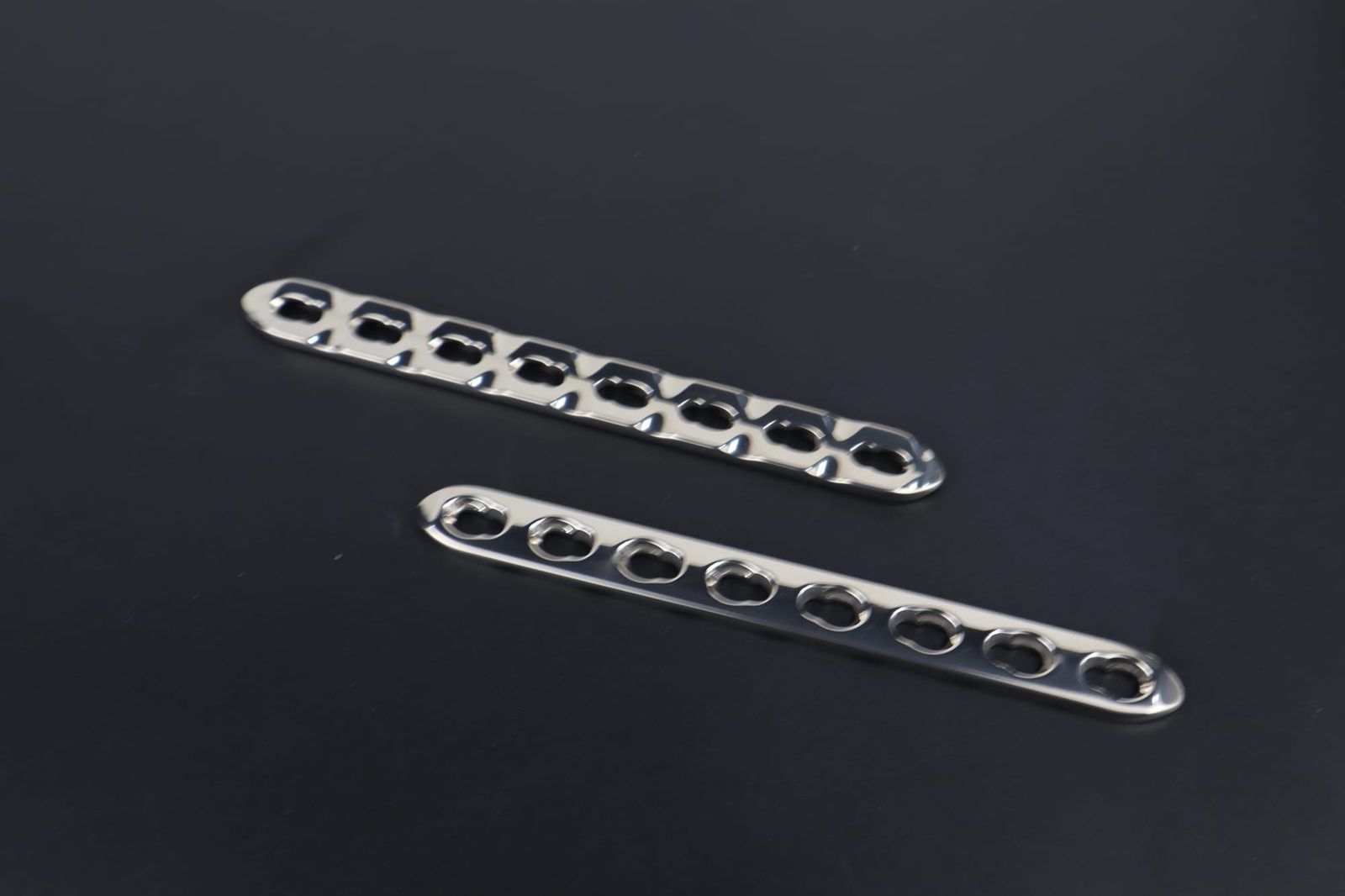
Gear teeth fail primarily from two preventable surface defects: micro-pitting along high-contact flanks and bending fatigue cracks initiating at sharp root fillets or un-deburred tooth ends. Controlled mass finishing solves both issues simultaneously by replacing directional cutter grooves with smooth isotropic plateaus while leaving consistent, stress-relieved edge radii.
Eliminating Hobbing & Grinding Burrs Without Distorting Involute Profiles
Hand-filing or wire-brushing helical gear ends frequently leaves uneven chamfers or misses tight root corners between adjacent teeth. By matching media geometry cleanly to tooth module spacing, a vibratory finishing machine flows abrasive cones smoothly into every root fillet, breaking sharp feather burrs uniformly while removing negligible stock from precision pitch-line flanks.
Lowering Mesh Friction, Oil Temperature & Acoustic Gear Whine
Under elastohydrodynamic lubrication, microscopic grinding peaks pierce thin gear-oil films and create metal-to-metal asperity contact that raises gearbox sump temperatures and high-frequency gear whine. Leveling tooth flanks via isotropic finishing improves bearing-area contact ratio and extends pitting fatigue life dramatically.
Preventing Tooth-on-Tooth Nicking During Bulk Tumbling
Heavy hardened steel ring gears and pinions carry sharp tooth crests that easily dent adjacent gear flanks if tumbled loose with insufficient media cushioning. Using wide-channel ZXL troughs with divider pins, racking gears on polyurethane fixtures, or maintaining strict media-to-part volume ratio loading protects involute tooth profiles completely.
| Gear Family | Incoming Process State | Primary Finishing Goal | Recommended SurfacePolish Equipment | Media & Compound Sequence | Critical Quality Guard |
|---|---|---|---|---|---|
| Precision spur & helical gears | Hobbed, shaved, or ground | Edge break + flank Ra drop |
ZL bowl or ZXL fixture trough |
Small ceramic media + LC10 -> plastic media + JTJ50 |
Zero tooth-tip impact dings |
| Sintered powder-metal gears | Sintered & sized | Strip sinter burrs + open-pore clean | ZL vibratory bowl + 35A/70A dry |
Resin plastic media + LC10 flow-through |
Prevent trapped soap / rust bleed |
| Hardened aerospace pinions | Case-hardened + ground | Ultra-low Rq isotropic tooth |
LLB50 / LLF120 centrifugal barrel |
High frequency ceramic + LC10 -> JTJ60 |
Strict pitch-line profile hold |
| Heavy automotive ring gears | Cut + heat-treated scale | Descale + smooth tooth roots | ZXL divided trough (L1300–L1800) |
Fast-cut ceramic + MC8/LC10 |
Divider padding prevents collisions |
| Small brass/stainless watch gears | Stamped or wire-EDM | Burr-free micro-teeth + bright | Rotary barrel tumbler / LLB50 |
Micro plastic media + HM3 / JTJ50 |
Non-lodging media sizing |
Selecting Non-Lodging Media Shapes for Gear Teeth & Splines
Media selection for gears is a geometric exercise first and an abrasive decision second. If ceramic or plastic chips wedge between gear teeth or inside internal splines, operators spend more time picking lodged stones out by hand than they saved by automating deburring.
Sizing Ceramic Media & Plastic Media to Reach Tooth Roots Cleanly
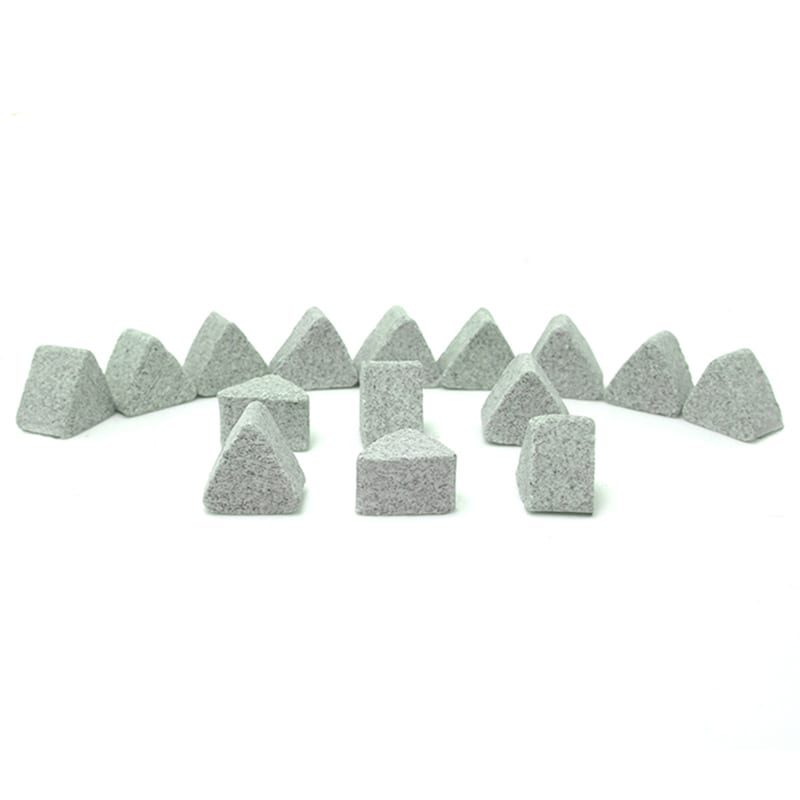
Small-angle triangle, tri-star, and angle-cut cylinder shapes of ceramic media or plastic media must either pass cleanly through tooth spaces with room to spare or stay large enough to bridge tooth tips while contacting outer chamfers. Follow our non-lodging media sizing rules—never choose media matching exact tooth-gap width—and keep weekly media screening and replenishment active so worn undersized chips exit before wedging.
Stage 1 Leveling with High Frequency Ceramic vs. Resin Plastic Cones
Hardened alloy steel gears carrying tough hobbing burrs or grinding cusps need dense ceramic media or high frequency formulations dosed with LC10 to cut cleanly without excessive cycle times. Conversely, softer sintered bronze gears, aluminum timing pulleys, or delicate thin-tooth stampings require cushioned resin plastic media with HM3 or JTJ50 to prevent edge battering.
Stage 2 304 Stainless Ball Burnishing for High-Load Racing Gears
Motorsport and high-torque industrial transmissions chasing mirror-smooth tooth flanks (N2–N4) follow Stage 1 ceramic/plastic leveling with clean 304 stainless steel balls and JTJ60. Strict isolation between Stage 1 cutting stones and Stage 2 ball bowls ensures zero stray grit scratches across high-stress root fillets.
Machine Selection & Chemical Dosing for Gear Production Lines
Matching machine architecture to gear weight and daily volume keeps cycle times short and tooth edges uniform across every batch. Dirty water or foamy compound baths quickly stall root polishing while leaving dark film inside internal splines.
ZL Bowls, ZXL Divided Troughs & LLB50 Centrifugal Barrels
Compact spur gears and sintered pinions run efficiently inside ZL round bowls with automated pneumatic separation decks. Large or heavy automotive ring gears and shafted pinions belong in ZXL (L1300–L1800) straight-wall troughs fitted with polyurethane dividers so gears never collide. When hardened aerospace gears demand ultra-fast isotropic smoothing, LLB50 and LLF120 centrifugal barrel finisher machines multiply abrasive force cleanly.
Calibrating LC10, MC8, HM3, JTJ50 & JTJ60 Chemistry
Pair ferrous gear deburring with alkaline LC10 for built-in short-term rust inhibition, heat-treat scale purging with MC8, non-ferrous brightening with HM3, and fine tooth-flank smoothing with JTJ50 or JTJ60. Using peristaltic compound dosing eliminates manual over-dosing foam that cushions tooth-root shear inside deep splines.
Flow-Through Rinsing, Water Hardness & Upstream Ultrasonic Cleaning
Gear-cutting oils and broaching lubricants cling tenaciously inside spline roots and contaminate porous ceramic media immediately. Pre-washing oily blanks inside an ultrasonic cleaner strips grease clean before tumbling begins. Pairing clean blanks with steady flow-through rinsing and softened water per our water hardness in mass finishing guide prevents ceramic media glazing mid-shift.
Post-Tumble Drying, Rust Prevention & Gear Tooth Metrology
Steel gears leave wet mass finishing with freshly activated metal surfaces that flash-rust within minutes in humid transmission shops. Rapid heated drying, oil-pore protection, and careful flank metrology close the loop.
Immediate 35A/70A Centrifugal Drying & Rust Inhibition
Transfer freshly rinsed steel and sintered gears straight into a heated 35A or 70A centrifugal dryer—together with compatible inhibitor protection per our rust inhibition after wet tumbling workflow—to spin moisture cleanly out of internal keyways and blind bores. Never leave damp gears sitting in shop totes to air-dry.
Auditing Flank Ra/Rq, Tooth Edge Radius & Involute Integrity
Verify first-article gears with flank stylus traces (Ra, Rz, and Rq per our surface roughness measurement guide), optical edge-radius checks on tooth tips, and coordinate gear-checker sweeps to confirm zero involute profile distortion.
Keeping Polyurethane Liners Tight & Organic Buffing Strictly Dry
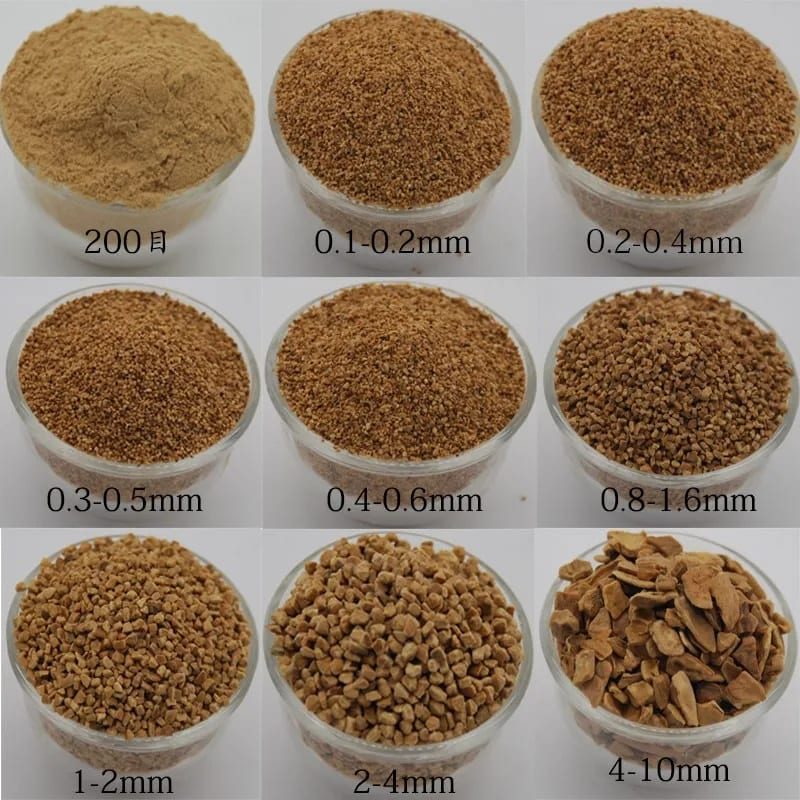
Audit polyurethane bowl ribs and divider pads weekly via our polyurethane bowl liner replacement guide so stray grit never hides between stages. If dry corncob or walnut shell (8#-80#) buffing is used on dry brass or precision watch gears, load parts strictly dry—never wet.
| Gear Finishing Problem | Likely Shop-Floor Root Cause | Immediate Corrective Fix | Preventive Line Control |
|---|---|---|---|
| Media wedged in tooth roots | Media size matches tooth-gap width | Screen & swap to non-lodging shape | Verify root clearance + weekly screen QA |
| Tooth-tip crescent nicks | Low media fill or missing trough dividers | Raise media fill; add divider pads | Post load weights & divider spacing |
Flank Ra stalls mid-cycle |
Oily blanks or glazed ceramic media | Ultrasonic wash + MC8 purge |
Upstream degrease + flow-through water |
| Flash rust inside spline bores | Slow air-drying after wet LC10 rinse |
Re-clean; inhibitor + 35A/70A spin |
Mandatory heated centrifugal drying |
| Rounded datum corners | Over-aggressive ceramic or long cycle | Shorten Stage 1; step to plastic media |
Separate Stage 1 deburr & Stage 2 polish |
Alloy-Specific Gear Finishing Recipes & Multi-Shift Process Control
Different gear materials—case-hardened alloy steel, porous sintered iron, stainless actuators, and non-ferrous brass—respond differently to abrasive cutting pressure and chemical pH. Matching each gear family to dedicated media, dosing, and drying routines keeps edge quality consistent across 21 machine platforms without cross-contamination.
Case-Hardened Alloy Steel Automotive & Industrial Pinions
Hardened steel teeth resist soft resin abrasives, requiring sharp ceramic media or high frequency formulations with LC10 to break tough hobbing burrs cleanly, followed by plastic media and JTJ50 smoothing. Always spin-dry rinsed pinions immediately inside 35A or 70A centrifugal dryers with inhibitor rinse so freshly exposed flanks never flash-rust.
Porous Sintered Powder-Metal Gears & Oil-Pump Rotors
Sintered iron gears hold residual pressing lubricants inside surface pores that bleed out during heat treatment or contaminate wet bowls. Pre-cleaning in an ultrasonic cleaner, running steady flow-through LC10 cycles with resin plastic media, and drying thoroughly in heated 35A/70A units prevents trapped soap staining and internal rust bleed.
Brass, Bronze & Stainless Micro-Gears for Actuators & Robotics
Small non-ferrous and 304 stainless actuator gears deform easily under heavy stones, requiring fine plastic media cones with HM3 or JTJ50 inside gentle rotary barrel tumbler or LLB50 chambers. Careful non-lodging media sizing ensures zero media wedging between fine-module teeth.
Preventing Ceramic Glazing & Chemical Foam in Gear Bowls
Hard shop water or excessive compound dosing glazes ceramic media pores and cushions tooth-root shear inside ZL bowls. Checking water hardness in mass finishing and running automated peristaltic compound dosing keeps root polishing fast and predictable.
Optimizing Gearbox Noise, Fatigue Life & Lubrication Retention Through Isotropic Flanks
Beyond burr removal, controlled mass finishing improves mechanical transmission performance in measurable ways. Smoother tooth flanks reduce micro-pitting under high contact stress while preserving microscopic oil-retaining pockets along the pitch line.
Lowering Acoustic Transmission Whine on Helical & Spur Sets
Hobbing and grinding cutters leave periodic directional ridges that vibrate against mating teeth under high-RPM load. Replacing those directional cusps with smooth isotropic surfaces reduces asperity friction and lowers overall gearbox acoustic noise without expensive single-tooth hand lapping.
Eliminating Root-Fillet Stress Risers for Higher Bending Fatigue
Sharp hobbing exit burrs and micro-tears along gear root fillets act as crack initiation sites under cyclic torque reversals. Flowing small ceramic and plastic cones smoothly through root corners rounds stress-concentrating edges uniformly and boosts tooth bending fatigue life.
Preserving Case-Hardened Depth & Pitch-Line Profile Accuracy
Controlled ZL, ZXL, and LLB50 cycles remove microscopic surface peaks rather than deep structural metal, keeping thin carburized or nitrided case layers and involute lead/profile tolerances completely intact across production lots.
Improving Oil-Film Retention Under Boundary Lubrication
Unlike directional grinding streaks that channel lubricant away from contact zones, random isotropic micro-valleys retain thin gear-oil films cleanly during cold starts and shock loads.
Standardizing Gear Line Setup Cards, Segregation & Quality Audits
Turning trial gear recipes into repeatable multi-shift production depends on clear operator paperwork, strict alloy segregation, and proactive screen maintenance.
Posting Laminated Setup Cards Beside Every Gear Machine
Mount weatherproof setup sheets at every ZL, ZXL, LLB50, and LLF120 station detailing gear module, media grade, media-to-part volume ratio, peristaltic compound dosing dial, water flow rate, cycle timer, and flank Ra limits.
Enforcing Color-Coded Totes Between Stage 1 & Stage 2 Zones
Keep Stage 1 ceramic deburring totes strictly separate from Stage 2 plastic media and 304 stainless ball bowls so stray abrasive shards never scratch mirror-bound racing gear flanks.
Scheduling Weekly Screen Deck & Media Replenishment Checks
Log weekly media top-ups and screen wear checks via our media screening and replenishment schedule to prevent undersized media chips from lodging inside splines.
Auditing First-Article Flank Roughness & Pitch-Line Geometry
Verify the first gear basket of each production lot with flank stylus Ra/Rq traces and gear-checker sweeps before releasing full shifts, catching upstream hobbing wear before defects multiply.
Protecting Finished Gears With Clean VCI Packaging
Transfer dried, inhibitor-protected steel gears straight from 35A/70A dryer baskets into clean VCI trays with nitrile-gloved hands so fingerprint oils never etch polished tooth flanks.
Validating Cycle Times Through Complimentary Sample Gear Trials
Testing actual hobbed or ground gears in our trial lab locks down non-lodging media clearance, root smoothness, and edge-radius compliance before full production rollout. Engineers receive documented setup parameters—covering exact ceramic or plastic media shapes, peristaltic compound dosing dial rates, water flow settings, and 35A/70A centrifugal drying intervals—verified directly on customer production blanks rather than generic catalog assumptions.
Managing Media Circulation Inside Internal Splines, Keyways & Blind Gear Bores
Internal broached splines, stepped bore keyways, and cross-drilled lubrication holes inside transmission gears pose unique challenges during bulk vibratory finishing. Oversized ceramic triangles bridge over internal spline teeth without touching burr roots, while undersized wedges risk jamming tightly inside keyway corners. Selecting slim angle-cut cylinders or small resin cones verified against exact spline slot widths ensures active media flows smoothly through internal bores, stripping broaching fuzz evenly without manual deburring rework. Pairing clean internal flow with steady flow-through rinsing also flushes loose metallic dust out of blind pockets before parts ever reach centrifugal drying.
Comparing Centrifugal LLB50/LLF120 Speed vs. ZXL Divided Trough Protection
Production planners must balance cycle-time speed against part-weight impact protection when selecting gear-finishing hardware. Lightweight spur pinions, planetary sun gears, and small hardened actuator rings thrive inside high-energy LLB50 and LLF120 centrifugal barrels, where elevated G-forces compress multi-hour ceramic and plastic cycles into rapid shifts without heavy tooth-tip collision. Conversely, heavy automotive ring gears, differential side gears, and long shafted pinions require divided ZXL (L1300–L1800) straight-wall troughs or fixtured ZL bowls so massive steel blanks never slam into neighboring involute flanks during tumbling.
Maintaining Clean Inhibitor Chemistry During Post-Wash Inspection & Gear Staging
Freshly deburred and isotropically polished steel gears expose highly reactive bare metal that can flash-rust rapidly if inspected bare-handed or staged damp near grinding coolant mist. Always transfer rinsed gears immediately into heated 35A or 70A dryers with clean rust inhibition after wet tumbling protection, then handle dried parts with clean nitrile gloves during involute gear checking. Keeping finished gears sealed in VCI-lined trays protects smooth tooth flanks and root fillets until final gearbox assembly.
Integrating Gear Polishing Seamlessly After Heat Treat or Final Grinding
Shops can deploy mass finishing either after green hobbing to break heavy burrs before carburizing, or after final tooth grinding to remove fine grinding fuzz and build low-friction isotropic flanks. Deburring green gears eliminates brittle hardened-burr breakage later, while post-grind isotropic polishing delivers the greatest acoustic noise and pitting-fatigue gains.
Auditing Polyurethane Bowl Liners & Screen Meshes Between Production Lots
Worn polyurethane bowl ribs and fatigued discharge screens harbor broken Stage 1 ceramic shards that can scratch precision ground gear flanks or wedge inside spline roots during subsequent polishing cycles. Scheduling weekly liner inspections per our polyurethane bowl liner replacement guide alongside regular media screening keeps abrasive beds uniform and prevents unexpected scratch outliers. Maintaining clean, color-coded transfer totes between Stage 1 ceramic cutting and Stage 2 plastic or 304 stainless ball polishing protects high-value aerospace and automotive gear lots from costly cross-contamination rework.
Documenting Peristaltic Dosing & Water Hardness Across Multi-Shift Gear Cells
Automated peristaltic compound dosing paired with softened flow-through rinse water ensures LC10, MC8, HM3, JTJ50, and JTJ60 baths maintain consistent pH and rust inhibition across day and night shifts without operator guesswork. Logging daily dosing rates, water hardness checks, and first-article flank roughness keeps gear production compliant with strict Tier-1 transmission quality audits. Combining clean non-lodging media selection with automated ZL/ZXL/LLB50 cycles and heated 35A/70A centrifugal drying eliminates manual tooth-filing bottlenecks while delivering quieter, longer-lasting gearsets across automotive, industrial, robotics, and aerospace programs. Reliable multi-shift dosing, strict Stage 1 and Stage 2 tote segregation, and weekly screen inspections keep tooth-root smoothness uniform from the first batch to the thousandth without manual rework, costly tooth-tip nicking, premature pitting wear, excessive acoustic gear whine, or unscheduled gearbox warranty failures.
Factory Capabilities & Verified Mass Finishing Supply
Consistent gear polishing and deburring across automotive, industrial, and aerospace transmissions requires matched equipment, precision non-lodging media, and reliable dosing from SurfacePolish (Xiamen Jin Tai Jin Grinding Technology Co.,Ltd.). Backed by 200,000+ verified customer trials, our engineers configure vibratory, divided trough, and centrifugal cells that lower gear noise while protecting critical involute tolerances.
Integrated 21 Machine Platforms, Media & Drying Hardware
From ZL vibratory bowls and ZXL (L1300–L1800) divided troughs to LLB50/LLF120 centrifugal barrels, rotary barrel tumbler lines, 35A/70A centrifugal dryers, and ultrasonic cleaner tanks, SurfacePolish supplies matched ceramic media, plastic media, 304 stainless steel balls, corncob/walnut shell (8#-80#), and LC10/MC8/HM3/JTJ50/JTJ60 compounds under one roof.
Quality Certifications, IP Rights & Complimentary Gear Trials
SurfacePolish operates under certified ISO 00726Q01571R001 quality management alongside CE M.2023.206.C88121 and CE M.2023.206.C88120 machine compliance, supported by 24 granted Chinese IP rights. Ship sample gears together with your tooth module and flank Ra specs to our laboratory for complimentary non-lodging media trials and documented production recipes.
 +86-592-2381506


 IPv6 network supported
