
Loading Ratio: The One Variable That Decides Whether the Cycle Is Repeatable
A finishing process has three variables that matter: the media, the compound, and how much you put in. The first two are discussed constantly. The third is the one that quietly decides whether the result is repeatable — and it is the one most often set by feel.
Loading ratio is the share of the working chamber the charge fills — media plus parts, by volume rather than by mass. Get it wrong and two things happen: the process does not cut properly, and the same recipe produces different results on different days.
This page is about that variable, and about the three things it controls.
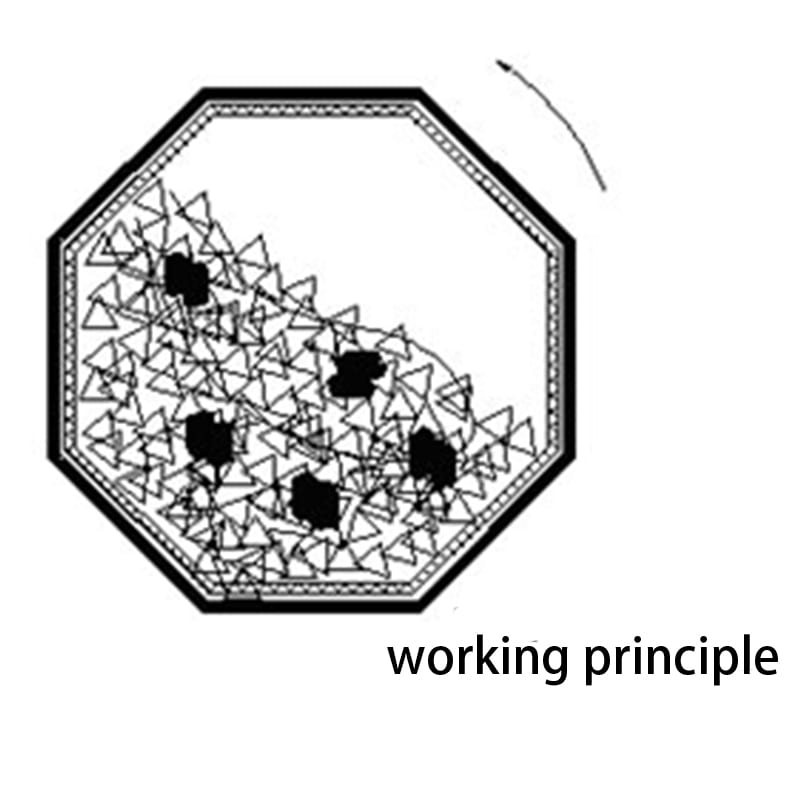
Why volume rather than mass
A charge is a moving mass of media and parts, and what matters is how much room it has to move in.
Too little in the chamber and the media does not build the relative motion that does the work — the parts sit and the media flows past them without pressure. Too much and there is no room for the charge to flow at all: the media locks, the movement stops, and the cycle becomes a slow rub.
Both failure modes look the same from outside: the machine runs, the parts come out, and the finish is disappointing. That is why loading ratio is hard to diagnose by watching — and why it is worth setting deliberately.
And it is why mass is the wrong measure. A chamber filled to the correct volume with dense ceramic media weighs very different from the same chamber filled to the correct volume with light plastic media. A shop that loads by weight will be over- or under-filled depending on which media it is running that week.
What loading ratio controls
1. Whether the cut happens at all
The media does its work through relative motion under pressure. That requires the charge to be free to move. Below a certain fill the charge is too slack to generate the pressure; above it the charge cannot move.
The symptom of an under-filled chamber: a cycle that takes much longer than expected for the same result, and parts that look "rubbed" rather than "worked".
The symptom of an over-filled chamber: a cycle where the finish is uneven — parts near the walls get work, parts in the middle do not — and where the machine sounds loaded rather than running.
2. Whether the recipe transfers between batches
This is the commercial consequence, and the one that costs most.
A cycle length is only meaningful if the loading ratio is the same. A shop that runs 200 parts one week and 260 the next, on the same cycle time, will get two different finishes and will not know why — because the recipe it wrote down assumed one fill.
The practical rule: write the loading ratio into the recipe, not just the cycle time. A recipe that says "cycle 40 minutes" is half a recipe. A recipe that says "cycle 40 minutes at this fill" is one that can be repeated.
3. The cost per part, through the media and the machine
Loading ratio sets how much work a chamber does per cycle, and therefore the media and machine cost per part.
- Under-filled → you are paying for a machine and a charge that are not being used, and the media wears while doing less work.
- Over-filled → the cycle lengthens or the result fails, so the cost per good part rises either way.
There is an optimum and it is not the maximum. The instinct to "fill it up and get more done" is the wrong instinct on a finishing machine, and it is the most common error I see described in enquiries.
How to set it, without a number
The honest position: there is no universal percentage. The right fill depends on the machine family, the media body, the part shape and the finish requirement. What can be given is the method.
1. Start from the chamber's working volume, not its nominal capacity. A machine's litre figure is a chamber size; the working volume is what the charge can occupy while still being free to move. Those are not the same number, and a quotation that gives only the nominal capacity has not told you what you can load.
2. Load by volume, and check it visually. Fill to the level the machine manufacturer specifies for that family, then confirm by looking at how the charge moves. A charge that is circulating has visible flow; a charge that is not is either slack or locked.
3. Fix the ratio, then vary the cycle. When tuning a process, hold the fill constant and change one other thing. Changing fill and cycle together makes the result unlearnable — and that is how a shop ends up with a process nobody can reproduce.
4. Record the ratio with the part, not with the machine. The same machine runs different fills for different parts. The number belongs on the job sheet.
5. Re-check when the media changes. A change of media body changes the bulk density, and therefore the fill at the same volumetric level. A shop that switches from ceramic to plastic at the same fill is running a different process.
What the field check looks like: after a cycle, look at whether every part received the same work. If the ones near the wall are finished and the ones in the middle are not, the chamber is over-full — the charge is not turning over, it is rotating as a mass.
Where this reasoning will not help
| Symptom | Loading ratio explanation |
|---|---|
| Cycle takes far longer than it should | Under-filled: the charge is too slack to build pressure |
| Finish is uneven — some parts done, some not | Over-filled: the charge rotates as a mass instead of flowing |
| Parts come out "rubbed" rather than "worked" | Under-filled, and often with a media that is too small for the fill |
| Media wears out faster than expected with little work done | Under-filled: the media moves and wears without doing the work |
| Same recipe gives different results week to week | The fill is not being held constant — the most common cause |
| Machine sounds loaded, cycle drifts longer | Over-filled: the drive is working against a charge that cannot move |
| Media lodges in parts and does not separate | Over-filled: parts are pressed together and trap media |
The fifth row is the one worth reading twice. Most "the process is inconsistent" complaints are not a machine problem or a media problem — they are a fill that changes between batches while the recipe says it does not.
Where this reasoning does not apply
A fully automatic machine that doses its own charge. Some machines control the fill internally. On those the ratio is a machine setting, not an operator decision — but it is still worth knowing what it is set to, because it is still what makes the recipe repeatable.
A fixture-held process. Drag finishing and other fixtured processes do not have a loose charge, so loading ratio in this sense does not apply. What replaces it is the fixture and the immersion depth.
A single part or a handful. Below a batch there is no ratio to speak of; the question becomes whether a machine is justified at all.
A dry process with an absorptive body. On walnut shell or corn cob the charge changes as it absorbs and breaks down, so the fill is not constant across the media's life. The ratio has to be checked at the media change, not assumed from the first fill.
The cycle and media figures the fill interacts with. A light deburr or edge stage runs about 10 to 20 minutes and a brightening stage 2 to 8 hours — and those bands assume a fill that lets the charge move. Media life runs 20 to 200 operating hours, and its replacement signal is a result that takes about 20% longer for the same appearance, which an unstable fill will mimic. Machines in this class run on three-phase 380 V or 415 V at 50 Hz, sit in the 75 to 85 dB(A) at one metre band, and ship in 25 to 35 days from the deposit.
What to send with an enquiry
- The part: dimensions, mass, and how many per batch.
- The chamber you are running, or the one you are considering — and whether the figure you have is nominal capacity or working volume.
- The media body and size, because the fill at a given volumetric level depends on bulk density.
- The cycle you are running, and whether it is being held constant.
- What is going wrong, if anything: an uneven finish, a cycle that drifts, parts coming out rubbed. Each of those points at a different fill problem.
FAQ
What is loading ratio in mass finishing? The share of the working chamber the charge fills — media plus parts — measured by volume. It controls whether the charge can move freely, which decides whether the cut happens at all and whether a cycle length is repeatable.
Why measure by volume and not by weight? Because the working limit is about room to move, not mass. A chamber correctly filled with dense ceramic media weighs very different from the same chamber correctly filled with light plastic media. Loading by weight gives a different result depending on which media is running.
Is there a standard percentage? No single number applies across machine families, media bodies and part shapes. What can be given is the method: start from working volume, fill to the manufacturer's level for that family, confirm by observing the flow, then hold it constant while tuning everything else.
Why does the same recipe give different results? Most often because the fill is not being held constant while the cycle is. A recipe that specifies a cycle time but not a loading ratio is half a specification, and the missing half is what changes between batches.
How do I know if the chamber is over-filled? Look at the parts after the cycle. If the ones near the wall are finished and the ones in the middle are not, the charge is rotating as a mass rather than flowing — that is the over-fill signature, and no cycle adjustment fixes it.
Does loading ratio matter on a dry process? It does, but it is harder to hold: an absorptive body like walnut shell or corn cob changes as it works, so the fill at a given level changes over the media's life. Check it at the media change rather than assuming the first fill holds.
Max Xu, Sales — Xiamen Jin Tai Jin Grinding Technology Co.,Ltd.
No. 31, Xinchang Road, Xinyang Industrial Zone, Haicang District, Xiamen
info@surface-polish.com
This article describes how loading ratio is reasoned about; it gives no universal percentage because none applies across machine families and part shapes, and it is not a claim about any specific part's achievable result. A finishing process is set by the material, the stock to be removed and the finish required, so the fill and the cycle for a specific part are confirmed against a trial on that part. We manufacture finishing equipment and the media and compounds that run in it; we do not offer a job-shop finishing service.
 +86-592-2381506


 IPv6 network supported
