
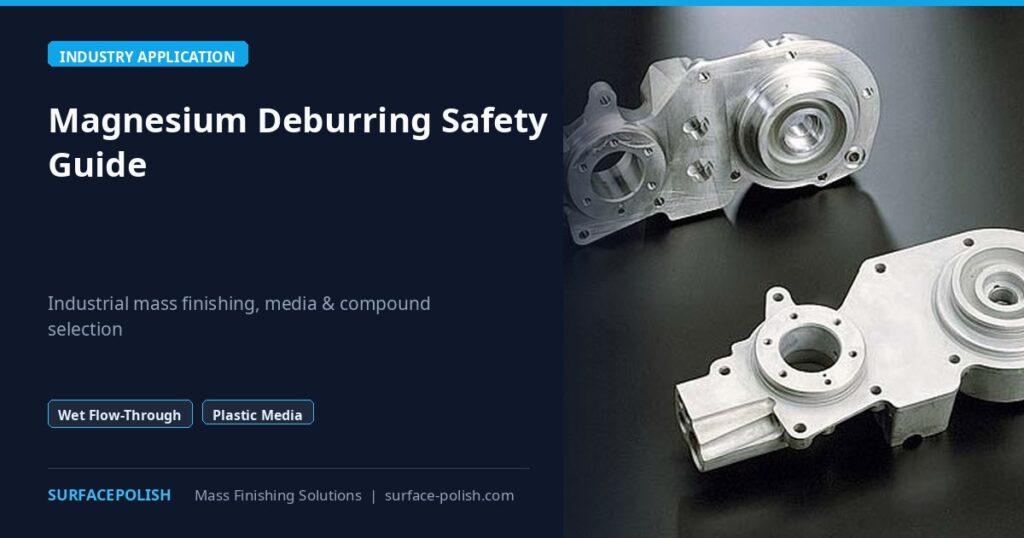
Magnesium Alloy Deburring: Safe Wet Ceramic & Plastic Tumbling Without Hydrogen Buildup

Aerospace, automotive powertrain, and portable tool engineers managing magnesium alloy deburring on AZ91D die-castings and ZK60 forgings face strict safety and metallurgical rules that differ sharply from 6061 aluminum or steel. Dry grinding or dry sanding magnesium generates highly flammable fine dust, while stagnant wet closed-sump recirculation reacts slowly with abraded magnesium fines to release hydrogen gas and form corrosive white hydroxide crust! Running wet magnesium alloy deburring inside well-ventilated, grounded ZL circular bowls or ZXL divided troughs with continuous single-pass flow through mass finishing, lightweight resin plastic cones (compound-LC10), strict acid/steel isolation, and immediate 35A/70A spin-drying keeps magnesium safe, clean, and pit-free.
Safety & Metallurgy Rules for Wet Magnesium Alloy Deburring

Why Wet Single-Pass Tumbling Beats Dry Grinding on Magnesium
Dry abrasive belt grinding or dry media tumbling of magnesium creates airborne metallic dust clouds that ignite easily from stray sparks or static discharge. By contrast, continuous wet vibratory tumbling inside ZL bowls or ZXL troughs keeps abraded magnesium fines completely submerged and immediately swept out bottom polyurethane drain grates into a vented multi-baffle settling tank—eliminating dry dust ignition hazards cleanly!
Preventing Hydrogen Gas Buildup via Open Ventilation and Single-Pass Flow
Magnesium metal reacts slowly with water—and much faster with acidic solutions—to generate hydrogen gas bubbles (H2). Never seal wet magnesium slurry inside airtight LLF120 centrifugal barrels for long runs or leave magnesium mud festering inside stagnant closed-sump recirculation tanks! Continuous single-pass flow through mass finishing inside open-top, well-ventilated ZL bowls flushes fine magnesium particles out nonstop before hydrogen can accumulate.
Absolute Ban on Acidic MC8 and Carbon-Steel Contact
Never allow acidic compound-MC8 carbon-steel descaler—or carbon-steel tumbling shot and steel scoops—anywhere near magnesium alloy cells! Acids react violently with magnesium, liberating rapid hydrogen gas and pitting castings black, while trace iron particles embedded onto magnesium cause severe galvanic corrosion in humid air.
Protecting Soft AZ91D Castings With Resin Plastic Cones (LC10)
AZ91D magnesium die-castings are lightweight and softer than structural steel; heavy vitrified high-frequency ceramic triangles peen thin casting walls into orange-peel dimples and knock through the dense chilled outer skin. Use lightweight resin-bonded synthetic plastic cones (compound-LC10) for gentle burr removal and parting-line smoothing. Review our synthetic plastic tumbling media guide.
| Magnesium Process Stage | Media Selection | Chemistry & Flow | Machine Platform | Safety & Surface Outcome |
|---|---|---|---|---|
| Upstream Mold-Release Wash | None (magnesium-safe spray wash) | Inhibited neutral/mild alkaline | Vented inline washer | Zero die-cast release; un-etched skin |
| Stage 1 Wet Deburring | Resin plastic cones (LC10) |
LC10 single-pass clean flow |
Open vented ZL / ZXL |
Smooth parting lines; zero dry dust |
| Heavy Flash Trim (Rugged Parts) | Fine high-frequency ceramic (brief) |
LC10 generous single-pass flow |
Open vented ZL bowl |
Controlled burr shear (no closed sump) |
| Stage 2 Non-Ferrous Brighten | Iron-free high-alumina spheres |
HM3 / JTJ50 softened flow |
Open ZL bowl (zero steel balls) |
Clean pit-free satin-bright sheen |
| Immediate Rinse & Dry | 35A/70A hot air + dry corncob |
Soft/RO spray rinse (zero MC8) |
35A/70A dryer + dry ZL |
Zero white hydroxide crust; coat-ready |
Media Sizing, Tumbler Media Ratio & Settling Tank Hygiene

Sizing Media Against Core Holes (Non-Lodging) and Weekly Screening
Magnesium gearboxes and aerospace electronics housings carry dozens of cored mounting bosses and blind slots. Select plastic cone and high-alumina sphere dimensions via our non-lodging media sizing guide and screen out worn slivers weekly via our media screening and replenishment SOP.
Protecting Thin Magnesium Housings With Tumbler Media Ratio & ZXL Troughs
Because magnesium parts are remarkably light yet brittle at thin die-cast ribs, overloading parts into an under-filled plastic bed causes cracked flanges and edge nicks. Maintain generous tumbler media ratio cushions inside cushioned ZL bowls, lower vibratory motor lead angles, and isolate long magnesium extrusions inside divided ZXL troughs.
Vented Multi-Baffle Settling Tanks and Regular Sludge Pump-Outs
Never let wet magnesium-resin sludge sit undisturbed inside covered floor pits for months! Route single-pass ZL drain hoses into an open-top, well-ventilated multi-baffle settling tank and scoop/pump settled magnesium sludge out regularly into vented outdoor drums per plant EHS rules.
Inspecting Polyurethane Bowl Liners and Grounding Machine Frames
Verify electrical grounding straps on all ZL, ZXL, and 35A/70A dryer frames, keep bottom polyurethane drain grates brushed open daily, and inspect bowl discharge ramps via our polyurethane bowl liner replacement guide.
Chemistry, Softened Water & Silicone-Free Pre-Coat Prep

Calibrated Peristaltic Compound Dosing With LC10 and HM3
Steady peristaltic compound dosing keeps compound-LC10 (Stage 1) and non-ferrous HM3 / JTJ50 (optional Stage 2 brightening) diluted evenly without foaming blankets that float ultra-lightweight magnesium castings out of the rolling bed! Check our preventing foam in vibratory bowls guide.
Softened Water Supply to Stop White Magnesium Hydroxide Crust
Hard tap water rich in calcium and magnesium bicarbonates reacts rapidly on warm magnesium castings to form chalky white hydroxide/carbonate crust that ruins downstream chromate or plasma electrolytic oxidation (PEO) coatings! Feed softened bowl water and an RO/DI separator spray rinse bar; review our water hardness in mass finishing guide.
Upstream Degreasing Before Vibratory Finishing for Die-Cast Release
Always strip silicone or wax die-cast mold releases upstream with an inhibited magnesium-safe cleaner following our degreasing before vibratory finishing guide so plastic cones never glaze.
Banning Silicone Defoamers Ahead of Conversion Coating and E-Coat
Magnesium housings nearly always enter chromate-free conversion coating, PEO ceramic coating, or epoxy e-coat primers immediately after deburring! Ban silicone defoamers completely so coating adhesion never blisters.
Clean Separator Rinsing, 35A/70A Drying & Dry Corncob Buffing
Enforcing Clean Softened / RO Spray Rinses Across the Separator Screen
Fine magnesium-resin slurry clings inside cored ribs as castings exit onto the vibratory separator screen. Install a dedicated softened or RO-water spray rinse bar across the screen so parts shed slurry cleanly before drying.
Immediate Heated 35A/70A Centrifugal Spin-Drying
Standing water sitting on bare wet magnesium triggers white hydroxide blooming within minutes! Transfer cleanly rinsed magnesium baskets straight into a grounded, heated 35, 35A, 70, or 70A centrifugal spin-dryer so warm airflow dries every boss cleanly. Review our centrifugal dryer guide.
Final Dry Corncob Wipe Buffing (Strictly Wet-Free Organic Bowl)
When cast magnesium covers need zero residual water haze before conversion coating, follow 35A/70A spin-drying with a brief dry pass in warm corncob media inside a strictly dry, grounded bowl—never adding water or liquid compounds to dry corncob or walnut shell (8#-80#)! See our corncob drying media grades guide.
Clean-Glove Handling and Dry Desiccant Storage Between Processes
Require clean powder-free nitrile gloves when unloading 35A/70A dryers so sweaty fingerprints never etch dark oxidation spots onto bare magnesium before conversion coating.
Troubleshooting Magnesium Defects & Multi-Shift EHS Audits

Fixing White Hydroxide Crust, Black Pitting, and Floating Castings
Match every magnesium defect directly to its fix: chalky white crust points to hard tap water or delayed 35A/70A drying; black pitting signals MC8 acid or uninhibited caustic contact; and floating parts indicate excess foam from plugged drain slots.
| Magnesium Defect | Likely Root Cause | Immediate Correction | Preventive Standard |
|---|---|---|---|
| Chalky white hydroxide crust | Hard tap water or slow ambient drying | Soft/RO rinse + immediate 35A/70A dry |
Softened separator spray + heated dryer |
| Violent black acid pitting | MC8 acid or steel cleaner cross-use |
Flush bowl immediately; isolate MC8 |
Lock MC8 away; magnesium-safe pre-wash |
Floating AZ91D castings |
Excess foam lifting light parts & cones | Clear drain slots; lower dosing speed | Calibrated peristaltic dosing + clean drains |
| Dented edges & cracked thin ribs | Heavy ceramic or low media ratio |
Switch to resin cones + higher media ratio |
Resin cones + ZXL dividers + low angle |
| Dull grey magnesium-mud film | Dirty closed sump recirculation | Purge sump; run open single-pass flow | Vented single-pass flow through + tank |
Running Empty Warm LC10 Media Washes on Resin Plastic Cones
Whenever resin plastic cones darken from die-cast release oil or magnesium silt, unload all parts and run an empty warm strip-wash with softened water and compound-LC10 until drain effluent runs clear.
Auditing Grounding Straps, Drain Grates, and Sludge Removal Weekly
Include grounding-strap continuity checks, bottom drain-grate brushing, and vented settling-tank sludge pump-outs on every weekly EHS and maintenance checklist.
Posting Laminated Setup Cards & Safety Rules Beside Every Station
Post clear laminated setup sheets beside every magnesium ZL and ZXL cell listing resin cone grade, LC10 dosing dial, softened water flow, 35A/70A dryer timer, and strict EHS zero-MC8 / zero-closed-sump rules.
Conversion-Coating Readiness, ZXL Trough Handling & EHS Controls
Preparing AZ91D Housings for Chromate-Free & PEO Coatings
Aerospace and automotive magnesium housings routinely move from wet magnesium alloy deburring straight into chromate-free conversion baths or plasma electrolytic oxidation (PEO) ceramic coatings. Enforcing silicone-free upstream mold-release washing, gentle resin plastic cone (LC10) leveling, zero silicone defoamers, RO/softened separator rinsing, and immediate 35A/70A spin-drying ensures uniform, blister-free coating adhesion across every housing.
Preventing Part-on-Part Cracking on Thin Die-Cast Ribs
Thin-walled magnesium gearbox covers and handheld tool housings chip or crack easily if tumbled with heavy ceramic stones or insufficient media cushioning. Keep generous tumbler media ratio cushions inside open vented ZL bowls, dial vibratory motor counterweight lead angles down, and load long structural extrusions inside divided ZXL/L1300–L1800 linear troughs.
Inspecting Separator Screen Apertures and Avoiding Dry Dust Traps
Match vibratory separator screen openings carefully so worn resin cone tips drop cleanly into the return chamber while every magnesium housing passes smoothly beneath the clean softened-water spray rinse bar. Never allow dry magnesium-resin dust to accumulate under separator decks or dryer vents—wipe and flush work zones cleanly per plant EHS checklists.
Managing Closed-Chamber Prohibition and Emergency Spill Containment
Keep secondary spill-containment pallets under all LC10 and HM3 drums, verify open-top settling tank ventilation daily, and train every operator never to run wet magnesium inside sealed LLF120 barrels or closed-sump recirculation tanks.
Logging Weekly EHS Grounding, Drain Flow, and Sample Validation
Record grounding-strap continuity checks, weekly media screening top-ups, and hardness test-strip readings alongside complimentary lab sample benchmarks so multi-shift magnesium production stays safe and spot-free year-round.
Isolating Magnesium Cells From Copper, Brass, and Iron Dust
Even microscopic copper fines or carbon-steel grinding sparks drifting onto damp magnesium housings initiate aggressive localized galvanic pitting corrosion! Locate wet magnesium alloy deburring cells physically separated from copper, brass, and carbon-steel grinding bays, and dedicate color-coded totes, catch baskets, and 35A/70A dryer liners exclusively to magnesium alloys.
Managing Closed-Chamber OBD and LLF120 Restrictions Safely
Because wet magnesium generates trace hydrogen gas slowly in confined water, never run long unvented LLF120 centrifugal barrel cycles on magnesium parts. Stick strictly to open-top, well-ventilated ZL circular bowls and divided ZXL troughs running continuous single-pass flow through drainage into a vented multi-baffle settling tank.
Auditing Peristaltic Compound Dosing Calibration and Drum Storage
Calibrate peristaltic compound dosing pump output weekly into a graduated cylinder so compound-LC10 dilution stays steady without foaming overflow, and store reserve chemical drums indoors above freezing temperatures on spill-containment pallets.
Training Operators on Immediate Wet-to-Dry Transfer Discipline
Train every shift operator never to let cleanly rinsed AZ91D magnesium castings sit damp in catch baskets—move each tray straight from the softened/RO separator spray bar into a heated 35A/70A dryer wearing clean powder-free nitrile gloves.
Selecting High-Frequency Ceramic vs. Resin Plastic Cones for Rugged Castings
While thin-walled AZ91D aerospace covers and consumer housings demand lightweight resin-bonded synthetic plastic cones (compound-LC10) exclusively, thick structural magnesium brackets with heavy trim-die flash can run brief, closely monitored cycles in fine-cut high-frequency ceramic stones with generous single-pass LC10 flow—followed immediately by softened/RO rinsing and 35A/70A drying.
Maintaining Open-Top Ventilation and Grounded Dryer Exhausts
Confirm local exhaust airflow above open ZL bowls, vented multi-baffle settling tanks, and heated 35A/70A centrifugal dryers at every shift start so trace moisture vapor and hydrogen never accumulate inside enclosed housings.
Verifying Conversion-Coating Water-Break Cleanliness Before Shipping
Test sample 35A/70A dried magnesium castings weekly under clean DI water spray before chromate-free conversion or PEO coating—confirming zero silicone mold release, zero hard-water white crust, and zero bare-hand oil spots.
Factory Capabilities & Verified Non-Ferrous Finishing Supply
Founded in 1992, Xiamen Jin Tai Jin Grinding Technology Co.,Ltd. (SurfacePolish) engineers and manufactures 21 machine platforms backed by 24 granted Chinese IP rights and more than 200,000+ solutions across certified facilities (ISO 00726Q01571R001, CE M.2023.206.C88121, and CE M.2023.206.C88120). Alongside ZL circular bowls, ZXL/L1300–L1800 divided troughs, LLB50/LLF120 centrifugal finishers, OBD-30..100 magnetic polishers, and heated 35/35A/70/70A centrifugal dryers, we supply LC10, HM3, JTJ50, JTS5, JTJ20, JTJ25, JTJ60, and isolated MC8 compounds matched to resin-bonded synthetic plastic cones, iron-free high-alumina spheres, high-frequency ceramic, 304 stainless balls and magnetic pins, corncob, and walnut shell (8#-80#). Standard machines ship in 25–35 days and custom lines ship in 45–60 days. Send sample raw AZ91D magnesium parts to surface-polish.com for complimentary process validation. Honest boundaries apply: we do not supply hot-chamber magnesium die-casting furnaces, PEO anodizing rectifiers, or explosion-proof dry dust collectors.
Frequently Asked Questions About Magnesium Alloy Deburring
Why is wet vibratory tumbling safer than dry grinding for magnesium alloy deburring?
Dry grinding magnesium creates fine combustible dust clouds, whereas wet single-pass vibratory tumbling inside open, vented ZL bowls keeps abraded fines submerged and flushed safely into a vented settling tank.
Why must I never run magnesium parts in a closed-sump recirculation tank?
Abraded magnesium fines react slowly with stagnant recirculated water to release hydrogen gas and build corrosive hydroxide mud. Always use continuous single-pass flow through drainage into a vented settling tank.
What media is best for deburring AZ91D magnesium die-castings?
Lightweight resin-bonded synthetic plastic cones (compound-LC10) shear parting flash cleanly without denting thin ribs or breaking through the dense chilled casting skin.
Can compound-MC8 or 304 stainless steel balls be used on magnesium alloys?
Never! Acidic MC8 reacts violently with magnesium (releasing hydrogen gas and pitting parts black), and heavy 304 steel balls embed galvanic iron into soft magnesium.
Why did white chalky crust form on my magnesium housings after wet tumbling?
White magnesium-hydroxide crust forms when hard tap water or wet parts sit damp in open catch bins. Rinse with softened/RO water at the separator screen and spin-dry immediately in a heated 35A/70A dryer.
Why do lightweight magnesium castings float on top of plastic cone beds?
Excess soap foam cushions light plastic cones and floats lightweight magnesium castings. Brush bottom drain slots open daily, calibrate peristaltic compound dosing, and run single-pass softened water.
Can I brighten magnesium housings without damaging conversion-coating adhesion?
Yes—after resin cone leveling (LC10), burnish cleanly inside iron-free high-alumina spheres (HM3 or JTJ50), avoid silicone defoamers completely, rinse with RO water, and spin-dry in 35A/70A.
How can I test wet magnesium alloy deburring safely on my castings before ordering?
Send representative raw AZ91D die-castings to surface-polish.com for complimentary lab testing; our engineers validate wet plastic cone leveling, LC10 clean flow, and 35A/70A drying and return finished samples before you order.
 +86-592-2381506


 IPv6 network supported
