
Aluminum Isotropic Superfinishing: The Finish You Buy for Friction, Not for Looks
Isotropic superfinishing is the one finishing process that is almost never bought for appearance. The word describes a texture with no direction — and a surface can be mirror-bright and still be strongly directional, because brightness and directionality are two different measurements.
That distinction is the whole purchasing decision. If the requirement is "looks polished", a standard mass-finishing sequence delivers it cheaply. If the requirement is lower friction, longer fatigue life or a seal that holds, directionality is a functional defect and the isotropic route is the only one that addresses it.
What "isotropic" actually changes
Mass finishing does not lay down a pattern the way a cutter does. In a bowl, a tub or a barrel the charge indents the surface at random orientations, so the resulting texture has no preferred direction. That is the physical basis of the term: measured along one axis and then across it, the roughness should read about the same.
Two consequences follow, and buyers conflate them:
| The measurement | What it describes | What "isotropic" means for it |
|---|---|---|
| Roughness (Ra, Rz) | how tall the peaks are | an isotropic finish is usually also low-roughness, but not necessarily — you can produce a fine, directional texture |
| Directionality / lay | whether the peaks line up along one axis | this is what isotropic addresses: no axis dominates, so no measurement direction is favoured |
A mirror-bright surface can fail the isotropic test and a uniform satin surface can pass it. Asking for "a mirror finish" and asking for "an isotropic finish" are different purchase orders, and only one of them can be inspected by eye.
The route most commonly used adds chemistry to the mechanical action: a cut chemistry converts the surface layer, the media wipes the reacted layer off the peaks, and a burnish chemistry neutralises what is left. The mechanical cut is small per pass; the chemistry is why the process is faster than running a fine media for days — and why the compound is not a consumable detail. It is the process.
What a part must be doing to justify it
Four functional drivers justify isotropic finishing, and a part needs at least one of them on the drawing:
1. Sliding or rolling contact. Two surfaces in relative motion share a contact area that depends on how the peaks meet. A directional lay gives that contact a preferred direction, so friction becomes orientation-dependent. On gears, bearings and hydraulic components, removing the direction is the effect being bought.
2. Fatigue. Every tool mark on a machined or ground face is a small notch, and peaks are where cracks start. An isotropic finish removes the directional notch pattern and leaves a shallower, random texture — the reason it appears wherever a part is cyclic-loaded rather than wear-limited.
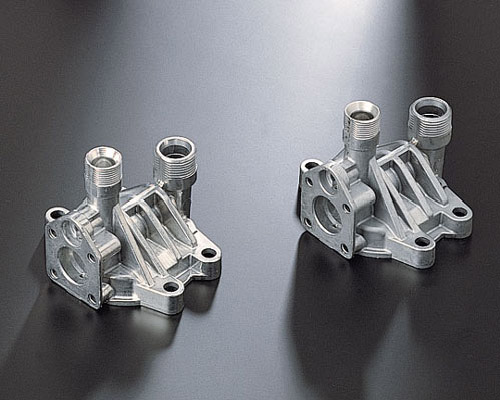
3. Sealing. A gasket, an O-ring or a metal-to-metal seal holds because the surfaces conform. A continuous scratch line across a sealing face is a leak path; a texture with no direction has no continuous path. This driver most often justifies the process on aluminium castings and copper-alloy valve bodies, where a leak costs more than the finishing.
4. Coating. A coating follows the texture beneath it, so a directional lay becomes a directional finish after anodising or plating.
The part profile that points at isotropic, in one line: a loaded or sealing surface, in a part whose failure is expensive, where the texture direction is a design constraint.
Where the ordinary finish already does the job
This is the part the process sellers leave out, and it is where money is wasted.
- Appearance is the only requirement. A decorative trim part, a visible housing with no contact and no seal — an ordinary brightening sequence is cheaper, and the directionality is invisible in service.
- The surface is painted, powder-coated or wrapped. The texture is buried under the coating; a directional lay under a paint film is not a leak path or a friction surface.
- The part runs unloaded. A bracket, a cover, a guard: no contact pressure, no cyclic load, no seal, nothing the lay can degrade.
- The lay is removed by a later operation. If the functional face is later ground, lapped or machined, paying to isotropise it first is paying twice.
- The tolerance is on the edge, not the face. If the drawing controls an edge radius or a dimension, this is the wrong purchase.
- The batch is one part. Process development is amortised across a batch, so a prototype is a trial.
The honest framing: isotropic is bought by the function, and if no function is written down, the buyer is paying for a word.
The three materials do not behave the same way
The mechanism is the same; the chemistry, the media and the risk are not.
| | Aluminium | Copper and brass | Stainless steel ||---|---|---|---|
| What governs the result | soft and gummy, so the cut smears rather than shears; the oxide reforms within seconds | work-hardens fast and reacts with the compound; colour is part of the job | hard and work-hardening, so removal is slow and the edge is at risk |
| The failure to watch | smearing and a grey, hard skin; media graded for steel cuts rather than smooths | staining and colour drift across a batch; a spent charge leaves a matt film | contamination — a carbon-steel particle shows up as a rust spot after passivation |
| Media direction | the soft end: plastic-bonded, fine ceramic later | fine ceramic and burnishing media | a harder, finer ceramic; dedicated, never shared |
| Where it justifies the cost | hydraulic bodies, pump housings, sealing faces on thin-walled castings | valve bodies and fittings where colour and contact both matter | cyclic-loaded parts, instrument and food-contact seals |
| What we would ask first | a trial on the worst-case wall | what the colour standard is — separate from texture | whether the charge can be dedicated |
Aluminium is the difficult one, and it is the keyword people search. It is soft enough that a media chosen for a harder metal pushes metal ahead of the abrasive instead of cutting it — the surface goes rough and hard, and the usual reaction, more time or a coarser grade, makes it worse. On a thin-walled casting the wall can bow before the surface is finished. Published bands run 10 to 20 minutes for a light deburr and 2 to 8 hours for a high-finish polish; an isotropic-type finish sits at the long end, and the number that matters comes from a trial, because a published cycle assumes a material and a removal that may not be yours. Deeper geometry is in polishing concave aluminium parts.
Copper and brass add a colour problem to a texture problem. The surface finishes to a slightly different shade depending on how much it was cut and how it was rinsed, so a batch can pass on texture and be rejected on appearance.
Stainless steel is the most forgiving surface and the least forgiving process. The risk is contamination: a charge shared with carbon steel leaves particles that appear as rust spots after passivation, which on a medical or food-contact part is a rejection.
What the published stream-finishing figures look like, for scale
We do not publish an isotropic superfinishing range of our own — we build to a workpiece, which is discussed below. For a sense of scale, published figures from a European manufacturer's catalogue (OTEC stream-finishing SF series, German-language brochure, captured 2026-10) sit in this range:
| Model group | Machine dimensions W × D × H (mm) | Max. workpiece Ø (mm) | Max. length (mm) | Max. mass | Holders |
|---|---|---|---|---|---|
| SF X/1 78 | 1930 × 1430 × 2585 | 150 | 250 | 2 kg | 1–2 |
| SF X/1 105 | 2560 × 1550 × 2820 | 230 | 300 | 15 kg | 2–5 |
| SF H-105 | 2110 × 1620 × 2820 | 300 | 300 | 60 kg † | 1–2 |
| SF-HD | — | 380 ‡ | 500 ‡ | 68 kg ‡ | — |
| SF-HP | — | 900 ‡ | 650 ‡ | 200 kg ‡ | — |
† The catalogue states this mass as workpiece plus holder. ‡ Stated including the holder.
Two published fields matter because they are the settings that make the process what it is: a maximum spindle speed of 1,000 rpm (SF-HD) and 260 rpm (SF-HP), with an immersion-angle range of ±35° and 0–35°. In plain terms the part is held and presented to the media at a controlled angle rather than tumbled loose — how one face gets treated without working the whole part.
Read those figures as an order of magnitude, not as our specification. They are third-party catalogue values for scale only; they are not our parameters and no machine is offered against them. The catalogue also states its dimensions including the fixture — the same trap as any enquiry: the numbers describe the machine, not your part.
What breaks, how to tell, and what to replace
| What you see | What it usually means | What to change |
|---|---|---|
| Bright, but roughness reads differently across and along | the lay was polished, not replaced | a cutting stage before burnishing — more burnishing will not fix direction |
| Grey, hard, matte surface on aluminium | media graded for a harder metal | softer, finer media and a shorter cutting stage |
| Colour drifts across a copper-alloy batch | inconsistent compound, rinse or dry | fixed dosing, a rinse stage and a dryer |
| Rust spots on stainless after passivation | contamination in the charge | a dedicated charge, and a clean-down |
| Edge radius out of tolerance | the cycle was set for finish where a deburr was needed | split the operation; state the edge limit |
| Result improves, then stops improving and reverses | spent charge — this is the consumable to change | full media change at a defined interval, not a top-up |
| A thin wall bows during the run | energy too high for the section | lower energy, or the process is wrong here |
The first row is the signature failure of a mis-sold isotropic job: a beautiful part that fails the only test that mattered. If a supplier cannot tell you how they will measure directionality, the claim is not inspectable — the same discipline as any burr and roughness measurement.
The parts that wear, and the signals that say replace rather than adjust. The charge decides this process, and it gives three signals before it fails outright: the finish stops improving, a matte grey haze appears that was not there last week, and the same result needs about 20% longer. Media life runs 20–200 operating hours depending on material and cycle — wide enough that hours alone are a poor indicator, which is why the signals matter more than the clock. The 20–35 mm polyurethane lining on a tub is the second wear part; one worn through to the shell is a repair. A spent charge does not just slow down — it produces the grey haze that looks like a process failure, and buyers then change the compound instead of the media.
Where isotropic is the wrong purchase
- No loaded or sealing surface. Decorative, structural, unloaded. Buy brightness instead.
- A part coated over the functional face. The coating hides the texture and the lay stops mattering.
- A feature the media cannot reach. A deep blind bore is not finished by a process that cannot enter it — and media must never be larger than about one third of the smallest feature, so a 3 mm feature needs media below 3 mm.
- A failure mode that is a crack or a fold, not a surface. A defect in the section is not a finishing problem.
- A batch of one, or a tolerance on the edges. Wrong for arithmetic and geometric reasons.
What we will and will not say about our own offer
We build finishing equipment and the media and compounds that run in it, and we build to a workpiece rather than a catalogue line:
- We do not publish an isotropic superfinishing model, because we do not have a catalogue one. The work is specified from the drawing and established by trial.
- If your part justifies the process, we will discuss building a configuration around it — media, compound and kinematics settled on your parts, not on a datasheet.
- The trial is the deliverable. A few representative parts, including the worst, come back as a finish, a cycle and a measured media consumption.
- We will not quote a finish we have not produced. An isotropic claim is a measurement, so it is confirmed on a sample.
The physical envelope follows the same rules as any machine we build: three-phase 380 V or 415 V at 50 Hz, 75–85 dB(A) at one metre, and every machine is run with a media load before shipping. Standard machines ship in 25–35 days from the deposit, built to order in 45–60 days, and sea transit from Xiamen is 30–40 days. Where a part needs the softer end of the media range, that is a plastic or fine ceramic choice, and the chemistry comes from the finishing compound range. For a held single part with a controlled local cut, the centrifugal disc family is the other route to compare.
FAQ
What is the difference between isotropic superfinishing and polishing? Polishing is aimed at roughness and reflectance; isotropic finishing is aimed at the absence of direction in the texture. A part can be polished to a mirror and still be strongly directional, so the two are bought against different acceptance criteria.
Which parts actually need an isotropic finish? Those with a loaded contact, a cyclic load or a sealing face, where the texture direction is a design constraint: hydraulic components, gears and bearing surfaces, sealing faces on castings and valve bodies, and parts where fatigue rather than wear is the limit.
Does aluminium need a different process from steel? Yes. Aluminium is soft and gummy, so a media graded for a harder metal smears it into a rough, hard surface, and more time or coarser media makes it worse. It takes the softer end of the range and a shorter cutting stage.
Can copper and brass be treated the same way? The mechanism is the same but the acceptance is wider: colour is a second criterion alongside texture, so the rinse and dry step is part of the specification.
Why is stainless steel the risky one for contamination? Because a charge shared with carbon steel leaves particles that appear as rust spots after passivation, and on a medical or food-contact part that is a rejection. A dedicated charge is the control, and it is a cost line to ask about before comparing quotations.
Max Xu, Sales — Xiamen Jin Tai Jin Grinding Technology Co.,Ltd.
No. 31, Xinchang Road, Xinyang Industrial Zone, Haicang District, Xiamen
info@surface-polish.com
The OTEC stream-finishing SF-series figures quoted are published third-party catalogue values (German-language brochure, captured October 2026), given for scale only: they are not our specification, they are not a claim about any machine we offer, and some of the catalogue's own fields are stated including the workpiece holder. A finishing process is set by the material, the stock to be removed and the finish required, so the configuration for a specific part is confirmed against a trial on that part. We manufacture finishing equipment and the media and compounds that run in it; we do not offer a job-shop finishing service.
 +86-592-2381506


 IPv6 network supported
