
Polishing Connecting Rods: A Long Part Is Its Own Process Problem
A connecting rod looks like a small part with a simple shape. In a mass finishing process it is neither: it is a long part, and length changes the physics before any other property does.
Three things go wrong on long parts that do not go wrong on compact ones, and all three are geometry rather than material:
- They bridge. In a bowl the charge moves in a ring, and a part longer than the ring's working width lies across it and stops moving. The middle gets no work and the ends get too much.
- They bend rather than break the burr. A rod is stiff along its length and flexible across it. A charge that removes an edge on a compact part puts a bending load on a long one.
- The two ends are not equivalent. A rod has a big end and a small end. In a loose charge the big end sees one contact pattern and the small end another, so the same nominal cycle produces two different finishes.
That is the whole subject. Choosing a machine for a connecting rod means answering the length question first, and everything else follows.
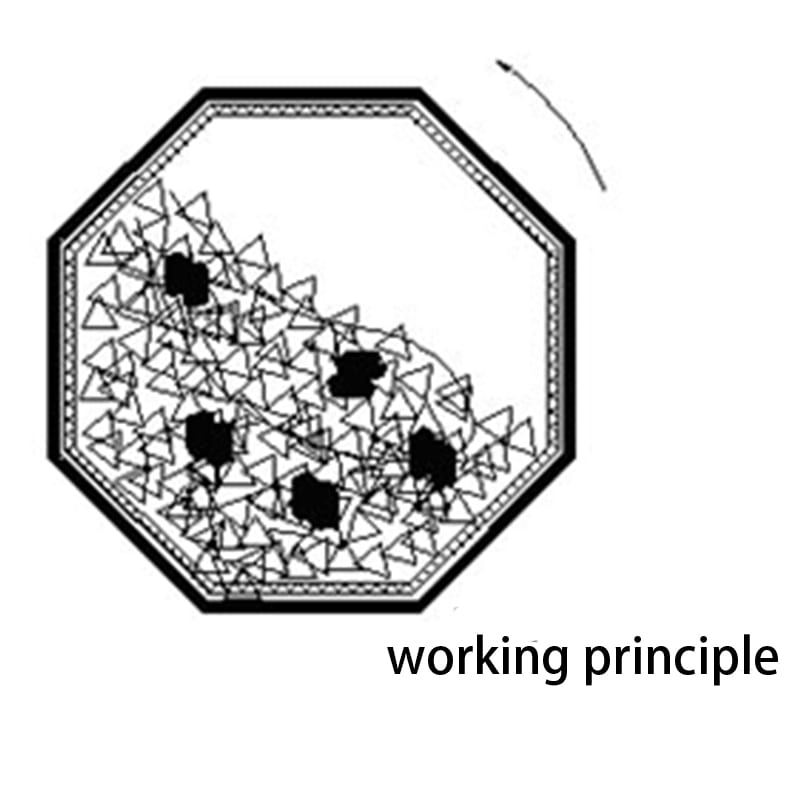
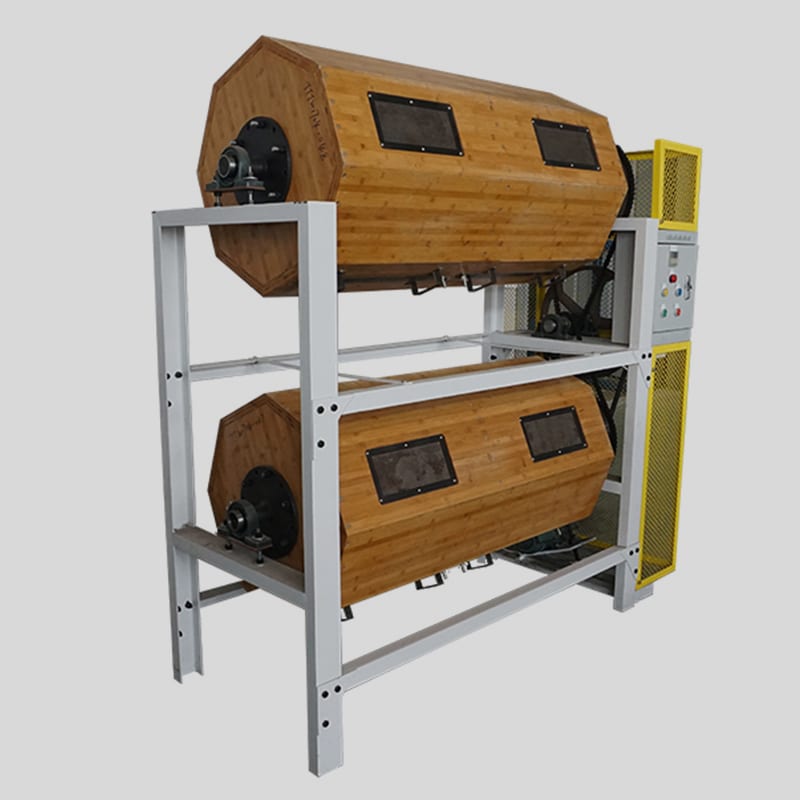
The four decisions, in order
1. Can the part lie in the flow, or will it bridge?
This decides the family:
| Machine form | Long part behaviour | Verdict |
|---|---|---|
| Bowl | The charge moves in a ring; a part longer than the ring's working width lies across it and stalls | Poor above a certain length |
| Tub | A channel; the part lies along the flow rather than across it | Good — the form for long parts |
| Barrel | The part travels with the charge; long parts can jam or bridge the drum | Poor to moderate |
| Fixture-held | The part is clamped and presented | Good, at a throughput cost |
The practical test: compare the part's longest dimension with the bowl's working width. If the part is comparable to or longer than that width, it will bridge — and no grade, cycle or load adjustment fixes a part that is not moving.
Note what this is not: it is not about the machine's capacity in litres. A 150 L bowl and a 150 L tub take the same charge volume and behave completely differently on a part 300 mm long.
2. What does the bending load do to the part?
A connecting rod has a duty: it carries a load along its axis in service. That makes straightness a real requirement, and it makes a loose charge a risk.
Two mechanisms:
- Static bending — the part spans between media and is loaded in the middle. Over a cycle this bends a slender rod.
- Impact — parts colliding in the charge. On a rod, a collision at the middle has a long lever arm to the ends.
What follows: if straightness is specified, either the part is supported (a tub with compartments, or a fixture), or the process is gentled (lower energy, more media cushioning), or the straightness check is deliberately placed after the process rather than before.
3. Can the two ends be made equivalent?
The big end and the small end differ in mass, surface area and how they sit in the charge. In a loose charge they will not receive the same contact unless something makes them.
Three ways to equalise:
- Fixtures or compartments in a tub, so each part is presented the same way.
- Batch separation — running the big-end work and the small-end work as separate specifications rather than hoping for one average.
- A fixture-held process (the drag finishing route), where the part's orientation is set rather than statistical.
The honest read: on a rod, the two ends are a specification problem before a process problem. If the drawing says "polish both ends to the same appearance", the process has to be designed to make them equal; a bowl running both together will produce an average of the two.
4. What is the surface requirement, and where?
A rod typically has three surface zones with different requirements:
| Zone | Typical requirement | What it means for the process |
|---|---|---|
| Big-end bore | Functional — bearing seat, tight tolerance | Not a loose-media job; bore geometry rules it out |
| Small-end bore | Functional | Same |
| Outer faces and the shank | Cosmetic or fatigue-related | The zone a loose charge works |
This split is the most useful thing on this page. A large share of the rod surface is functional and cannot be touched by a loose charge, because the charge would change the bore. The process is therefore working the outer faces and the shank, and the bores are masked or the process is specified not to reach them.
And the fatigue point: on a rod, surface finish on the shank is not only cosmetic — a smoother surface reduces the notch effect that starts fatigue cracks. That is a real reason to polish a rod beyond appearance, and it is the reason the shank is the zone that matters.
The scale reference
We do not publish a connecting-rod machine. As a scale reference for the tub form, which is the family that handles long parts, our model range is:
| Model | Nominal capacity (L) | Dimensions L×W×H (mm) | Power (kW) |
|---|---|---|---|
| L1300 | 1200 | 2700×1300×1400 | 5.0 × 2 |
| L1500 | 1500 | 3340×1290×1440 | 5.5 × 2 |
| L1800 | 1800 | 2800×1700×2000 | 7.5 × 2 |
These are catalogue ratings — confirm against your own part. Note the dimensions: a tub machine is a long machine, and that is not an accident. The channel length is what allows a long part to lie in the flow rather than across it. On a rod, the machine's length is a functional dimension, not just a footprint.
Where a loose-media process will not help here
The bores. A loose charge changes bore geometry. If the bore is a bearing seat, the process is specified not to reach it, or the bore is masked. A charge bought to polish a rod and left to work the whole part will fail the bore.
A part that must stay straight to a tight tolerance. A loose charge bends slender parts. If the straightness tolerance is tight, the part needs support or a fixture, or the process is the wrong one.
A part where the two ends must match exactly. A statistical process gives a statistical result. If both ends must be identical, a fixture-held process or separate specifications are the answer.
A single rod, or a handful. The setup and the media charge dominate; the per-part economics do not work. That is a bench or a specialist job.
A rod with a coated or treated surface. A loose charge removes material, and a coating is material. If the surface is treated, the process is a different specification — often "do not cut".
The media and the services, if a machine is involved. Media should never be larger than about one third of the smallest feature, so on a rod the shank diameter and the oil hole set the maximum size before the grade is discussed. A machine in this class runs on three-phase 380 V or 415 V at 50 Hz, sits in the 75 to 85 dB(A) at one metre band, and a standard configuration ships in 25 to 35 days from the deposit with built-to-order at 45 to 60 days.
What to send with an enquiry
- The drawing, with the bores, the faces and the straightness requirement marked, and the surfaces that must not be touched.
- The part's dimensions — length, mass, and the shank diameter. Length is the first question, because it decides the family.
- The material and its condition — a forged steel rod and a cast one behave differently.
- The stock to be removed, in tenths of a millimetre, and whether the requirement is cosmetic or fatigue-related (they are specified differently).
- The straightness and bore tolerance, because those decide whether a loose charge can be used at all.
- The volume and mix — rods per batch and how many part numbers, because the fixtures and compartments are the per-part cost.
- What happens downstream — shot peening, coating, assembly — because a polished surface that is then peened or coated is a different specification.
FAQ
Can connecting rods be polished in a vibratory bowl? Often not directly. A rod is a long part, and in a bowl the charge moves in a ring — a part longer than the working width lies across it and stops moving, so the middle gets no work. The tub form, where the part lies along the flow, is the family that suits long parts.
What is bridging, and why does it matter? Bridging is when a long part spans across the flow instead of travelling with it. The part stops moving, the middle is untouched and the ends overwork. No grade or cycle adjustment fixes it — the geometry has to change, by using a different machine form or compartments.
Will polishing bend a connecting rod? It can, if straightness is tight and the part is slender. A loose charge applies a bending load as the part spans between media, and impacts at the middle have a long lever arm. If straightness is specified, the part needs support or a fixture, or the requirement needs to be checked after the process rather than assumed.
Do the bores get polished too? They should not, in a loose-media process — the charge changes bore geometry, and a bearing seat is a tolerance. The process works the outer faces and the shank, and the bores are masked or the process is specified not to reach them.
Is polishing a rod only cosmetic? No. On the shank, surface finish affects fatigue behaviour: a smoother surface reduces the notch effect where cracks start. That is a functional reason to polish, and it is why the shank is the zone that matters rather than the whole part.
What machine size do I need? It is a length question before a capacity question. The tub models in our range run to 3340 mm in length, and that length is functional — it is what lets a long part lie in the flow. Match the part's length to the channel, not the charge volume to the litre figure.
Max Xu, Sales — Xiamen Jin Tai Jin Grinding Technology Co.,Ltd.
No. 31, Xinchang Road, Xinyang Industrial Zone, Haicang District, Xiamen
info@surface-polish.com
The model figures above are catalogue ratings for models in our range; they describe the machine, not the result on a specific part. A finishing process is set by the material, the stock to be removed and the finish required, so the configuration for a specific part is confirmed against a trial on that part. We manufacture finishing equipment and the media and compounds that run in it; we do not offer a job-shop finishing service.
 +86-592-2381506


 IPv6 network supported
