
Superfinishing and Tumbling Surface Finish: Achieving Mirror-Low Roughness Without Distortion
Manufacturing teams searching for super finishing or tumbling surface finish control rarely struggle with removing big burrs—they struggle with erasing the last stubborn machining ridges without rounding tight tolerances, overheating thin edges, or creating inconsistent gloss across a batch. Standard coarse tumbling knocks down sharp edges quickly, yet leaves behind a matte stone-cut texture that falls short of hydraulic sealing, gear-tooth contact, or optical hardware specifications.
The core thesis of this guide is clear: true mass-finishing superfinishing is a staged roughness-reduction sequence—converting directional grinding peaks into a smooth, non-directional plateau through progressively finer media, controlled chemical softening, and high-energy centrifugal or fixtured motion. Skipping intermediate media grades or rushing straight into bright burnishing only smears sharp machining peaks instead of erasing them cleanly. For related gear and isotropic processes, see our isotropic finishing guide and gear and crankshaft polishing guide.
What Separates Superfinishing From Standard Deburring
Standard deburring targets exposed edges and corners; super finishing targets the microscopic peak-to-valley texture across functional load-bearing faces.

Directional Machining Ridges vs. Non-Directional Plateau Finish
CNC turning, milling, and cylindrical grinding leave parallel feed ridges across every face. Under sliding contact or hydraulic seal motion, those microscopic peaks concentrate stress, accelerate wear, and tear elastomer seals. Staged tumbling surface finish workflows shear down the sharp peak crests while preserving load-bearing valley pockets that retain lubrication.
Why Single-Stage Tumbling Plateaus Early
Loading rough-ground parts into a single ceramic charge removes initial burrs, then hits a roughness floor where stone grit scratches just as deeply as it smooths. Achieving true low-roughness super finishing requires stepping down through two or three distinct media grades—or combining chemical film softening with non-abrasive high-alumina or steel burnishing.
Peak Compression vs. Abrasive Micro-Cutting
Abrasive micro-cutting with fine resin-bonded plastic or dense ceramic removes tiny peaks cleanly to flatten surface waviness. Non-abrasive burnishing with smooth high-alumina porcelain spheres or stainless steel burnishing media compresses remaining micro-peaks under wet lubrication without further stock loss.
| Finishing Objective | Primary Mechanism | Media Family | Typical Chamber Format |
|---|---|---|---|
| Rough edge deburring | Aggressive stone cutting | Preformed ceramic triangles + LC10 |
Vibratory bowl or octagonal barrel |
| Pre-polish peak leveling | Fine micro-abrasive smoothing | Fine resin-bonded plastic cones | Centrifugal disc or vibratory bowl |
| Chemically assisted superfinish | Soft oxide film wipe + polish | Non-abrasive porcelain / ceramic | Vibratory bowl or fixtured drag unit |
| Zero-loss final brightening | Wet peak compression | Smooth porcelain or stainless balls + JTJ50 |
Reinforced vibratory bowl or rotary barrel |
[DESIGN: Four-panel surface comparison showing directional CNC ridges, coarse ceramic matte, fine plastic satin, and superfinished plateau]
Equipment Platforms for High-Energy Superfinishing
Achieving low roughness in reasonable production cycle times depends heavily on how the chamber transfers energy into the media bed.
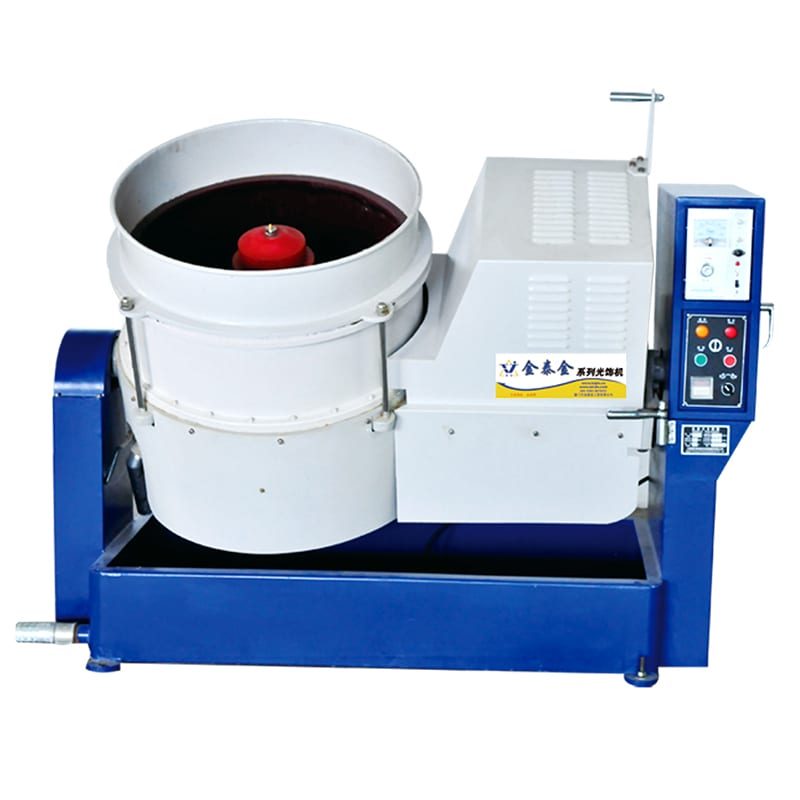
Centrifugal Disc Finishers for Rapid Small-Part Superfinishing
A centrifugal disc finisher spins a polyurethane-lined rotor plate inside a stationary drum, generating toroidal media velocity many times faster than a standard vibratory bowl. That concentrated shear force cuts tumbling surface finish cycle times dramatically on small precision gears, coin blanks, surgical fasteners, and valve spools.
Drag Finishing for Heavy or High-Value Precision Components
When parts are heavy enough to bruise each other in free tumbling—such as hardened transmission gears, turbine blades, or orthopedic implants—drag finishing clamps each workpiece on a rotating spindle and pulls it smoothly through stationary fine media. Parts achieve uniform super finishing with zero part-on-part collision.
Reinforced Vibratory Bowls for Large Batches and Isotropic Cycles
For large batch throughput on connecting rods, crankshaft journals, or stamped stainless hardware, a heavy-duty vibratory grinder maintains gentle, continuous contact across every part while chemical active-film compounds soften surface peaks for non-abrasive porcelain burnishing.
Dry Double-Deck Barrels for Plastics and Soft Non-Ferrous Gloss
For acrylic lenses, acetate frames, and soft brass trim where wet slurry cannot reach final optical gloss, a dry rotary barrel charged with walnut shell, hardwood pegs, or corncob media delivers cool, streak-free final brightening.
Multi-Stage Media Progression for Roughness Reduction
Skipping intermediate media steps is the fastest way to trap deep scratches beneath a shiny smeared skin.

Stage 1: Coarse-to-Medium Cut to Erase Tool Lines
Start with preformed ceramic triangles (for hard steel, titanium, and stainless) or medium resin-bonded plastic cones (for aluminum, brass, and zinc) paired with LC10 compound to erase directional milling or grinding marks completely.
Stage 2: Fine Plastic or Micro-Ceramic Pre-Polish
Transfer rinsed parts into fine-grit resin-bonded plastic pyramids or dense smooth ceramic bodies. This intermediate stage replaces coarse stone scratches with a tight, uniform satin matte skin ready for final burnishing.
Stage 3: High-Alumina Porcelain or Stainless Burnishing
In the final wet stage, smooth high-alumina porcelain spheres or stainless steel burnishing balls lubricated with JTJ50 or JTS5 compress micro-peaks into a bright, reflective plateau finish with negligible dimensional change.
Stage 4: Clean Flushing and Heated Centrifugal Spin-Drying
Immediately flush finished parts in clean water and dry them inside a heated centrifugal spin dryer so dried compound film never dulls the newly achieved tumbling surface finish. On high-precision steel shafts or bearing rings, follow spin-drying immediately with a clean lint-free inspection and protective oil or VCI packaging so ambient shop moisture cannot pit newly smoothed peaks.
Selecting Media Shape for Complex Fillets and Roots
Smooth spheres polish broad flats rapidly yet bridge right over sharp gear roots and internal fillets. When superfinishing splined shafts, turbine blades, or stepped valve spools, pair fine spherical porcelain with small angle-cut cylinders or ballcones sized to enter every root radius without wedging in keyways or cross-holes.
Balancing Cycle Duration Against Dimensional Tolerance
Every super finishing stage removes or compresses surface peaks on a microscopic scale. Establish baseline profilometer and micrometer readings on sample parts from your first controlled trial batch so operators know exactly when directional ridges vanish without eroding tight bearing-journal diameters or O-ring groove widths.
Handling High-Alloy Titanium and Nickel Components
Titanium and nickel-base alloys work-harden rapidly and resist light abrasive cutting. Extend Stage 1 ceramic or high-density plastic cutting cleanly before moving to high-alumina porcelain burnishing, and maintain steady flow-through lubrication so smeared metal never gall-welds onto smooth porcelain spheres.
[DESIGN: Four-stage superfinishing sequence: coarse cut, fine satin level, porcelain/steel burnish, and heated spin-dry]
Chemically Assisted Superfinishing vs. Pure Mechanical Polishing
Combining mild surface chemistry with gentle non-abrasive media unlocks roughness levels that pure mechanical stone cutting cannot reach efficiently on hard alloys.

How Soft Oxide Film Formation Accelerates Peak Leveling
In chemically assisted isotropic workflows, a controlled conversion chemistry forms a microscopic, soft reaction film on exposed steel peaks. As non-abrasive high-alumina media wipes across the part, it shears away only the softened peak film while leaving valleys untouched—rapidly leveling directional grinding ridges without tearing metal.
Neutralizing and Brightening After Chemical Stages
Every chemically assisted stage must be followed by a thorough alkaline neutralizing or brightening rinse (JTJ50 / JTS5) so reactive film stops immediately and bare steel develops a clean, bright luster rather than dull gray staining.
When Pure Mechanical Staging Is Safer
Soft aluminum, zinc die-castings, and delicate copper alloys rarely need aggressive conversion chemistry. Pure mechanical staging using neutral compound, fine resin-bonded plastic cones, and high-alumina porcelain spheres achieves uniform satin-to-bright finishes without risking selective grain etching.
Keeping Compound Flow-Through Consistent
Whether running mechanical or chemically assisted super finishing, never allow spent abrasive fines to recirculate endlessly in dirty sump water. Steady fresh water and metered compound dosing keep cut rates predictable and surfaces spotless. Installing a multi-baffle settling tank beneath the drain line prevents ultra-fine ceramic and metal dust from re-entering recirculated rinse lines.
Preventing Thermal Warping and Edge Burn on Thin Parts
Unlike dry buffing wheels that heat thin stampings and warp flat blades, wet tumbling surface finish cycles keep workpieces completely submerged in cool liquid compound. That continuous liquid heat sink lets thin surgical clips, spring washers, and precision valve shims reach mirror-low roughness without losing heat-treat temper or flatness.
Staging Parts Between Bowls Without Cross-Contamination
Never carry rough ceramic grit or steel dust from Stage 1 into a fine porcelain or stainless burnishing bowl. Thoroughly rinse both the parts and transfer baskets between stages, and dedicate separate screen decks to coarse cutting versus fine final brightening so a single stray coarse chip never scratches an entire superfinished batch.

Measuring and Controlling Surface Finish Without Guesswork
Visual shine alone is a misleading metric—a scratched part smeared with heavy wax or over-burnished balls can look shiny under shop lights while failing profilometer inspection.

Visual Gloss vs. True Roughness Plateau
True super finishing lowers peak height uniformly across the part. Inspect finished parts under low-angle task lighting and run a calibrated contact stylus profilometer across multiple orientations—especially perpendicular to the original machining feed direction—to confirm directional peaks are genuinely gone rather than merely flattened into shiny smeared ridges.
Checking Edge Rounding Within Tolerance Limits
Aggressive tumbling rounds sharp corners faster than it flattens broad faces. Always check critical gear tip chamfers, O-ring groove edges, and bearing shoulders against blueprint radius limits at the end of Stage 1 before moving parts into final burnishing.
Preventing Part-on-Part Micro-Nicks in Final Stages
A single heavy part colliding with its neighbor during the final porcelain burnish leaves a bright crescent dent that ruins a whole batch of superfinished shafts. Keep media-to-part volume generous, or run heavy precision components in divided troughs or drag finishing spindles. Even during unloading onto screen decks, line discharge chutes and catch trays with soft polyurethane sheet so freshly superfinished journals never strike bare stainless steel hoppers.
Verifying Cleanliness Before Packaging or Assembly
Residual porcelain dust or dried liquid brightener trapped inside spline roots or oil galleries can score mating bearings during first startup. After heated centrifugal spin-drying, inspect blind bores under bright task lighting, blow out internal oil passages with clean dry air, and store superfinished components in compartmentalized trays rather than bulk tote bins where parts can rub against each other in transit.
Documenting Repeatable Recipes Across Production Shifts
Superfinishing fails when each shift operator adjusts water valve flow, compound scoops, or bowl timers by feel. Lock down exact media grade, media-to-part load volume, compound dilution flow, and cycle duration per part number on a laminated cell sheet next to the control cabinet. Consistent recipe control ensures Monday morning batches match Friday afternoon batches on profilometer inspection.
Avoiding Over-Polishing and Subsurface Fatigue
Running parts longer than needed in high-energy centrifugal disc or heavy steel burnishing chambers does not improve roughness indefinitely. Once peak-to-valley texture hits its plateau, extra cycle time simply erodes sharp sealing corners, widens bearing clearances, or over-peens soft alloy skins. Always verify the shortest cycle that reliably clears Stage 1 tool marks and hits target roughness.
| Inspection Parameter | What Visual Shine Misses | Production Verification Method |
|---|---|---|
| Directional grinding ridges | Shiny smeared peaks still tear seals | Measure roughness perpendicular to feed marks |
| Edge radius growth | Smooth corners may exceed tolerance | Check edge radius on optical comparator after Stage 1 |
| Part-on-part micro-dings | Hidden in glare under overhead lights | Inspect under low-angle grazing light before packing |
| Residual compound film | Cloudy haze appears hours later | Clean rinse + heated spin-dry + white-cloth wipe check |
[DESIGN: Troubleshooting decision matrix linking hazy shine, residual scratches, edge rounding, and micro-dings to stage fixes]
Four Common Superfinishing Failures and How to Diagnose Them
Failure Mode 1: Shiny Surface With Underlying Grinding Lines Still Visible
Parts reflect light well yet still show faint parallel lathe or grinder tracks under angled light.
Diagnostic rule: If parts look bright yet feed lines remain visible, Stage 1 cut time was too short before moving to burnishing—extend the ceramic or plastic cut stage until feed lines disappear completely in a uniform matte finish before brightening.
Failure Mode 2: Hazy, Smeared Film Across Stainless or Aluminum
Instead of crisp reflection, parts look milky or slightly cloudy.
Diagnostic rule: If haze spreads uniformly across flat faces, fine wear slurry is redepositing or compound flow-through is too lean—increase clean water flow, switch to fresh brightening compound, and verify porcelain media is clean.
Failure Mode 3: Over-Rounded Edges Before Flat Faces Reach Target Smoothness
Corners lose crisp geometry while broad center faces still carry rough texture.
Diagnostic rule: If edges round faster than faces smooth, media size is too aggressive or chamber impact is too high—step down to smaller, denser media shapes or move parts to fixtured drag finishing.
Failure Mode 4: Random Crescent Nicks on Finished Precision Shafts
Isolated bright dents mar otherwise smooth cylindrical journals.
Diagnostic rule: If dents appear randomly across heavy parts, parts are colliding inside the bowl—lower part load, raise media volume, or switch to a divided trough or planetary drag fixture.
Honest Capability Boundaries and Production Standards
What Mass Finishing Superfinishing Can and Cannot Replace
Mass finishing chambers excel at lowering directional machining roughness, smoothing fillets, reducing gear-tooth friction, and building uniform commercial-to-mirror finishes across batches. However, mass finishing does not correct out-of-round cylindrical geometry, fix taper errors, or replace precision cylindrical grinding, honing, or optical-flat lapping. Always machine and grind parts to true dimensional geometry before entering the finishing cell. For related stainless and aluminum workflows, see our ss polisher guide and aluminum polishing machine guide.
What We Supply and What We Do Not Supply
At Xiamen Jin Tai Jin Grinding Technology Co.,Ltd. (brand: Jings Polish), our workshop roots date back to 1996 and our company was formally established in 2009, delivering over 200,000+ sets of grinding and polishing solutions worldwide. Across our catalogue, we manufacture 21 machine platforms backed by 24 granted Chinese IP rights (1 invention patent, 15 utility model patents, and 8 design patents), under ISO 9001 certification 00726Q01571R001 (valid 2026-06-03 to 2029-06-02) and CE certifications M.2023.206.C88121 (Vertical, 8 models) and M.2023.206.C88120 (Horizontal, 13 models), valid until 2028-07-24.
To keep boundaries transparent: we supply industrial mass finishing equipment (centrifugal disc finishers, drag finishers, vibratory bowls, divided troughs, octagonal rotary barrels, heated centrifugal spin dryers), tumbling media (ceramic, resin-bonded plastic, high-alumina porcelain, stainless burnishing media, organic media), and liquid compounds; we do NOT supply CNC cylindrical grinders, honing stones, electropolishing/plating baths, or contract job-shop superfinishing services. Keeping these capability boundaries explicit ensures engineers pair mass finishing cleanly with upstream precision machining rather than expecting a tumbling bowl to correct dimensional taper or ovality errors.
Choosing Between Centrifugal Disc, Vibratory Bowl, and Drag Finishing
No single superfinishing machine wins across every part weight and geometry. Small, light parts with high daily volume belong in centrifugal disc finishers where fast toroidal shear cuts cycle times dramatically. Medium-sized castings and stamped hardware run reliably in polyurethane-lined vibratory bowls with built-in deck separation. Heavy, high-value shafts, gears, and turbine blades that cannot afford a single collision nick belong in fixtured drag finishers. Matching chamber physics to part mass prevents costly capital mistakes and ensures consistent surface roughness from the first batch to the thousandth batch across busy production floors.

Honest Lead Times and Remote Engineering Review
Standard machines ship in 25–35 days, while custom fixtured drag finishers and multi-stage lines require 45–60 days. Because incoming surface roughness, alloy hardness, and edge-radius limits vary widely across precision components, we do not promise free sample trials by mail or guarantee cycle times before reviewing your parts—send clear photos of your workpieces, incoming surface finish, alloy grade, and target roughness via our custom polishing solution page for an initial engineering review. Detailed photos of tool marks, fillets, and mating surfaces help our engineers configure the right multi-stage sequence upfront.
Frequently Asked Questions
Can tumbling surface finish replace precision cylindrical grinding?
No. Mass finishing reduces microscopic peak-to-valley roughness and smooths edges, but it does not fix macro geometric errors like taper, out-of-roundness, or flat-parallelism defects. Complete precision grinding first, then use staged mass finishing to polish the surface.
How many stages are needed for super finishing in a vibratory or disc tumbler?
Most precision metal parts require two to three stages: an initial ceramic or plastic cut to erase tool lines, an optional fine plastic leveling stage, and a final non-abrasive porcelain or stainless burnishing stage with clean rinsing and heated spin-drying.
Why do grinding lines still show up even after bright steel burnishing?
Burnishing compresses peaks without removing enough stock to erase deep directional tool marks. Always finish the abrasive cut stage until the surface looks uniformly matte before switching to porcelain or stainless burnishing.
Which machine is better for superfinishing precision gears: vibratory bowl or drag finisher?
Small, lightweight gears run fast in centrifugal disc finishers or vibratory bowls with generous media cushioning. Heavy, high-value transmission gears that cannot tolerate part-on-part contact belong in fixtured drag finishing machines.
How do I prevent water spots from ruining a superfinished surface?
Flush finished parts immediately in clean water and run them through a heated centrifugal spin dryer. For decorative brass or stainless hardware, an optional warm corncob wipe removes residual moisture spots cleanly.
What details should I send before requesting a quote for a superfinishing line?
Send clear close-up photos of your parts showing current machining marks, critical edges, and holes, along with alloy grade, part weight, target finish, and hourly batch volume. Our engineers can recommend the right machine sequence and media progression from photos and drawings.
[DESIGN: Annotated buyer enquiry checklist showing surface close-up photos, alloy grade, edge tolerances, and hourly throughput]
 +86-592-2381506


 IPv6 network supported
