
Medical Device Metal Finishing: Where the Process Changes, and What It Cannot Do
Medical parts are finished on the same machine families as industrial parts. What changes is not the equipment — it is what the process has to prove, what may be left behind, and how narrow the material window becomes. A shop that runs medical work on an ordinary finishing line usually finds out at validation, not at the machine.
This page is about those differences and which route applies to which device. Material-specific detail lives on its own pages — nitinol in particular: nitinol medical device polishing. For an engineering case study on implant surface integrity, see our joint case study on implants and instruments. For our overall equipment scope across manufacturing, see what we build and what we do not.
What Makes a Medical Part Different
When machine shops take on medical parts finishing, engineers often assume the task is just high-precision deburring. They use the same tumbler, load the same stones, and inspect parts under a shop microscope. That approach works until the customer asks for batch records, cleanliness verification, and process validation documentation.
The four constraints that do not exist on ordinary parts
Finishing metal for medical applications introduces four strict manufacturing constraints that never appear on commercial prints:
- Full batch traceability: Machine ID, fixture position, media lot, compound batch, cycle timers, and water quality must tie to the traveler.
- Cleanliness verification: Components cannot carry media residue, compound film, abrasive dust, or metal fines into assembly.
- Biocompatibility preservation: The mechanical and chemical finish must leave a passive, non-reactive metal skin free of questionable binders or dirty residues.
- Tight tolerance balance: Edges must be radiused to protect soft tissue without eroding critical dimensions on bone-screw threads and sliding fits.
Why "it looks right" is not a finish specification here
On commercial parts, an operator can hold a bracket up to shop light, decide it looks smooth, and sign off the bin. In medical component grinding and polishing, "it looks right" is completely unacceptable as an acceptance criterion.
Inspectors and validation engineers evaluate how the surface was created, whether media broke down into fine crevices, and whether the process repeats across future lots. You must be able to prove why the surface is correct through measurable inspection, documented parameters, and verified cleanliness.
Traceability is a process requirement, not paperwork
Traceability directly governs cell layout. If media wears down, cutting rates drift; if compound is added by eye, chemistry varies. Media batches must be tracked for wear life, chemical dosing must be automated, and machine speeds must be locked behind password-protected PLC recipes to prevent batch discrepancies.
The Process Families That Apply, and What Each One Is For
Because medical components vary from surgical retractor handles to delicate memory-alloy vascular implants, no single finishing machine handles every catalog number. Metal finishing for medical devices divides across four primary mechanical routes.
Mass finishing — what it can reach and what it cannot
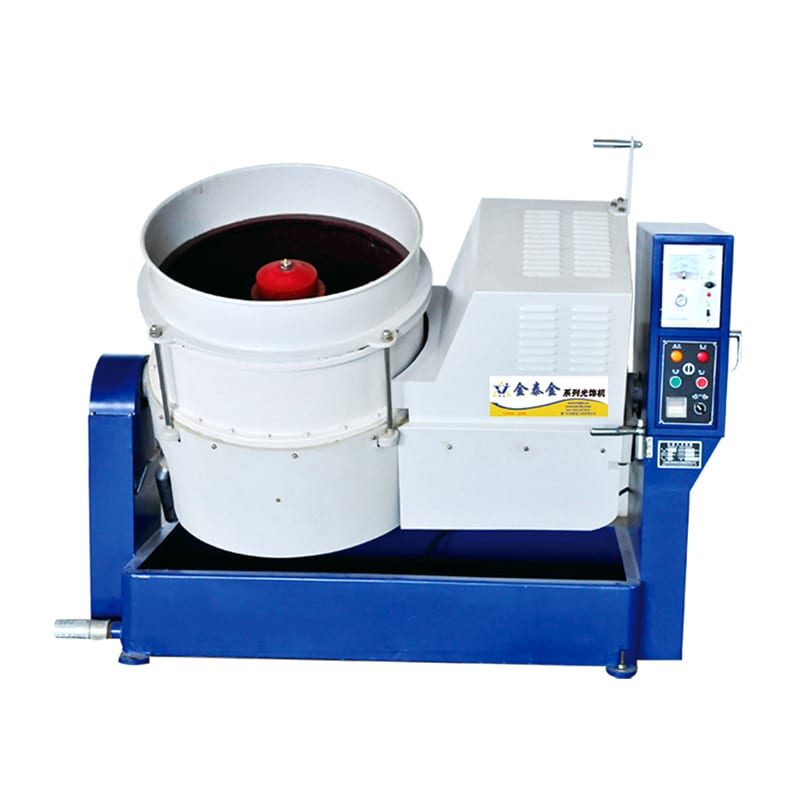
Vibratory bowls and tub vibrators handle batch deburring medical metal on bone plates, knee stems, and instrument bodies using ceramic or plastic grinding media.
However, loose tumbling cannot reach deep cannulations or tiny blind threads, and delicate implants must be fixtured or compartmentalized to prevent impingement marks.
Magnetic and drag finishing — the ones that reach inside
When miniature precision parts have cross-holes, internal slots, or delicate teeth that loose stones cannot touch, shops move to specialized motion:
- Magnetic pin finishing: Driven by rotating permanent magnets inside magnetic finishing machines, fine stainless steel needles swirl through deep cannulations, bone screw threads, and internal manifolds to strip micro-burrs without rounding outer profiles.
- Fixture drag finishing: Heavy orthopedic hip stems and surgical tools clamp onto rotating spindles. The spindles pull the parts through a dense bed of media, delivering targeted edge radiusing with zero part-on-part collision.
Where a surface process is the wrong route entirely
Mechanical mass finishing modifies surface topography; it is not a stock-machining process, and it cannot alter base alloy chemistry. If a part has deep machining gouges, warped geometry, or casting porosity, tumbling will only polish the defect rather than fix it. Likewise, mechanical finishing does not replace downstream chemical passivation, electropolishing, or functional barrier coatings.
The route-selection table
Use the four-column table below to match your device geometry to the proper mechanical finishing route.
| Device Category | Recommended Route | Why It Fits the Geometry | Critical Process Caution |
|---|---|---|---|
| Bone plates and hip stems | Fixtured vibratory finishing then centrifugal burnishing | Blends cutter marks into satin skin and rounds tissue-contact edges | Workpieces must be fixtured to prevent part-on-part collision |
| Surgical instruments | Vibratory finishing followed by chemical passivation | Strips stamping burrs, blends seams, and restores passive oxide skin | Cutting edges and sharp functional tips must be masked or isolated |
| Memory-alloy vascular stents | Low-energy magnetic pin finishing or gentle drag finishing | Clears micro-burrs without generating localized friction heat | High contact energy can alter phase behavior in temperature-sensitive alloys |
| Cannulated screws and tubes | Magnetic pin finishing with dedicated separation | Slender stainless pins flow through internal bores where stones bridge | Pins must be fully flushed so no media lodges in blind ends |
| Dental brackets and turned parts | Centrifugal barrel finishing or magnetic pin finishing | High contact pressure or fine wire reach deburrs tiny parts rapidly | Small parts require fine mesh separation screens to prevent loss |
| Trays and structural frames | Linear tub vibrators with compartment dividers | Open rectangular trough accommodates long parts with gentle roll | Check media drainage from deep corners before moving parts to washing |
| Implant mirror surfaces | Multi-stage centrifugal barrel burnishing with steel media | High sliding compression flattens micro-peaks into reflective luster | Verify that no lubricant or tallow grease film remains on the metal skin |
| Anodized or colored surfaces | Pre-plate vibratory smoothing before external coating line | Mechanical tumbling prepares an even matte canvas for oxide growth | Mass finishing cannot add color; parts must move to external chemical baths |
For high-energy centrifugal alternatives on small implants, see our guide on centrifugal disc vs barrel finishing. For selecting media shapes across complex alloys, review our vibratory tumbler media selection guide.
The Materials You Will Actually Meet
Medical manufacturing relies on a narrow family of specialized alloys. Each material responds differently to mechanical contact pressure and frictional heat.
Titanium alloys — why they behave differently from steel
Titanium alloys like Ti-6Al-4V serve widely in orthopedic implants and bone screws. Finishing titanium medical implants demands care: titanium is softer than tool steel, galls easily, and conducts heat poorly. Dry rubbing traps heat at the contact point, causing surface smearing. Finishing titanium requires smooth plastic or fine ceramic media paired with continuous compound flow to cool the cut.
Nitinol — the material that punishes heat
Nitinol nickel-titanium shape-memory alloys serve in self-expanding stents and guidewires. Nitinol is uniquely sensitive: friction heat from aggressive grinding can push the metal past its transformation temperature, permanently ruining its superelastic function. Deburring medical metal made of nitinol requires gentle, liquid-cooled magnetic finishing or low-speed drag finishing where parts remain cool.
Cobalt-chrome and 316LVM
Cobalt-chromium-molybdenum alloys are hard and wear-resistant for articulating joint bearings. Orthopedic implant polishing on cobalt-chrome demands high contact pressure — found in centrifugal barrel finishing machines or drag finishers — because gentle vibratory bowls cut too slowly.
Vacuum-melted 316LVM stainless steel cuts predictably in vibratory units, but requires downstream acid passivation to dissolve free iron and restore its passive chromium-oxide skin.
What changes in practice: temperature, not media
The same preformed ceramic stone that deburrs 316LVM stainless steel cleanly can ruin a delicate nitinol vascular component. The difference on the shop floor is rarely the abrasive mineral itself; it is how the machine manages contact temperature and mechanical shock. Maintaining steady coolant flow, using low-amplitude vibration, and choosing fixtured handling protects temperature-sensitive alloys from permanent structural damage.
The Residue Problem
In commercial metal finishing, a trace amount of dried soap or stone dust left on a bracket is an aesthetic inconvenience easily wiped off with a rag. In medical device polishing, media residue is a critical failure that can cause an entire production lot to be rejected during cleanliness verification.
Note: This diagram is explained in the text and table above rather than shown as a separate figure.
What media residue actually is
Media residue on a finished component falls into three distinct categories:
- Abrasive particulate: Microscopic ceramic chips, plastic resin dust, or fractured stainless pin tips.
- Compound film: Dried surfactant, defoamer, or lubricant residues that resist cold rinsing.
- Metal fines: Smears of abraded titanium, cobalt-chrome, or free iron pressed into the surface during unlubricated contact.
Where it hides
Media residue never settles on smooth, flat outer walls where rinse sprays hit cleanly. It hides in protected recesses: the root of internal bone-screw threads, blind cannulation holes, laser-etched lot traceability markings, porous coatings, and intersecting fluid ports. Slender stainless tumbler pins are especially prone to lodging mechanically across internal cross-holes if pin length is poorly matched to bore depth.
Why cleaning is a process step, not a cleanup
Cleaning after mass finishing is an engineered manufacturing stage rather than end-of-shift housekeeping. Water purity standards, ultrasonic frequencies, wash temperatures, and drying parameters must be locked on the routing.
Using formulated, free-rinsing liquid finishing compounds during tumbling keeps metal fines suspended so they flush out the bowl drain rather than embedding in pores.
The inspection that catches it
Shop-floor inspection must actively hunt for hidden residue before parts move to passivation or packaging:
- Optical inspection: Checking thread roots, laser marks, and cross-holes under angled light for trapped chips.
- Membrane filtration: Flushing cannulations with filtered water and checking filter patches for dislodged particles.
- Wipe checks: Rubbing critical surfaces with a solvent-wetted lint-free cloth to verify that no metal smudge remains.
- Blank-part runs: Running featureless sample parts through the wash line to verify that the rinse system does not redeposit dirt.
Finishing Equipment vs Finishing Service — Which Do You Actually Need
When medical device engineers search for medical device metal finishing services or medical finishing services, they often find themselves on a website that manufactures machines rather than a contract processing shop. Deciding whether to buy machinery or contract an outside service is the first major fork in your procurement path.
Two different purchases people make with the same search
Buyers searching these terms fall into two distinct camps:
- Contract processing buyers: Companies that want to ship crates of machined implants to an outside facility, receive finished parts back in validated packaging, and pay a per-piece processing fee.
- In-house manufacturing buyers: Device makers and contract machine shops that want to install mass finishing machinery on their own floor. They aim to control lead times, protect intellectual property, and validate their own closed-loop production line.
The questions that tell you which one you are
Ask these three questions to clarify which route your company actually needs:
- Does your batch volume justify dedicated equipment? If your plant machines high monthly volumes of bone screws or surgical fittings, paying outside vendors per piece creates large ongoing costs and extends lead times.
- Are you prepared to own the validation burden? Installing equipment in-house means your quality engineering team must write installation, operational, and performance qualification protocols, validate cleaning lines, and maintain chemical dosing logs.
- Can your product risk outside job shop contamination? Sending proprietary implant geometries to external job shops that process multiple customer materials on shared lines creates cross-contamination risks and exposes manufacturing know-how.
What we do and do not supply
Let us state our manufacturing boundaries plainly: we manufacture and supply mass finishing equipment, custom fixtures, media, and compounds; we do not provide contract medical part-finishing services.
If your business needs an outside service bureau to take in raw medical parts, tumble them, and ship them back under a contract processing agreement, we are not the right vendor. We supply the machines, tumbling media, and chemical formulations to manufacturers and precision machining plants who want to build and control their own in-house finishing capability.
Cost and What Actually Drives It
When companies budget for an in-house medical finishing line, evaluating only the equipment purchase price misses half of the true operating cost.
Five cost lines in a medical finishing installation
Every in-house medical finishing installation pays for five distinct cost categories:
- Machine and tooling: The vibratory bowl, centrifugal barrel, or magnetic unit, plus custom clamping fixtures and controls across our all machines lineup.
- Initial media fill: The first full charge of ceramic stones, plastic media, or stainless pins.
- Consumables and water: Replenishment media, liquid compounds, and effluent filtration.
- Operator labor: Loading fixtures, masking sharp edges, transferring parts to cleaning, and inspection.
- Validation documentation: Engineering hours spent writing qualification protocols, testing sample lots, and verifying cleaning efficacy.
The two that people forget
First-time buyers almost always forget two critical cost lines: the custom fixture package and the validation workload. Because medical implants cannot tumble loose without nicking, custom fixtures engineered to clamp specific part geometries represent a major portion of the tooling investment.
Equally important is the validation effort. Qualifying a new machine, proving process repeatability across multiple test lots, and validating post-finishing cleaning lines consumes significant engineering and laboratory resources before the first production part ships.
Why the validation work is a cost, not an afterthought
In commercial manufacturing, a finishing machine pays back as soon as it deburrs parts faster than a hand bench. In medical manufacturing, the machine cannot touch saleable product until the process is formally validated and locked down. Treating validation as an afterthought leads to delayed production launches, unexpected laboratory testing bills, and costly re-tooling if the initial media choice produces unverified residue.
What to Send, and What a Supplier Should Tell You
Because medical finishing parameters cannot be chosen from a standard sales catalog, evaluating an equipment builder depends on how thoroughly they handle sample part testing and process documentation.
What to send for a real evaluation
When requesting an application review for a medical component, provide your equipment supplier with complete technical context:
- Representative workpieces: Real machined or cast parts with production burrs and coolants, not pre-cleaned prototypes.
- Drawings with critical callouts: Marked sealing lands, cutting edges, and threads requiring protection.
- Surface targets: Physical control samples or print notes defining whether the goal is deburring, satin prep, or mirror burnish.
- Validation constraints: Known restrictions on media binders, water additives, or process temperatures.
The five questions a good supplier answers
A knowledgeable finishing equipment manufacturer should be able to answer these five questions in writing:
- Will the recommended machine motion or compound generate friction heat that could alter the metallurgical state of temperature-sensitive alloys like nitinol?
- How does the proposed media shape and size avoid wedging inside internal holes, cross-bores, and thread roots?
- What liquid compound formulation is required to keep metal fines suspended and ensure complete post-finishing rinsability?
- Can the machine controls store password-locked parameter recipes to ensure repeatable cycle execution across different shifts?
- What documentation, operational parameter ranges, and maintenance guidelines will you provide to support our internal qualification protocols?
The answers that should make you walk away
Walk away immediately if a vendor gives you any of these three red-flag responses:
- "Our standard machine finishes any medical alloy with no adjustments." Titanium, cobalt-chrome, and nitinol behave completely differently under mechanical contact; claiming one universal recipe proves a lack of medical manufacturing experience.
- "You do not need to run a sample trial; just purchase the standard media package." Sizing media to prevent hole lodging and verifying edge-radius limits without live part testing is reckless in medical production.
- "Cleaning is just a quick water rinse at the end of the cycle." Any builder who dismisses media residue and post-finishing cleanliness verification does not understand the regulatory demands of medical manufacturing.
At our Xiamen factory, founded in nineteen ninety-two, we design and manufacture mass finishing equipment across twenty-one machine platforms and six product lines, backed by twenty-four authorized Chinese IP rights. We manufacture vibratory bowls, tub vibrators, centrifugal disc and barrel systems, magnetic pin deburrers, media, and compounds. We clearly state our business scope: we build machines and consumables for your factory floor; we do not provide contract part-processing services, regulatory filing consulting, chemical passivation lines, cleanroom packaging, or sterilization services.
Frequently Asked Questions About Medical Device Finishing
Is mass finishing suitable for medical devices?
Yes, mass finishing is widely used across medical manufacturing to deburr, radius, and polish orthopedic implants, bone plates, trauma screws, surgical instruments, and dental components. When parts are properly fixtured to prevent part-on-part impingement and paired with clean, free-rinsing media and compounds, mass finishing delivers superior edge uniformity and surface consistency compared to manual hand deburring.
Can you finish medical parts on an ordinary vibratory machine?
Yes, the basic mechanical platform — the vibrating drive, spring suspension, and lined bowl — is mechanically identical to standard industrial machinery. However, the operational setup must be customized for medical standards: using dedicated, uncontaminated media batches, installing custom clamping fixtures, adding automated compound dosing, locking process parameters behind PLC controls, and establishing verified downstream cleaning lines.
What is the main difference between medical and industrial finishing?
The primary difference is the requirement for process repeatability, full batch traceability, and verified cleanliness. Industrial finishing accepts parts if they look clean and feel smooth. In contrast, medical finishing requires documented parameter windows, certified media traceability, and complete removal of all media and chemical residues. It also requires proof that mechanical action did not alter critical dimensions or alloy properties.
How do you remove media from internal channels?
Preventing media lodging starts during process design by selecting media shapes that are either much larger than the opening or slender pins that flow straight through without wedging. For lodged pins or fine particulate, shops use reverse-polarity magnetic jogging, ultrasonic bath agitation, and dedicated vibrating magnetic separation screens before parts enter the final drying stage.
Can nitinol be mass finished?
Yes, but it requires strict control over mechanical contact energy and process temperature. Because nitinol's superelastic and shape-memory performance can be altered by localized frictional heating, it must be finished using low-energy, liquid-cooled processes. Gentle magnetic pin finishing or low-speed drag finishing ensures that parts stay cool throughout the cycle.
Do you offer medical device finishing services?
No. We design and manufacture mass finishing equipment, custom fixtures, tumbling media, and chemical compounds. We do not operate a contract job shop, and we do not take in outside customer parts for contract processing. If you want to evaluate an in-house vibratory, centrifugal, or magnetic finishing system for your medical manufacturing line, reach out on our contact page to arrange a technical sample trial with our engineering team.
 +86-592-2381506


 IPv6 network supported
