

Fast-Cut vs. Fine-Cut `Ceramic Grinding Grades`: Matching `High-Frequency` Bond Strength to Burr & `Ra` Goals
Manufacturing engineers evaluating ceramic grinding grades often assume that buying the fastest-cutting stone automatically lowers finishing cost per part. On the shop floor, running an ultra-coarse silicon-carbide heavy-cut ceramic stone on precision CNC-turned 304 stainless valve stems chews through critical corner chamfers and leaves deep Rz scratch valleys that double downstream burnishing time—while loading a gentle fine-cut polishing stone onto thick laser-cut carbon-steel dross stretches cycles endlessly.
The central thesis of this guide is simple: getting optimal throughput and target Ra from ceramic grinding grades requires matching vitrified high-frequency abrasive grain and bond friability to raw burr severity (heavy-cut for dross, mill scale, and sharp CNC flash; general/fine-cut for clean pre-burnish Ra; non-abrasive high-alumina spheres strictly for Stage 2 mirror compression), running continuous single-pass LC10 or MC8 wet flow-through, and restricting ceramic stones to ferrous and titanium alloys.
In this engineering guide, you will compare fast-cut versus fine-cut high-frequency ceramic grinding grades against high-alumina Stage 2 spheres, pair each grade with ZL bowls, ZXL divided troughs, and LLF120 centrifugal barrels, and prevent glazing, over-radiusing, and liner wear.
How Abrasive Grain & Vitrified Bond Define Ceramic Grinding Grades
Silicon Carbide vs. Aluminum Oxide Grain Inside High-Frequency Ceramic
Inside vitrified high-frequency ceramic grinding grades, fast-cut formulations pack coarser silicon-carbide or sharp fused aluminum-oxide grain inside a moderately friable porcelain bond that fractures cleanly under cascade impact to expose fresh sharp cutting points continuously. By contrast, general-purpose and fine-cut grades pack finer micro-crystalline aluminum-oxide flour inside a denser, smoother-wearing binder that levels Rz peaks gently into a tight pre-plate or pre-burnish satin surface. Review our ceramic tumbler media guide and high-frequency ceramic media guide.
Stage 1 Abrasive Cutting vs. Stage 2 Non-Abrasive High-Alumina Burnishing
Many buyers mistakenly lump fine-cut abrasive ceramic grinding grades together with non-abrasive high-alumina burnishing spheres. Even the finest abrasive ceramic stone still removes microscopic metal to leave a clean uniform matte finish; achieving specular mirror brightness requires switching cleanly into iron-free high-alumina spheres or 304 stainless steel balls during Stage 2. Explore our porcelain ball burnishing media guide and ceramic media vs steel balls guide.
Honest Alloy Boundary: Ferrous & Titanium Only (Never Aluminum or Brass)
Regardless of whether you buy coarse fast-cut or smooth fine-cut ceramic grinding grades, vitrified ceramic carries high specific gravity designed for carbon steel, alloy steel, 304/316 stainless steel, and titanium. Loading heavy ceramic stones onto soft 6061 aluminum, brass, copper, or Zamak zinc bruises sharp chamfers and hammers flat walls into an orange-peel texture—use lightweight resin-bonded synthetic plastic cones and pyramids instead. See our synthetic plastic tumbling media guide.
Self-Sharpening Bond Breakdown vs. Glazing Risk
A healthy ceramic bond wears slowly enough to hold working fill height across shifts yet steadily enough to shed dulled grit before metal swarf packs into pores. If an overly dense fine-cut bond tumbles oily CNC parts with starved LC10 flow, pores load shut and trigger ceramic media glazing. Read our ceramic media glazing fix guide.
Comparing Fast-Cut, General-Cut, Fine-Cut, and High-Alumina Grades
Fast-Cut Heavy Ceramic: Stripping Laser Dross, Weld Spatter, and Scale
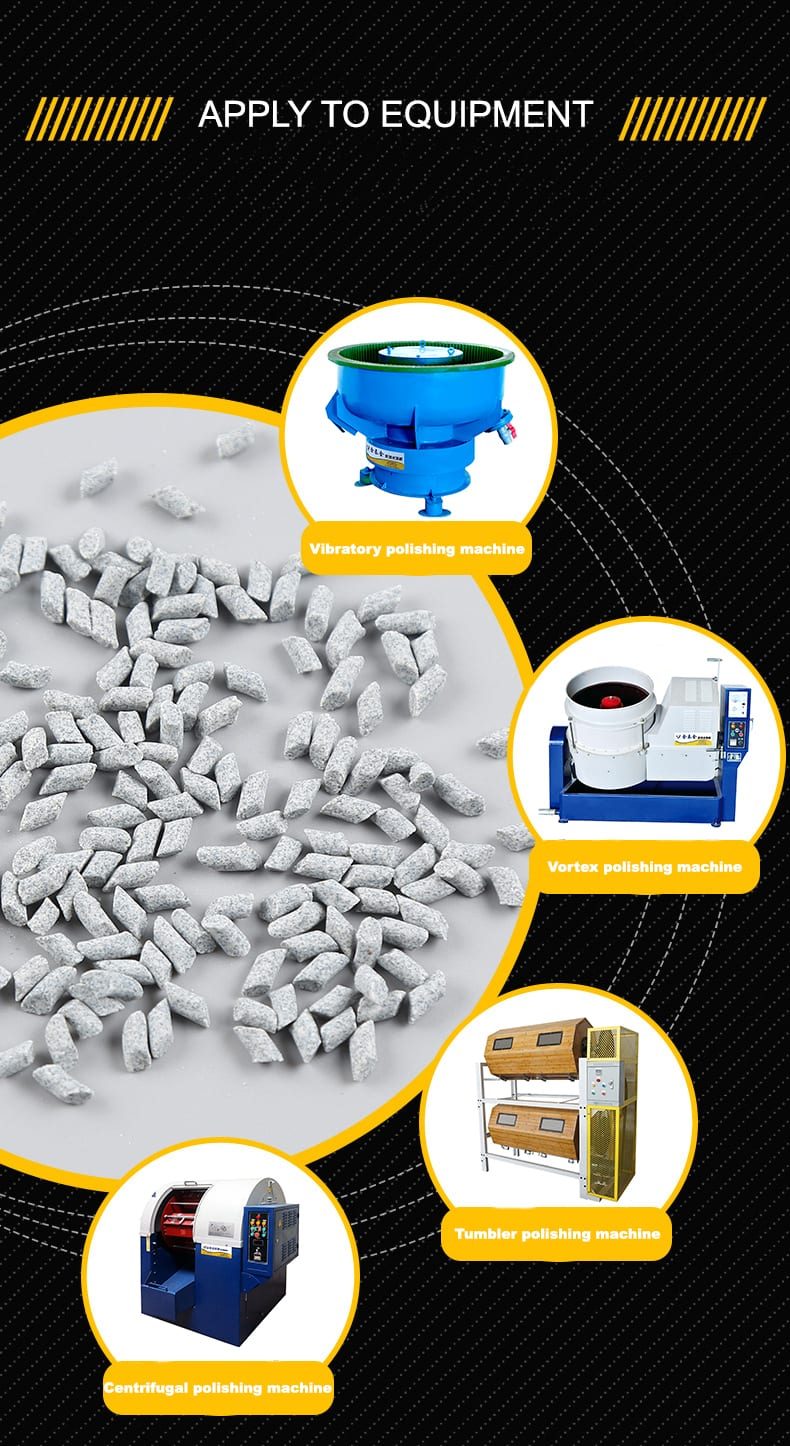
Select heavy fast-cut high-frequency ceramic grinding grades when parts arrive with thick laser-cut oxide slag, heavy stamping shear burrs, forge parting flash, or black heat-treat mill scale. Fast-cut stones bite aggressively into stubborn metal peaks, slashing Stage 1 roughing times on carbon steel and tough 316 stainless steel.
General-Purpose Ceramic: Everyday CNC Burr Removal and Edge Radiusing
General-purpose high-frequency ceramic balances brisk burr removal with smooth, predictable wear across everyday CNC-milled brackets, cross-drilled manifolds, and precision fasteners—holding edge radii safely inside blueprint tolerances while delivering a clean uniform satin base.
Fine-Cut Ceramic: Low-Ra Satin Prep Before Plating or Burnishing
When raw parts already carry clean machined finishes with light micro-burrs—or immediately after a fast-cut roughing pass—fine-cut ceramic grinding grades erase coarse cutter ridges (Rz) smoothly so Stage 2 high-alumina or 304 stainless ball burnishing reaches mirror clarity rapidly.
Choosing Non-Lodging Geometry Alongside Each Cut Grade
Always verify non-lodging clearance independently of abrasive grade: use angle-cut cylinders when round bolt holes dominate, tri-star shapes when flat washers stick or curved ribs appear, and angle-cut triangles for open ninety-degree pockets. Review our non-lodging media sizing guide and angle-cut ceramic cylinders guide.
| Ceramic Grade Tier | Primary Abrasive / Matrix | Best Starting Part Condition | Resulting Finish & Ra Role |
Compatible SurfacePolish Machine |
|---|---|---|---|---|
Fast-Cut High-Frequency |
Coarse silicon carbide / friable bond | Laser dross, weld spatter, heavy burrs | Rapid burr & scale strip; open matte | ZL bowl / LLF120 / ZXL trough |
General-Cut High-Frequency |
Balanced aluminum oxide / vitrified bond | Standard CNC steel, stainless, titanium | Uniform edge radius & everyday satin | ZL bowl / ZXL / LLF120 |
Fine-Cut High-Frequency |
Fine micro-grit / dense vitrified bond | Light CNC burrs or post-fast-cut leveling | Tight low-Ra pre-plate / pre-burnish |
ZL bowl / LLF120 / ZXL |
Stage 2 High-Alumina |
Non-abrasive iron-free porcelain | Clean Stage 1 leveled surfaces | Specular mirror compression (no cut) | ZL bowl / LLB50 disc / ZXL |
| Resin Plastic Cones (Non-Ferrous) | Polymer binder + mild grit | 6061 aluminum, brass, zinc die castings |
Bruise-free pre-anodize satin | ZL / LLB50 disc / ZXL |
Machine & Chemistry Pairing (LC10, MC8, JTS5) Across Cut Grades
Tuning Wet Flow-Through Chemistry for Fast-Cut vs. Fine-Cut Stones
Fast-cut ceramic grinding grades shed greater volumes of abraded metal swarf and fractured ceramic silt per hour than fine-cut stones. Maintain strong single-pass clean water flow paired with metered compound-LC10 (or acidic MC8 strictly on isolated carbon-steel descaling lines, and JTS5 for thin stamped steel washers) routed into a multi-baffle settling tank so coarse grit silt never recirculates back into the bowl. See our mass finishing compounds guide and compound for steel guide.
Mandatory Upstream Alkaline Pre-Degreasing Before Fine-Cut Runs
Fine-cut vitrified bonds feature tighter surface porosity that glazes shut almost immediately if oily CNC parts bypass upstream alkaline degreasing. Always wash oily batches first so clean water and LC10 keep abrasive faces open.
Pairing Fast-Cut vs. Fine-Cut Grades With ZL Bowls, ZXL Troughs, and LLF120 Barrels
Standard ZL circular bowls handle general and fine-cut ceramic runs economically, while long shafts and rails ride safely in ZXL and L1300–L1800 divided troughs. When ultra-hard tool steels or aerospace titanium brackets take too long in circular bowls, running general or fine-cut ceramic inside an LLF120 planetary centrifugal barrel multiplies sliding force cleanly without requiring overly coarse, scratch-prone grit. Explore our centrifugal barrel finishing machine guide and divided trough vibratory finisher guide.
Protecting Polyurethane Bowl Liners From Coarse Fast-Cut Abrasion
Coarse fast-cut ceramic grinding grades abrade polyurethane bowl ribs and discharge dams noticeably faster than smooth fine-cut stones. Inspect liner thickness weekly, maintain healthy working media fill lines, and schedule timely polyurethane bowl liner replacement before steel backing exposes.
Two-Stage Cut-to-Finish Workflows and Heated 35A/70A Drying

When Tough Parts Benefit From Sequential Fast-Cut + Fine-Cut Stages
Heavy forged steel arms or rough laser-cut brackets needing mirror stainless or pre-chrome smoothness often finish fastest in two sequential wet stages: a crisp fast-cut cycle to erase heavy burrs and heat-treat scale rapidly, followed by a clean fine-cut high-frequency (or Stage 2 high-alumina / 304 stainless ball) pass to erase Stage 1 scratch depth cleanly.
Clean Spray Rinsing and Immediate 35A/70A Centrifugal Spin-Drying
Pass deburred steel and stainless parts across the vibratory separator screen beneath a filtered clean-water spray bar to strip away all loose abrasive silt, then transfer wet batches straight into a heated 35, 35A, 70, or 70A centrifugal spin-dryer—adding dry corncob or walnut shell (8#-80#) buffing when zero water spots are required. Review our centrifugal dryer guide and pneumatic separation screen deck guide.
Multi-Shift Screening, Color Segregation, and Troubleshooting

Keeping Fast-Cut, Fine-Cut, and Alloy Bins Strictly Segregated
Never dump leftover fast-cut coarse stones into a fine-cut satin finishing bowl—even a handful of coarse silicon-carbide stones leaves random deep scratches across an entire batch of precision parts! Maintain color-coded totes, scoops, and separator screens by both cut grade and alloy (carbon steel vs. stainless/titanium), and run weekly fragment screening to purge worn chips. Review our media screening and replenishment SOP.
| Ceramic Grade Issue | Likely Root Cause | Immediate Correction | Preventive Standard |
|---|---|---|---|
| Deep random scratches in fine-cut batch | Coarse fast-cut stone mixed into bowl | Purge contaminated bed; scrub bowl & screen | Color-code totes & scoops by cut grade |
| Slow burr removal on thick laser dross | Grade too fine or overly hard bond | Step up to fast-cut silicon-carbide grade | Qualify cut grade on raw sample burrs |
| Smooth glazed stones mid-week | Oily CNC parts or starved LC10 flow |
Pre-degrease batch; hot LC10 strip flush |
Upstream alkaline wash + single-pass flow |
| Corner bruising on aluminum or brass | Ceramic used on soft non-ferrous alloy | Switch Stage 1 to resin-bonded plastic cones | Restrict ceramic strictly to steel/titanium |
| Over-radiused sharp blueprint edges | Overly coarse grade or excess timer | Step to fine-cut grade; shorten cycle time | Verify edge-break specs on sample trial |
Standardizing Grade Selection Across Multi-Shift Production
Qualifying Edge-Break and Ra Targets on Raw Sample Blanks
Never guess ceramic grinding grades from catalog descriptions alone. Running raw stamped or CNC blanks through physical trials lets engineers measure exact Ra reduction, chamfer radius consistency, and burr clearance across ZL bowls and LLF120 barrels before committing to pallet stock.
Matching Working Fill Lines and Tumbler Media Ratio to Cut Speed
Even the sharpest fast-cut silicon-carbide ceramic slows down if worn attrition drops the bowl bed below its working fill gauge. Top up fresh stones daily and preserve a healthy tumbler media ratio around heavy steel manifolds so rolling shear stays steady across every shift.
Auditing Bottom Drain Grates and Settling Tank Clarity
Coarse fast-cut grades generate heavy metallic swarf that settles quickly inside bottom bowl drain slots. Brush drain grates open at every shift start and clean multi-baffle settling tank compartments weekly so clean single-pass LC10 water keeps pores sharp.
Documenting Approved Cut Grades on Shop Work-Order Travelers
Record exact stone geometry, cut grade (fast-cut, general-cut, or fine-cut), compound flow rate, and cycle timer directly on each part traveler so second- and third-shift operators never substitute unapproved grades.
Factory Capabilities & Verified Ceramic Media Supply
Founded in 1992, Xiamen Jin Tai Jin Grinding Technology Co.,Ltd. (SurfacePolish) engineers and manufactures 21 machine platforms backed by 24 granted Chinese IP rights and more than 200,000+ solutions across certified facilities (ISO 00726Q01571R001, CE M.2023.206.C88121, and CE M.2023.206.C88120). Alongside ZL circular bowls, ZXL/L1300–L1800 divided troughs, LLF120/LLB50 centrifugal finishers, OBD-30..100 magnetic polishers, and 35/35A/70/70A dryers, we supply graded high-frequency ceramic grinding grades (fast-cut, general-cut, and fine-cut across cylinders, triangles, and tri-stars), iron-free high-alumina spheres, resin plastic cones, 304 stainless balls, corncob, walnut shell (8#-80#), and LC10/MC8/HM3/JTJ/JTS5 compounds. Standard machines ship in 25–35 days and custom lines ship in 45–60 days. Send sample raw parts to surface-polish.com for complimentary grade selection and Ra validation. Honest boundaries apply: we do not supply loose dry sandblasting grit, hobby rock-tumbler kits, or electroplating baths.
Frequently Asked Questions About Ceramic Grinding Grades
What is the main difference between fast-cut and fine-cut ceramic grinding grades?
Fast-cut ceramic grinding grades use coarser silicon-carbide or sharp aluminum-oxide grain inside a freer-breaking vitrified bond to strip heavy laser dross, mill scale, and thick CNC burrs quickly, whereas fine-cut grades use finer abrasive inside a denser bond for smooth low-Ra satin leveling.
Can fine-cut ceramic grinding grades produce a mirror polish on stainless steel?
No. Even fine-cut abrasive ceramic leaves a clean uniform satin matte surface. To achieve true mirror luster, rinse Stage 1 parts thoroughly and run Stage 2 non-abrasive 304 stainless balls (JTJ60) or iron-free high-alumina spheres (HM3).
Which ceramic grinding grade works best for 6061 aluminum or brass parts?
None—avoid vitrified ceramic stones on soft 6061 aluminum, brass, copper, and zinc because heavy ceramic density bruises corners and leaves an orange-peel surface. Choose lightweight resin-bonded synthetic plastic cones or pyramids with compound-LC10 instead.
How do I keep fine-cut ceramic stones from glazing smooth?
Pre-degrease oily CNC parts in an upstream alkaline wash, brush bottom bowl drain grates daily, and run continuous single-pass clean water with metered compound-LC10 into a multi-baffle settling tank.
Can I mix fast-cut and fine-cut ceramic stones in the same vibratory bowl?
Never mix fast-cut and fine-cut grades in one tub; coarse fast-cut stones scratch surfaces faster than fine stones can level them, destroying surface uniformity. Keep grades strictly separated in color-coded bins.
Do fast-cut ceramic grinding grades wear polyurethane bowl liners faster?
Yes. Coarser abrasive grit and sharper bond breakdown abrade polyurethane wall ribs faster than fine-cut stones or smooth high-alumina spheres, making weekly liner checks and healthy working media fill levels essential.
When should I switch from circular bowls to LLF120 centrifugal barrels?
When tough hardened steel or aerospace titanium parts require faster burr removal without jumping to an overly coarse scratch-prone grit, LLF120 planetary centrifugal barrels accelerate general or fine-cut ceramic cleanly.
How can I verify the right ceramic grinding grade before ordering bulk pallets?
Send representative raw production parts along with your target Ra and edge-break tolerances to surface-polish.com for complimentary lab testing; our engineers compare fast-cut, general, and fine-cut grades directly on your parts and return finished samples before you order.
How does media wear rate compare between fast-cut and fine-cut ceramic grinding grades?
Fast-cut silicon-carbide ceramic grinding grades use a freer-breaking vitrified binder that sheds dulled grain faster to expose fresh sharp cutting points, meaning weekly top-up weights are higher than dense fine-cut aluminum-oxide stones that wear slowly while producing tight satin Ra.
Can compound-MC8 accelerate cutting inside a fast-cut carbon-steel ceramic bowl?
Yes, when carbon-steel parts arrive covered in heavy black heat-treat mill scale or red rust, dosing acidic MC8 in an isolated ferrous fast-cut ceramic line strips oxide film rapidly so abrasive grit bites straight into base steel rather than sliding over hard scale.
Why should I inspect 35A and 70A centrifugal dryer baskets after running fast-cut ceramic?
Worn fast-cut ceramic slivers that slip past separator screens can ride into heated 35A or 70A centrifugal spin-dryers and scratch finished steel housings during spin-up; wiping dryer baskets clean weekly protects surface quality cleanly.
What happens if I load long stamped steel rails into a circular bowl with fast-cut ceramic?
Long rails bend or collide end-to-end inside open circular bowls regardless of ceramic cut grade. Route long ferrous profiles strictly into ZXL or L1300–L1800 divided troughs where lane dividers protect part geometry throughout Stage 1 cutting.
How does single-pass LC10 water flow affect fast-cut vs. fine-cut ceramic performance?
Because fast-cut silicon-carbide ceramic grinding grades shed greater volumes of abraded metal swarf and fractured grit silt, maintaining brisk single-pass LC10 clean water flow into a multi-baffle settling tank is essential to keep pores open and prevent dull grey oxide smearing across precision stainless and carbon-steel parts.
Should I screen worn fast-cut ceramic chips more frequently than fine-cut stones?
Yes. Because fast-cut bonds fracture faster to expose fresh sharp cutting grain, undersized fragments accumulate sooner across weekly shifts. Running weekly classification screening across your vibratory separator screen removes shrinking chips before they wedge in bolt holes and keeps working fill lines consistent.
Can JTS5 compound help prevent thin stamped washers from sticking to fine-cut ceramic?
Yes. Thin flat steel washers and shims often stick via surface tension against smooth fine-cut ceramic faces; dosing compound-JTS5 with generous single-pass water breaks flat capillary cling cleanly.
How do I transition cleanly from fine-cut ceramic into Stage 2 mirror burnishing?
Pass finished Stage 1 parts beneath a clean-water spray rinse bar across the separator deck, inspect blind pockets to ensure zero loose abrasive dust remains, and transfer batches via dedicated Stage 2 totes into high-alumina spheres or 304 stainless balls.
Why do fast-cut and fine-cut ceramic grinding grades require separate separator screen decks?
Using a single shared vibratory separator screen without thorough washdowns lets coarse silicon-carbide fragments ride backward into fine-cut satin batches, causing deep random scratches across finished stainless housings. Keeping color-coded screens and catch baskets per cut grade guarantees uniform surface finish across shifts.
How does counterweight lead-angle tuning interact with ceramic grinding grades?
Raising motor counterweight lead angles boosts kinetic rolling impact for fast-cut burrs, while lowering lead angles lets fine-cut stones glide smoothly over delicate edges without over-radiusing blueprint chamfers. Always qualify both stone grade and motor angle together on raw sample parts, and document approved settings directly on the work-order traveler so second- and third-shift operators reproduce identical Ra finishes consistently across every production batch.
 +86-592-2381506


 IPv6 network supported
