
Ra Surface Finish Chart: Matching Vibratory Media, Compounds, and Cycles to Blueprint Ra Targets
An Ra surface finish chart turns abstract arithmetic-average roughness numbers on a CAD drawing into an actionable sequence of abrasive media, liquid compounds, and tumbling cycles. Whether your plant finishes stamped automotive brackets, 6061 aluminum housings, or 304 stainless surgical hardware, selecting the wrong starting media wastes machine hours or damages delicate tolerances. SurfacePolish (Xiamen Jin Tai Jin Grinding Technology Co.,Ltd.) calibrates every roughness step using our 200,000+ verified finishing trials so engineers can match incoming baselines directly to predictable Ra outcomes.
Understanding Ra on Engineering Drawings Before Tumbling
Arithmetic average roughness (Ra) calculates the mean vertical deviation of microscopic peaks and valleys across a standardized stylus evaluation length. Because Ra averages every point equally, it provides a clean, stable metric for monitoring steady production drift across CNC milling, turning, stamping, and mass finishing lines. However, achieving a lower Ra number always depends on the starting depth of upstream tool marks—not just running a polishing cycle longer.
Why Incoming Tool Marks Dictate Total Ra Cycle Time
Deep lathe feed grooves, coarse end-mill scallops, and laser-cut striations require mechanical shearing before smooth burnishing can occur. Loading rough machined parts directly into fine plastic media or 304 stainless steel balls merely polishes peak crests while leaving deep valleys untouched, stalling Ra well above target. Always match Stage 1 abrasive aggression to the worst incoming raw blank rather than the best sample in the bin.
What Ra Captures—and What Rz and Rq Catch Instead
While Ra tracks overall surface smoothness reliably, it averages out isolated scratches, un-leveled forging pits, and part-on-part collision dings. Two batches can record identical Ra values even though one displays crisp mirror clarity and the other shows hazy directional streaks or scattered Rz outliers. Pairing your Ra chart with surface roughness measurement gates for Rz and RMS surface finish Rq protects both sealing integrity and cosmetic uniformity.
Translating Ra Chart Tiers into Real Machine Energy
Lower Ra targets demand progressively finer surface shear paired with cleaner chemical lubrication and gentler mechanical cushioning. Heavy steel castings tolerate high-impact ZL and ZXL bowl agitation or LLB50/LLF120 centrifugal barrels, whereas soft brass, zamak, and thin-wall aluminum housings require lighter plastic media or controlled rotary barrel tumbler speeds so parts never bruise while stepping down the Ra ladder.
Ra Chart Tier |
Typical Raw Baseline | Primary Goal | Stage 1 Media & Compound | Stage 2 Media & Compound | Expected Visual Appearance |
|---|---|---|---|---|---|
Coarse Deburr (N9–N10) |
Foundry scale, heavy stampings | Strip burrs & thermal scale | Fast-cut ceramic media + MC8 / LC10 |
Rinse + 35A/70A centrifugal dry |
Clean matte, rounded edges |
Standard Machined (N7–N8) |
Milling scallops, turned flats | Level tool marks uniformly | Medium-cut ceramic media + LC10 |
Optional plastic media refine |
Uniform satin isotropic matte |
Precision Fine (N5–N6) |
Fine CNC finish, extruded profiles | Tight Ra & low Rz scatter |
High frequency ceramic or fine plastic media |
Non-abrasive plastic media + JTJ50 |
Smooth low-glare semi-satin |
Pre-Plate / Pre-Anodize (N4) |
Die-cast zamak, 6061 aluminum |
Zero directional lines | Resin plastic media + HM3 |
Fine plastic media + clean rinse |
Bright, pore-free satin base |
Mirror Burnish (N1–N3) |
Pre-leveled 304 stainless / brass |
Specular cold-worked gloss | Fine plastic media + JTJ25 |
304 stainless ball + JTJ60 or corncob (8#-80#) |
Deep, distortion-free mirror |
Mapping Your Ra Surface Finish Chart to Ceramic, Plastic & Ball Media
Stepping down the Ra surface finish chart cleanly requires pairing each roughness band with the correct media bond, density, and geometry. Jumping too aggressively creates peening dimples on soft metals, while starting too fine stalls productivity for hours. Use a disciplined two-stage or three-stage progression tailored to your alloy family.
Stage 1 Rough Leveling with Ceramic Media (N7–N10)
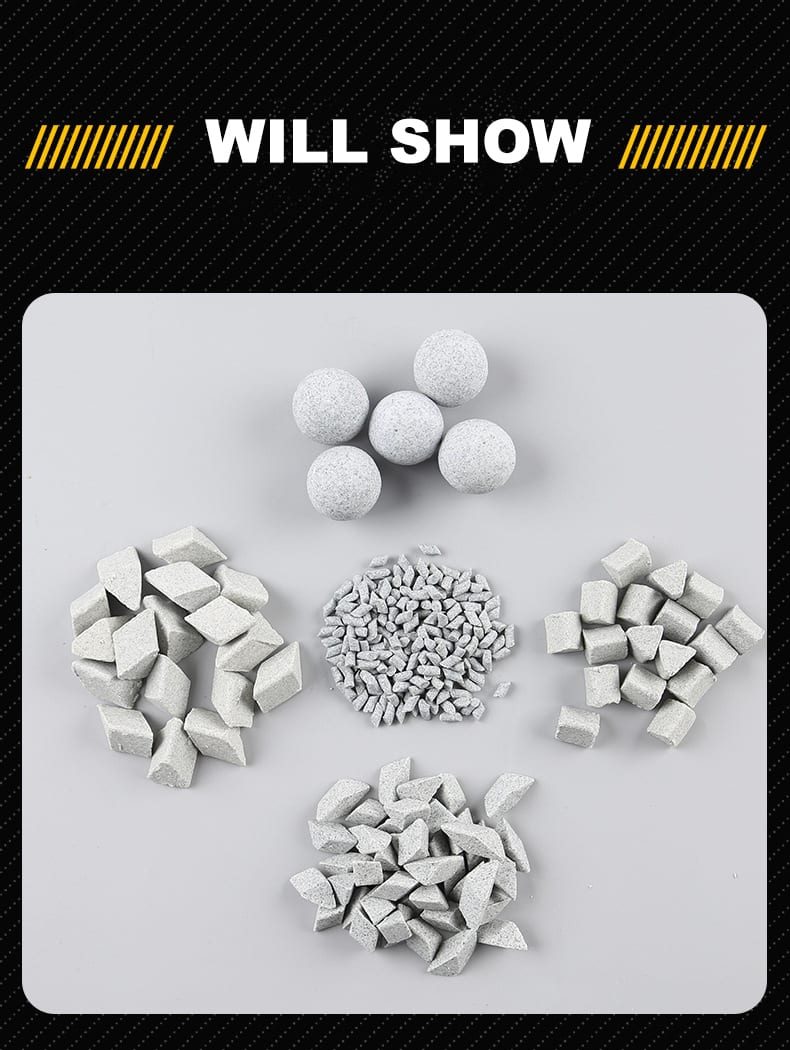
Sharp aluminum-oxide and silicon-carbide ceramic media cuts away stubborn machining burrs, weld spatter, and coarse CNC ridges quickly. Choose fast-cut ceramic triangles or angle-cut cylinders for heavy steel and cast iron, or switch to high-density high frequency ceramic formulations when leveling precision stainless parts with minimal edge rounding. Periodic media screening and replenishment removes undersized wedges before they lodge inside slots or stall circulation.
Stage 2 Pre-Plate Smoothing with Resin Plastic Media (N4–N6)
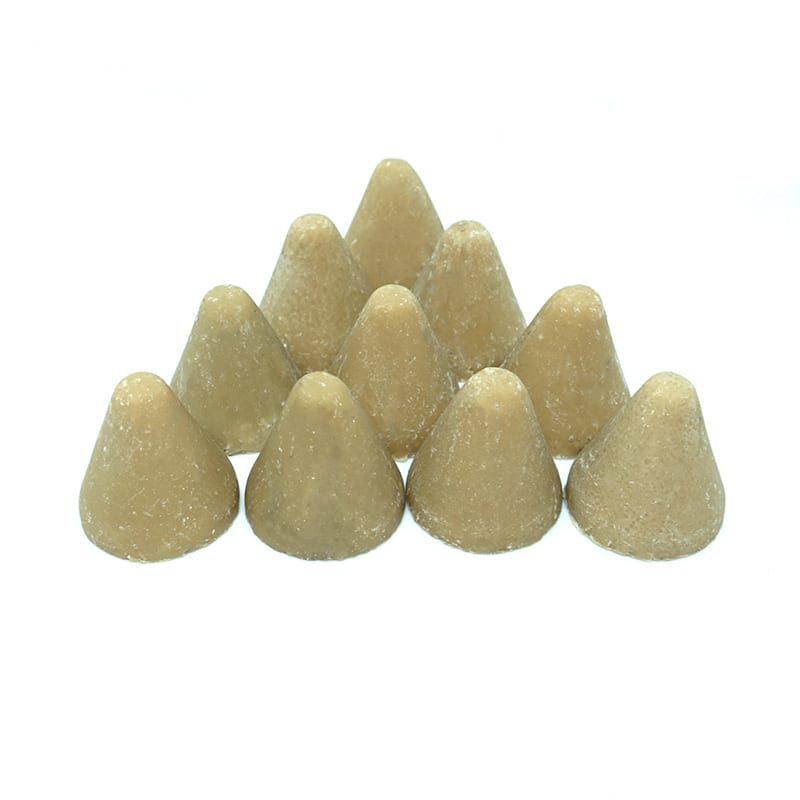
Once burrs and coarse tool marks are gone, transferring parts into resin-bonded plastic media cones or pyramids erases remaining ceramic scratch marks smoothly. Because plastic media weighs roughly half as much as dense ceramic stones, it cushions 6061 aluminum, brass, copper, and zamak castings against impact bruising while stepping Ra down cleanly into N4–N6 pre-plate readiness. Verify non-lodging media sizing across every hole diameter before loading production batches.
Stage 3 Cold-Work Burnishing with 304 Stainless Balls & Dry Organics (N1–N3)
Reaching mirror-class N1–N3 finishes requires non-abrasive burnishing rather than further abrasive cutting. Dense 304 stainless steel balls paired with JTJ60 or JTJ20 soap film glide over pre-leveled metal plateaus, cold-forging microscopic peaks down into high-gloss reflectivity without removing dimensional stock. For delicate brass, plated hardware, or water-sensitive parts, dry corncob and walnut shell (8#-80#) beds buff surfaces cleanly after heated drying.
Controlling Compound Chemistry, Water & Machine Dynamics for Stable Ra
Even the best abrasive media fails to hit blueprint Ra targets if dirty shop water, starved dosing pumps, or foamy bowls cushion cutting action. Chemical lubrication and machine amplitude govern how consistently media shears peaks across multi-shift runs. Locking down these variables keeps lot-to-lot Ra variance razor tight.
Matching LC10, MC8, HM3, JTJ50 & JTJ60 to Each Ra Tier
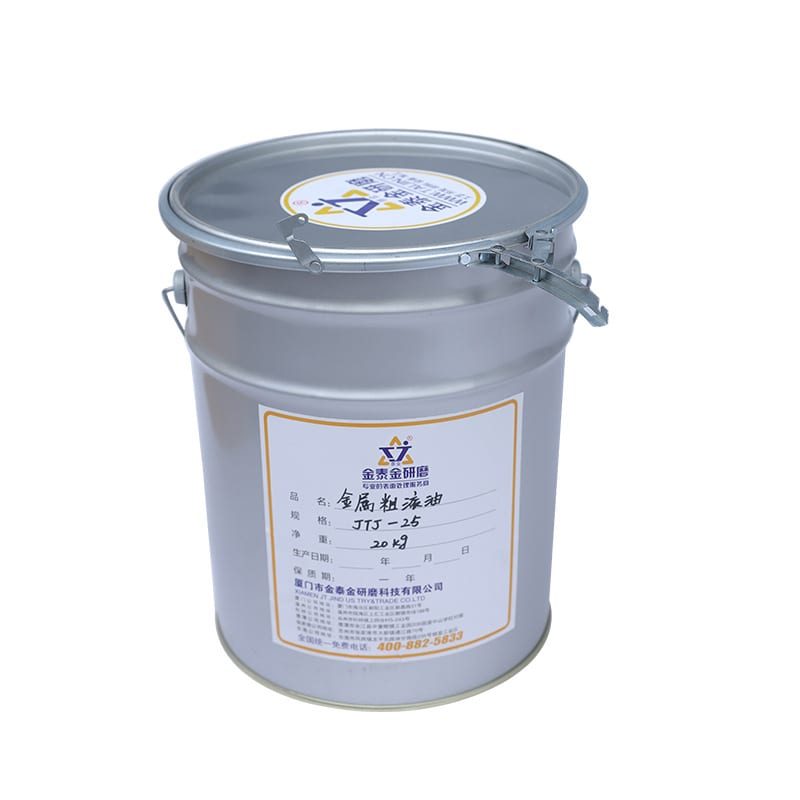
Selecting the right compound ensures active abrasive exposure and clean surface metallurgy at every chart tier. Run LC10 for general steel deburring, MC8 for rapid oxide and heat-treat scale purging, HM3 for bright non-ferrous copper/brass/aluminum protection, and JTJ50 or JTJ60 for fine smoothing and mirror ball burnishing. Automating feed rates via peristaltic compound dosing eliminates manual bucket-pouring swings across shifts.
Flow-Through Water Control & Foam Prevention
Hard shop water reacts with alkaline cleaners to coat ceramic media in gummy soap scum, driving ceramic media glazing that freezes Ra reduction mid-cycle. Maintain steady flow-through rinsing alongside softened supply water per our water hardness in mass finishing checklist so abraded metal fines flush continuously out the drain. Balanced drainage also prevents thick foam blankets from dampening shear inside fast vibratory finishing machine bowls.
Selecting ZL/ZXL Bowls vs. LLB50/LLF120 Centrifugal Barrels
Standard ZL round bowls and ZXL straight-wall tubs excel at continuous, gentle N6–N8 smoothing and large welded or cast structures where part-on-part separation is critical. For compact hardened steel, carbide, or titanium components requiring ultra-fast leveling down to N4–N5, LLB50 and LLF120 centrifugal barrel finisher machines deliver high-G shear that slashes cycle times dramatically.
Avoiding Common Ra Failures Across Metal Alloys & Post-Tumble Handling
Material metallurgy and post-tumble handling determine whether freshly achieved Ra readings survive intact until final customer assembly. A recipe validated on 304 stainless steel can smear zamak zinc or corrode carbon steel within hours if chemistry or drying protocols slip. Tailoring workflows by alloy protects surface integrity end-to-end.
Upstream Ultrasonic Cleaning & Post-Tumble Centrifugal Drying
Machining coolants, drawing oils, and polishing pastes insulate burrs from LC10 wetting and contaminate porous ceramic media within minutes. Pre-cleaning oily blanks in an ultrasonic cleaner strips hidden oil films from blind bores before parts ever enter Stage 1 bowls. After final rinsing, transfer batches immediately into a heated 35A or 70A centrifugal dryer—together with inhibitor protection per our rust inhibition after wet tumbling guide on steel—so water spots or flash rust never spike finished Ra.
Preventing Stray Grit Carry-Over & Part-on-Part Collision
Carrying even one fractured Stage 1 ceramic chip into a Stage 2 304 ball bowl ruins mirror Ra lots with deep random scratches. Enforce dedicated color-coded totes for Stage 1 versus Stage 2, inspect bowl liners via our polyurethane bowl liner replacement guide, and uphold strict media-to-part volume ratio loading so heavy workpieces never strike one another in the mass.
Calibrating Stylus Traces & Visual Master Boards on the Line
Because handheld stylus profilometers measure tiny evaluation tracks, operators should sample multiple orientations across machined flats and curved shoulders—never just one polished highlight spot. Mount laminated setup cards beside each ZL, ZXL, LLB50, and LLF120 unit listing media grade, compound dial, water flow, cycle timer, and Ra release limits alongside sealed master visual witness coupons.
Selecting Ra Targets by Application: Sealing, Plating, Anodizing & Wear
Not every engineering blueprint demands mirror-smooth N2 reflectivity; over-finishing functional surfaces wastes machine capacity and can even harm coating adhesion or lubrication retention. Matching each Ra chart tier to its downstream manufacturing operation optimizes both cost and component reliability.
Pre-Paint & Powder-Coat Anchor Profiles (N7–N8)
Powder coatings and industrial wet paints bond best over clean, uniform matte anchor textures rather than slick mirror faces. Targeting N7–N8 with medium-cut ceramic media and LC10 strips loose laser scale and sharp burrs while leaving uniform microscopic tooth for durable coating adhesion.
Pre-Anodize & Decorative Electroplate Readiness (N4–N5)
Bright anodizing on 6061 aluminum and decorative chrome plating on zamak zinc or brass magnify every lingering CNC chatter line or ceramic pit. Stepping smoothly through resin plastic media with HM3 and JTJ50 removes directional tool arcs cleanly so plated and anodized layers look uniform under showroom lighting.
Dynamic O-Ring & Hydraulic Sealing Surfaces (N3–N5)
Hydraulic valve spools and reciprocating seal lands require tight Ra control combined with low Rz peak height so sharp crests never shred elastomer seals on initial stroke. Fine plastic media followed by light 304 stainless steel ball burnishing rounds micro-peaks into smooth, low-friction plateaus.
Cosmetic Stainless Steel & Medical Hardware (N1–N3)
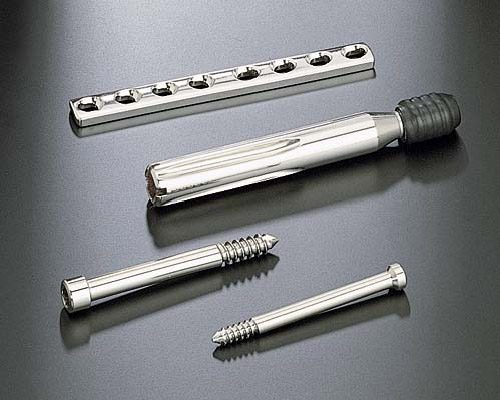
Consumer cutlery, architectural hardware, and surgical fasteners demand clean specular brightness that resists bacterial entrapment and fingerprint staining. Multi-stage high frequency ceramic leveling, fine plastic media refinement, and 304 ball burnishing with JTJ20 or JTJ60 deliver uniform mirror gloss across complex contours.
Troubleshooting Specific Ra Chart Discrepancies in Multi-Shift Operations
Even carefully engineered Ra cells experience occasional drift when water chemistry shifts, media wears undersized, or incoming machining feeds vary across batches. Structured troubleshooting isolates whether an out-of-spec reading reflects true surface roughness or a metrology/process artifact.
Diagnosing Why Ra Drops Quickly at First Then Stalls Completely
Rapid initial Ra improvement followed by a hard plateau almost always signals glazed ceramic media stones or an under-cut incoming valley depth that fine media cannot reach. Inspect media surfaces for metallic smear and run an MC8 purge or verify ceramic media glazing steps immediately.
Resolving Directional Tool Lines Remaining After Full Cycle Time
When finished parts exhibit low Ra across flat lands yet retain visible parallel milling arcs under angled inspection light, Stage 1 cutting stopped before tool troughs were fully leveled. Extending Stage 1 fast-cut ceramic or high-energy LLB50 centrifugal time erases deep cusps before Stage 2 burnishing seals plateaus.
Stopping Edge Rounding on Precision Gears & Datum Shoulders
Running oversized ceramic media or overly long cycles to force rough blanks down to N4 can wash out sharp bearing seats and thread crests. Splitting heavy roughing into a brief ceramic media deburr followed by cushioned plastic media smoothing preserves crisp edges while still hitting Ra targets cleanly.
Auditing Hard-Water Soap Scum & Foam Dampening Effects
Excessive foam inside ZL and ZXL bowls floats parts and media apart, slashing mechanical shear while leaving cloudy mineral residue on finished surfaces. Checking water hardness in mass finishing and dialing back peristaltic compound dosing restores crisp media contact and bright visual luster.
Integrating Ra Quality Gates Across Incoming, In-Process & Final Inspection
Treating Ra as a three-point process gate—rather than a single pass/fail check at shipping—keeps scrap near zero across high-volume OEM lines. Clear inspection checkpoints connect upstream machining directly to finishing bowl performance.
Auditing Incoming CNC, Stamping & Casting Baselines
Spot-check raw blank Ra and burr height whenever a new machining lot arrives from upstream cells. Catching dull end-mills or coarse lathe feeds early lets finishing leads select the right Stage 1 media grade before undersized cycles produce rework lots.
Verifying Stage 1 Leveling Before Advancing to Stage 2 Burnish
Never move parts into 304 stainless steel balls or fine JTJ50/JTJ60 bowls until visual magnification and spot Rz checks confirm raw machining marks are completely gone. Gatekeeping Stage 1 exit prevents wasted Stage 2 cycle time on un-leveled valleys.
Protecting Media Hygiene with Weekly Screening & Color-Coded Totes
Enforce strictly color-coded transfer totes between Stage 1 cutting and Stage 2 burnishing, inspect discharge screens weekly via our media screening and replenishment guide, and audit bowl ribs so stray grit never scratches mirror-bound lots.
Documenting Peristaltic Dosing & Stylus Logs for Customer Audits
Maintaining simple shift logs linking peristaltic compound dosing rates, media top-ups, 35A/70A dryer temperatures, and first-article stylus traces provides full traceability for aerospace, automotive, and medical OEM quality audits.
Protecting Ra Consistency With Upstream Ultrasonic Cleaning & Dry Buffing Control
Oily CNC coolants and drawing lubricants insulate metal peaks from LC10 and HM3 wetting, stalling Ra leveling during the critical opening minutes of every batch. Pre-washing blanks in a heated ultrasonic cleaner guarantees uniform bare-metal contact immediately. Likewise, whenever dry corncob or walnut shell (8#-80#) buffing follows wet finishing, ensure parts exit 35A/70A dryers completely dry so moisture never turns organic media into clumped mud.
Auditing Polyurethane Bowl Liners & Media-to-Part Volume Ratios
Worn polyurethane bowl ribs trap fractured Stage 1 ceramic chips that later scratch Stage 2 mirror batches and spike Ra and Rz scatter unpredictably. Inspect liners weekly via our polyurethane bowl liner replacement guide, and maintain generous media-to-part volume ratio fill levels so heavy steel or aluminum parts never collide mid-cycle. Recording media top-up dates, screen replacement intervals, and compound pump calibrations beside every machine prevents subtle mechanical drift from eroding Ra repeatability across high-volume multi-shift OEM finishing runs.
Standardizing Shift-to-Shift Operator Setup Cards & Visual Witness Samples
Mount weatherproof setup cards beside every ZL, ZXL, LLB50, and LLF120 unit listing incoming part alloy, target Ra tier, Stage 1 and Stage 2 media shapes, peristaltic compound dosing dial settings, water flow rates, and cycle timers alongside sealed master witness coupons. Clear line documentation removes recipe guesswork between day and night crews and keeps every production basket comfortably inside blueprint tolerances.
Ra Chart Problem |
Likely Root Cause | Immediate Line Fix | Long-Term Preventive Standard |
|---|---|---|---|
Ra plateaus early above target |
Glazed ceramic media or residual oil | Degrease blanks; MC8 media purge |
Upstream ultrasonic cleaner + flow-through rinse |
Passes Ra yet looks hazy/scratched |
Incomplete Stage 1 CNC valley leveling | Extend Stage 1 ceramic/plastic cut | Gate Stage 1 completion on raw-mark removal |
Soft aluminum Ra worsens in bowl |
Heavy ceramic stones bruising alloy | Swap to resin plastic media + HM3 |
Match media density to alloy hardness chart |
Random Ra outliers between baskets |
Low media-to-part ratio or grit carry-over | Increase media volume; scrub Stage 2 bowl | Color-coded totes + weekly screen inspection |
Steel Ra rises during bin staging |
Flash oxidation from slow air-drying | Re-clean in LC10; inhibitor + 35A/70A dry |
Mandatory heated centrifugal drying post-rinse |
Factory Capabilities & Verified Mass Finishing Supply
Every Ra conversion tier and process sequence above is supported by industrial-grade equipment, engineered media, and certified quality control from SurfacePolish (Xiamen Jin Tai Jin Grinding Technology Co.,Ltd.). Our engineering team helps manufacturers translate drawing Ra callouts into turnkey, repeatable shop-floor cells grounded in 200,000+ documented finishing trials.
Turnkey Equipment, Media & Compound Integration
Across 21 machine platforms—spanning ZL and ZXL vibratory bowls, LLB50/LLF120 centrifugal barrels, rotary barrel tumbler lines, 35A/70A centrifugal dryers, and ultrasonic cleaner tanks—we supply matched ceramic media, plastic media, 304 stainless steel balls, organic corncob/walnut shell (8#-80#), and LC10/MC8/HM3/JTJ50/JTJ60 compounds from one integrated source. Single-source compatibility eliminates chemical foaming, premature media breakdown, and inconsistent surface luster across multi-shift OEM operations.
Certified Manufacturing & Complimentary Part Trials
SurfacePolish maintains ISO 00726Q01571R001 quality certification alongside CE M.2023.206.C88121 and CE M.2023.206.C88120 machine compliance, backed by 24 granted Chinese IP rights. Ship your raw machined, stamped, or cast samples with your blueprint Ra specification to our laboratory for complimentary multi-stage finishing trials, verified stylus reports, and ready-to-run production parameters.
 +86-592-2381506


 IPv6 network supported
