

Eyewear Frame Polishing in Production: Mass-Finishing Lines for Acetate, Plastic, and Metal Frames
Eyewear manufacturing demands a tactile, skin-safe gloss across thousands of delicate frames per week—without snapping thin temple arms, rounding nose-bridge bevels, or tangling metal hinges together. Unlike heavy steel hardware, eyewear frame polishing splits into three distinct production lines based on frame material: acetate frame polishing, plastic eyewear finishing (TR90, polycarbonate, and injected nylon), and metal eyeglass frame tumbling (titanium, stainless steel, and nickel-silver wire).
Running all three materials through one generic tumbler scratches clear lenses, warps heat-sensitive temples, and tangles soldered bridges into scrap. This guide lays out the dedicated machines, bamboo and wood media, and dry/wet polishing creams used across industrial eyewear plants. For broader machine naming, see finishing machine names and acrylic polish.
Why Eyewear Frames Split Into Three Separate Finishing Lines
Every frame material fails for a completely different reason inside a tumbling chamber. Separating acetate, injected plastic, and metal frames from day one protects both finish clarity and dimensional fit.

Cellulose acetate frames require cool, dry multi-stage tumbling
Cellulose acetate sheet frames leave CNC routing with sharp step edges, saw marks, and matte faces. Acetate softens if barrel friction overheats and swells if left soaking in aggressive wet chemistry. Dedicated dry bamboo and hardwood barrel tumblers—such as ventilated dry-polishing drums—keep barrel temperatures cool while stepping acetate from coarse cut-down to optical gloss without warping thin temples.
Injected plastic frames need gentle wet smoothing before dry gloss
Moulded TR90, nylon, and polycarbonate frames carry fine parting lines and gate marks rather than deep CNC steps. Aggressive dry cutting smears soft injected polymers, so plastic eyewear finishing relies on controlled wet plastic polishing machines to erase parting lines cleanly before gentle dry brightening in conditioned walnut or corn cob media.
Metal eyeglass frames tangle unless mounted on racks
Loose-tumbling soldered stainless, titanium, or monel wire rims in an open bowl twists delicate temple hinges, bends nose-pad arms, and tangles frames into knots. Metal eyeglass frame tumbling uses specialized rack-mounted wet and dry barrels that hold every frame apart while media flows smoothly across weld joints and solder fillets.
Why cloth wheel buffing stays a touch-up step, not the batch engine
Hand-buffing every bevel and hinge recess on a spinning cotton wheel takes minutes per frame and fatigues operators quickly. Automated barrel finishing smooths virtually the entire frame uniformly across batches, leaving only minimal final inspection or selective hand touch-up. We do not sell cloth buffing wheels or solid wheel wax bars—we build the automated barrel and rack machines.

Line 1: Acetate Frame Polishing (Dry Bamboo & Hardwood Barrels)
Acetate frame polishing is a multi-stage dry tumbling sequence built around wooden pegs, bamboo granules, and graded polishing creams.
| Acetate Stage | Objective | Typical Media & Action | Barrel Design Advantage |
|---|---|---|---|
| 1. Coarse Cut-Down | Erase CNC router ridges and sharp bevel edges | Coarse-cut hardwood/bamboo pegs + coarse paste | Ventilated bamboo/wood drum lowers barrel heat |
| 2. Intermediate Smoothing | Remove coarse peg scratches; soften touch | Medium-grade wood pegs + intermediate cream | Steady cascading flow without chipping thin bridges |
| 3. Fine Brightening | Build deep, smooth optical lustre | Fine bamboo/wood pegs + fine acetate cream | Clean dry sheen across inner rims and temples |
| 4. Final Gloss & Clean | Lift mirror-clear presentation; strip oil film | Clean dry organic media + final finishing cream | Ready for hinge assembly and inspection |
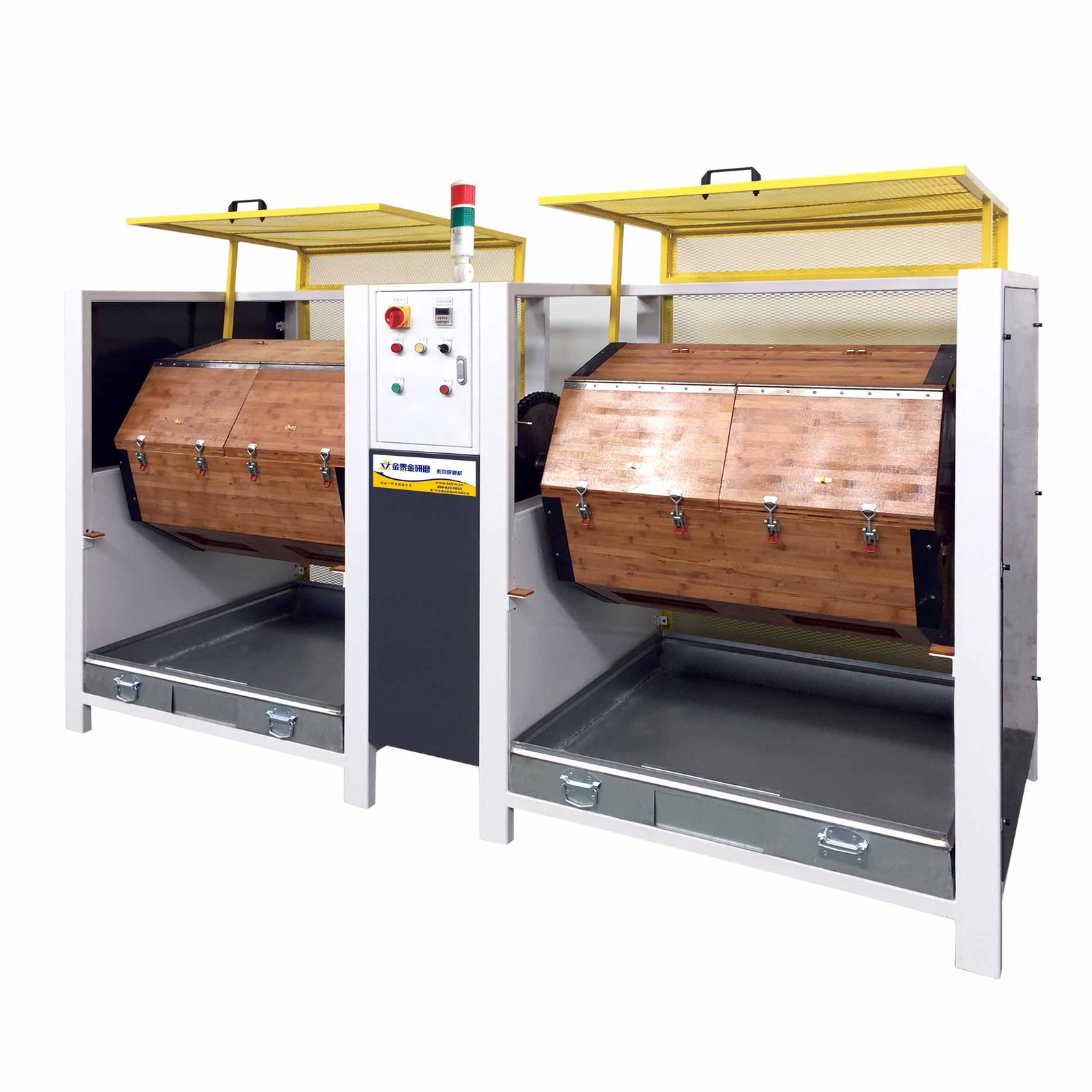
Why ventilated bamboo and wood barrels prevent acetate heat warp
Traditional sealed steel drums trap friction heat during long acetate frame polishing runs, causing thin temple tips to bow or soften. Ventilated bamboo-slat and wood-lined dry polishing barrels—such as our BLG400 and BLG200 dry-polishing series (covered under CE Vertical M.2023.206.C88121)—let warm air escape continuously while reducing polishing-cream consumption and shortening overall cycle times. Cool airflow keeps sculpted cellulose acetate frames flat and distortion-free.
Multi-stage wood pegs and bamboo media conditioning
Never dump raw acetate polishing paste directly onto dry frames; raw paste smears into thick clumps inside hinge slots and nose-bridge grooves. Always pre-blend coarse, medium, or fine paste into the wood pegs or bamboo media alone until every peg is evenly coated and dry to the touch. Keeping separate drums dedicated to coarse, medium, and fine stages avoids cross-scratching bright frames and preserves optical clarity.
Protecting sharp keyhole bridges and bevels
Over-running coarse cut-down pegs rounds crisp keyhole bridges and blurs sculpted brow-line facets. Inspect sample frames at scheduled intervals during initial setup so each batch moves to intermediate smoothing as soon as CNC router lines disappear, leaving bevels sharp and touch-friendly. Controlled stage timers preserve designer bevel geometry across entire production runs.
Avoiding alcohol or harsh solvents on acetate frames
Just like machined PMMA in acrylic polish, stressed cellulose acetate crazes or turns cloudy if wiped with acetone or strong alcohol cleaners. Keep frames dry, use dedicated acetate polishing creams, and remove light dust with clean dry air or mild detergent compatible with cellulose acetate frames before final hinge assembly.
Line 2: Plastic Eyewear Finishing (Wet PLC Barrels & Dry Brightening)
Injected plastic eyewear finishing pairs programmable wet smoothing with clean spin drying and gentle dry brightening so soft polymers never smear or lose mould detail during batch finishing.

Programmable wet polishing machines for parting lines
Moulded plastic frames carry fine flash along mould parting lines that must be smoothed without melting soft nylon or polycarbonate. Programmable wet barrel machines—such as our BJ160B and BJ200 series—use touch-screen PLC controls, water lubrication, and fine plastic or resin media to erase parting lines evenly while keeping the polymer cool across every batch. Water flushing carries away fine plastic swarf so it never embeds back into soft frames.
Clean rinsing and centrifugal drying before dry barrels
Pulling wet injected frames out of a wet barrel and dropping them directly into dry wood pegs or corn cob ruins the dry media charge immediately by clumping granules into sticky paste. Rinse wet-smoothed frames thoroughly in clean water and dry them completely—using a heat centrifugal spin dryer (35, 35A, 70, or 70A models) or clean warm air—before entering dry brightening. See post-finishing separate wash and dry for proper stage separation.

Gentle dry brightening for injected polymers
Once bone-dry, injected plastic frames move into a dry organic barrel dressed with fine polishing cream to lift clean surface lustre. Keep batch load conservative so lightweight plastic frames stay cushioned inside the media bed rather than banging against drum walls or scratching clear temple cores. Consistent media cushion protects delicate moulded hinges and thin nose pads.
Handling matte vs glossy plastic eyewear specs
Many modern plastic frames specify a uniform velvety matte finish rather than high gloss. For matte eyewear, stop after controlled wet plastic smoothing (or light fine-media conditioning) and skip high-gloss dry brightening altogether so surface glare stays low and even. Matching stage exit to the exact finish spec eliminates unnecessary rework.
Line 3: Metal Eyeglass Frame Tumbling (Rack Wet & Dry Barrels)
Metal eyeglass frame tumbling solves the hardest geometry problem in eyewear: cleaning weld scars, flux, and machining marks on delicate wire rims without bending a single frame.

Rack-mounted wet tumbling for weld scars and deburring
After metal rims, bridges, and endpieces are brazed or laser-welded, joints carry dark flux residue, weld beads, and sharp burrs. Specialized rack wet-tumbling machines (CJS480A, CJS320, CJG480A, CJG320 series—all covered under CE Vertical M.2023.206.C88121) mount metal frames onto removable racks inside rotating water-and-media barrels so delicate rims never collide or bend. Frames stay rigidly separated on racks while media flows evenly around every solder joint and hinge.
Rack-mounted dry polishing for final metal frame lustre
Once weld scars are smoothed and frames are rinsed dry, rack dry-polishing barrels finish metal frames in conditioned dry organic media and fine metal polishing cream. Keeping frames mounted on racks throughout dry polishing prevents delicate titanium or stainless wire rims from tangling or scratching against neighbouring frames while lifting clean lustre. Rack-mounted dry tumbling delivers uniform metal lustre across soldered bridges and temple hinges.

Magnetic and vibratory options for metal hinges and nose-pad arms
Small loose metal eyewear components—hinge barrels, temple cores, screw sleeves, and nose-pad arms—do not need full-frame racks before assembly. Loose components run efficiently in circular vibratory bowls (ZL series) with plastic or ceramic media, or in magnetic precision polishers (OBD / HBPG series) for cleaning tiny hinge bores and threads without rounding outer edges. See magnetic tumbler for cleaning non-magnetic stainless and titanium micro-hardware.
Honest scope: no electroplating, PVD, or lacquer coating
After metal eyeglass frame tumbling, stainless, titanium, and nickel-silver frames leave our machines as clean, bare mechanical metal ready for downstream electroplating, PVD vacuum coating, or clear lacquer by your plating vendor. We do not offer electroplating, PVD coating, anodizing, passivation, or clear-coat sealing—and we do not operate a contract job shop or accept frames for paid finishing.
Consumables: Wood Pegs, Bamboo, Walnut, and Eyewear Creams
Even the best eyewear barrel fails if dressed with the wrong media size or greasy wheel wax. Match consumables strictly to frame material and stage.
| Consumable Item | Frame Material Fit | Stage Role | Key Shop-Floor Rule |
|---|---|---|---|
| Hardwood & Bamboo Pegs | Acetate frames | Coarse cut-down to fine dry smoothing | Keep separate peg sizes/grades per barrel stage |
| Resin-Bonded Plastic Media | Plastic & metal frames | Wet parting-line and weld-scar smoothing | Match cone size to bridge/rim clearances |
| Walnut Shell & Corn Cob | Acetate, plastic & metal | Final dry brightening & oil/cream absorption | Confirm corn cob mesh grade when ordering |
Wet Liquid Compounds (JTJ60, JTS5, HM3) |
Metal frames & micro-hinges | Wet lubrication, weld-cleanup support, brightening | Never run wet metal barrels in plain tap water |
| Dry Polishing Creams / Pastes | Acetate, plastic & metal | Dry barrel cut-down and final lustre | Pre-blend into media alone before loading frames |

Separating acetate, plastic, and metal media charges
Never share wood pegs or walnut shell between metal eyewear frames and clear or tortoiseshell acetate frames. Microscopic titanium or stainless dust embedded in organic media immediately scratches soft acetate and clouds transparent frames. Dedicate colour-coded media bins strictly to each eyewear material line.

Screening out broken pegs and dust before loading
Worn wood pegs splinter into fine dust that packs inside hinge recesses, while broken plastic cones wedge inside narrow rim grooves and screw holes. Screen your media charge regularly and refresh dry organic media once it turns dark grey or loses crisp brightening speed. Clean, well-screened media keeps frame surfaces clear of swirl haze.
Verified Jings Polish compounds for metal eyewear hardware
For wet metal eyeglass frame tumbling and loose hinge deburring, pair ceramic or plastic media with verified liquid compounds such as compound-LC10 (deburring), compound-JTJ20 (coarse stainless), compound-JTJ50 (stainless brightening), compound-JTJ60 (fine metal polishing), compound-JTS5 (thin-sheet/delicate metal polishing), and compound-HM3 (final polishing). We supply liquid compounds for wet media systems and dry pastes for tumbling, while never designing custom chemical cleaning formulas.
Avoiding solid cloth-wheel wax bars inside barrels
Never drop solid buffing-wheel wax bars into wet or dry eyewear barrels. Solid wax bars need high-speed wheel friction to melt evenly; inside tumbling barrels, they clump onto pegs and pack sticky residue into hinge knuckles and nose-bridge grooves.
Common Eyewear Frame Polishing Mistakes—and Fixes
Avoid these four shop-floor traps when running eyewear frame polishing across high-mix frame styles.
[DESIGN: Troubleshooting matrix showing four eyewear polishing defects: heat-warped acetate temple, tangled loose metal rims, greasy cream packed in hinge slots, and scratched clear frames from contaminated media]
Loose-tumbling assembled metal frames without racks
Dropping soldered metal frames loose into a standard bowl twists nose-pad arms and snaps brazed bridges within minutes, creating bent scrap that no hand pliers can fix cleanly. Always use rack-mounted wet and dry barrels (CJS / CJG series) for assembled metal frames, and keep loose tumbling strictly for small unassembled hinge parts and screws.
Overheating acetate barrels by running overloaded drums
Packing too many acetate frames into an unventilated drum traps friction heat, warping thin temples and dulling edges across the whole batch. Use ventilated bamboo/wood barrels (BLG400 / BLG200) and keep media-to-frame volume generous so frames stay cool and cushioned throughout every stage.
Moving wet frames straight into dry brightening barrels
Damp frames clumped into dry wood pegs or corn cob turn the entire charge into muddy paste that coats frames in hazy residue. Always rinse clean and dry thoroughly in a centrifugal spin dryer (35 / 70 series) or warm air dryer before loading dry barrels.
Skipping pre-blending of dry polishing creams
Squeezing dry cream directly onto frames leaves heavy wax streaks inside engraved temple logos and hinge slots, forcing tedious manual cleanup. Always run the cream with dry media alone first until evenly distributed across every granule.
How Xiamen Jin Tai Jin Builds Eyewear Finishing Lines
At Xiamen Jin Tai Jin Grinding Technology Co.,Ltd. (brand: Jings Polish), our workshop started in 1992 and our company was formally established in 2002, delivering over 200,000+ sets of grinding and polishing solutions to customers worldwide. Across our catalogue and machines portfolio, we manufacture 21 machine platforms backed by 24 granted Chinese IP rights—including 1 invention patent, 17 utility model patents, and 6 design patents—under ISO 9001 certification 00726Q01571R001 (valid 2026-06-03 to 2029-06-02) and CE certifications M.2023.206.C88121 (Vertical, 8 models, including CJS480A, CJS320, CJG480A, CJG320, BJ160B, BLG400, BLG200) and M.2023.206.C88120 (Horizontal, 13 models), valid until 2028-07-24.

Complete eyewear equipment, media, and cream lines we build
We manufacture dedicated finishing lines for all three eyewear verticals—Acetate Products (BLG400, BLG200 dry bamboo/wood barrels), Plastic Products (BJ160B PLC wet polishing machines), and Metal Products (CJS480A, CJS320, CJG480A, CJG320 rack wet/dry barrels, plus ZL vibratory bowls and OBD / HBPG magnetic polishers for loose hinges). We also supply wood pegs, bamboo, resin plastic media, dry finishing media, grinding media, heat centrifugal spin dryers (35, 35A, 70, 70A), and verified compounds/creams for multi-stage production.
Honest boundaries on what we do not offer
In accordance with our choosing a mass finishing supplier checklist, we state our boundaries plainly before quoting any equipment. We do not operate a contract job shop or polish customer eyewear frames for hire; we do not offer electroplating, PVD coating, anodizing, or clear-coat lacquer spraying; we do not sell cloth buffing wheels, solid wheel wax bars, or handheld buffers; and we do not design custom chemical cleaning formulas.
Standard and custom build lead times
Standard eyewear barrel, wet polishing, and drying equipment ships within a 25 to 35 day production lead time once specifications are confirmed. Custom-engineered rack fixtures, multi-barrel lines, and specialized separation setups carry a 45 to 60 day build lead time to manufacture and test.
Requesting an initial assessment from frame photos
We do not promise free mail-in sample trials or guarantee cycle times before inspecting your frames. Send clear close-up photos of your acetate, plastic, or metal eyewear frames showing CNC/mould/weld marks, bridge geometry, overall frame dimensions, and daily frame volume via our custom polishing solution page—our engineers can recommend the right machine line and media sequence from photos and drawings, including alongside job shop finishing and barrel finishing machines.
Frequently Asked Questions
What machine is best for acetate frame polishing without warping?
A ventilated dry-polishing barrel tumbler with bamboo or wood drums (such as our BLG400 or BLG200 series) is the standard choice for acetate frame polishing, because ventilation prevents heat buildup while wood pegs and bamboo step frames cleanly from CNC marks to optical gloss without distorting thin temple arms or sculpted brow lines.
Why do plastic eyewear frames need wet polishing before dry brightening?
Injected TR90, nylon, and polycarbonate frames soften and smear under aggressive dry friction. Controlled wet polishing inside a programmable barrel (BJ160B series) erases mould parting lines and gate flash coolly before gentle dry organic brightening in conditioned media.
How do you tumble metal eyeglass frames without tangling hinges and bridges?
Use specialized rack-mounted wet and dry tumbling barrels (CJS480A, CJS320, CJG480A, CJG320 series) that hold every metal frame separated on mounting racks while media flows smoothly around weld joints, nose-pad arms, and rims without bending delicate wire shapes.
Can I use the same wood pegs for both metal frames and acetate frames?
No. Metal frames shed microscopic alloy dust into wood pegs and walnut shell, which scratches soft cellulose acetate and clouds clear frames instantly. Keep separate colour-coded media charges strictly for acetate, plastic, and metal lines across every shift.
How do I keep polishing cream from packing inside eyewear hinge slots?
Never squeeze dry polishing cream directly onto frames inside a barrel. Pre-blend the cream with dry wood pegs, walnut shell, or corn cob media alone until evenly coated and dry to the touch before loading frames.
What photos should I send before ordering an eyewear frame polishing line?
Send clear photos of your raw and target-finished frames showing CNC steps, parting lines, or solder joints, frame material (acetate, injected plastic, titanium, or stainless), overall frame dimensions, and daily frame output. Our engineers can recommend the right machine and media setup from photos and drawings before quoting.
[DESIGN: Annotated buyer enquiry checklist showing eyewear frame close-ups, hinge/bridge geometry, and daily frame volume notes]
 +86-592-2381506


 IPv6 network supported
