
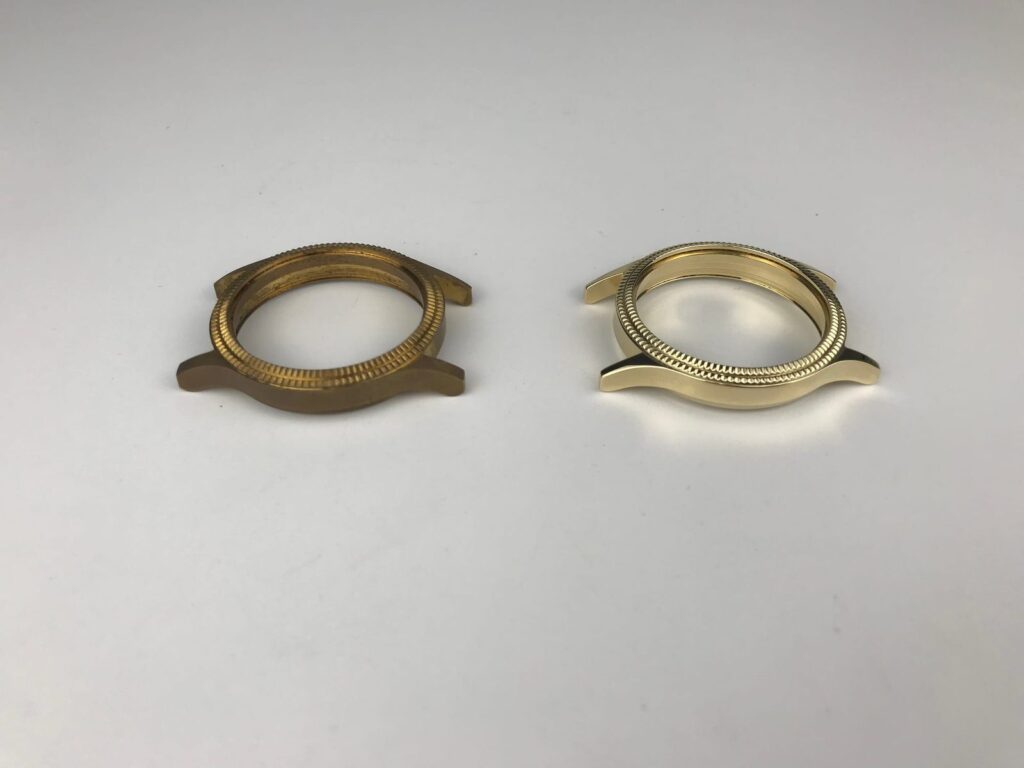
Finishing Gold and Silver in Production: Choosing Mass-Finishing Chambers Over Harsh Dips
When a jewellery plant, watch-case maker, or precious-metal hardware shop scales beyond one bench, finishing gold and sterling silver stops being a hand-wheel exercise. Every gram of gold dust swept into an exhaust hood or etched away by an aggressive chemical silver polish dip cuts straight into material margin. At the same time, cast rings, filigree links, and stamped findings carry tight undercuts where no cloth wheel can reach.
This guide covers batch finishing gold and silver workflows using industrial mass-finishing chambers—magnetic pin polishers, centrifugal disc machines, and dry organic barrel tumblers—while separating true production equipment from household gold polish creams and chemical dips. For broader equipment naming across our catalogue, see finishing machine names and copper alloy finishing.
Why Gold and Silver Require Different Finishing Rules
Precious metals are soft, dense, non-magnetic, and expensive per gram. Every rule used for steel deburring changes when the workpiece is karat gold or fine silver.

Minimizing precious-metal stock loss during smoothing
Cutting steel with aggressive ceramic triangles removes metal quickly and nobody weighs the swarf. In finishing gold, every micro-gram shaved off a casting stays trapped in dirty compound water unless recovered. Production shops rely on gentle plastic cut-down media, non-abrasive burnishing balls, and magnetic stainless pins that compress surface peaks rather than grinding bulk metal away.
Reaching under prongs, filigree, and hollow links
Investment-cast rings, hollow chain links, and watch bezels hide rough casting skin inside gallery cutouts and under stone prongs. Pressing a spinning cloth wheel against those recesses rounds delicate claws while leaving inner corners dull. Mass-finishing pins and fine tumbling media flow inside filigree cutouts without distorting outer setting geometry.

Why silver tarnishes faster than gold during wet runs
Fine and sterling silver react readily with sulfur, chlorides, and residual moisture, turning grey or yellow if left wet after tumbling. Gold resists oxidation, yet copper-rich rose and yellow alloys still stain if rinsed poorly. Using clean, non-corrosive liquid compounds and drying parts immediately in a spin dryer prevents post-cycle tarnish.
Benchtop studio tumblers versus industrial production units
Compact tabletop tumblers sold for single-bench studios are a different product class built for light artisan runs, not inferior—they simply serve small craft volumes. Industrial workshops running daily production lots step up to heavy-duty floor machines—such as our HBPG-01, HBPG-02, OBD, LLF120, and multi-barrel dry tumblers—engineered for repeatable batch separation, cooling, and shift reliability.
Four Industrial Routes for Finishing Gold and Silver
Across our machines portfolio, four chamber routes handle precious-metal castings, stampings, and decorative hardware. Each serves a distinct stage between raw sprue removal and final presentation.
| Finishing Route | Media & Action | Best Precious-Metal Stage | Metal-Loss Risk |
|---|---|---|---|
Magnetic Precision Polisher (OBD / HBPG) |
Fine stainless steel pins driven by rotating magnets | Post-cast cleanup, filigree brightening, prong recesses | Very low — pins peen and clean without grinding |
Centrifugal Disc / Barrel (LLF / LX) |
High-G rotation with fine resin-bonded plastic or porcelain | Smoothing investment-cast skin and light sprue marks | Low to moderate — controlled by plastic media grade |
Vibratory Bowl (ZL Series) |
Gentle spiral tumbling in polyurethane-lined chamber | Larger batches of silver hardware, buckles, flatware | Low when paired with plastic cones or high-alumina balls |
| Dry Organic Barrel Tumbler | Crushed walnut shell or corn cob with polishing paste | Final warm lustre, oil removal, and mirror sheen | Virtually zero — pure dry burnishing |

Magnetic precision polishers for filigree and castings
Both gold and silver are non-magnetic, making them ideal candidates for a magnetic precision polisher (HBPG-01, HBPG-02, OBD-30 through OBD-100). Fine stainless steel pins swirl inside water and liquid compound, slipping directly under stone settings, inside ring shanks, and through chain links. Magnetic finishing brightens intricate castings evenly without rounding sharp bezel edges.
Centrifugal disc machines for rapid sprue-area smoothing
Investment castings carry micro-porosity and light texture that magnetic pins alone cannot level. A centrifugal disc machine (such as our LLF120 series) from our barrel finishing machines and disc line drives fine resin-bonded plastic media smoothly across cast surfaces. Centrifugal disc action levels casting skin uniformly while keeping delicate prongs intact.
Vibratory bowls for larger silver hardware and flatware
Sterling silver spoons, belt buckles, religious medallions, and heavy decorative fittings need open-bowl capacity rather than compact jewellery drums. A vibratory finishing machine lined with smooth polyurethane cushions soft silver while tumbling parts in plastic cones or high-alumina ceramic balls. See our vibratory finishing guide for how open-bowl spiral flow prevents part-on-part nicking.
Dry barrel tumblers for final warm sheen
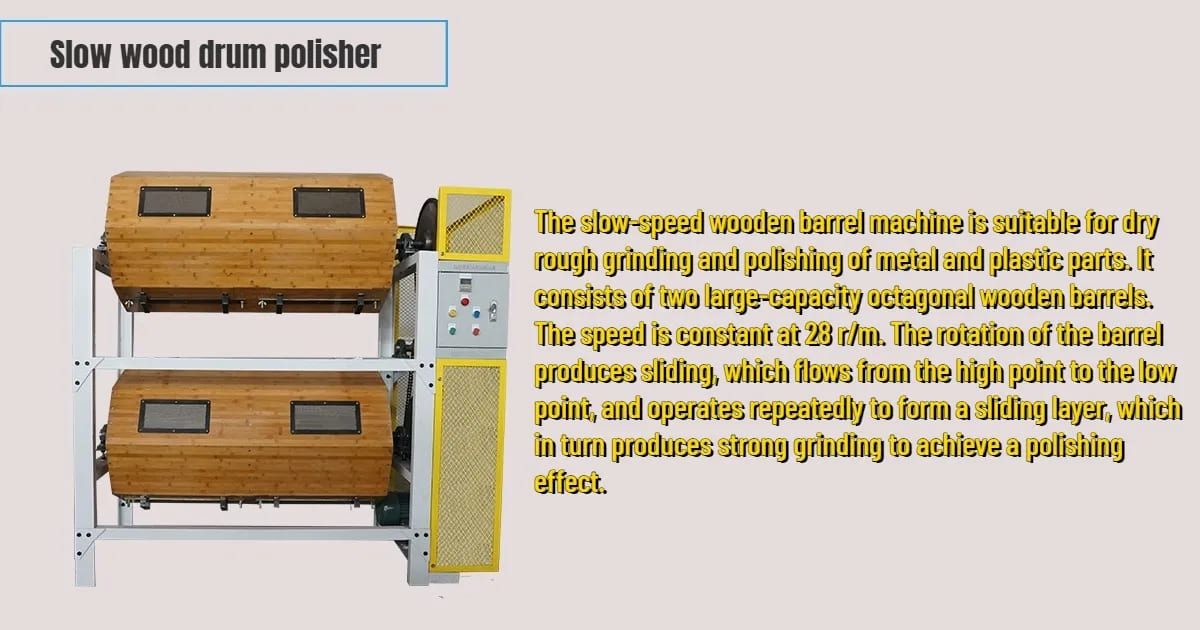
After wet smoothing and rinsing, dry barrel tumbling in crushed walnut shell or corn cob from our dry finishing media line delivers a crisp, distortion-free gold polish and silver polish sheen. Pre-blended polishing paste coats every granule evenly, buffing curved and recessed faces gently without catching prongs. Dry organic tumbling produces uniform batch lustre without manual wheel streaks.
Mass Finishing vs Chemical Dips and Cloth Buffing Wheels
Buyers searching gold polish or silver polish often compare mass-finishing chambers against liquid acid dips and stationary cloth wheels. Knowing what each method actually does protects fragile castings.
| Comparison Factor | Mass-Finishing Chamber (Magnetic / Centrifugal / Dry) | Liquid Chemical Silver Dip | Cloth Buffing Wheel & Rouge Bar |
|---|---|---|---|
| How It Works | Mechanical pin peening, plastic smoothing, or dry organic buffing | Chemical dissolution of silver sulfide tarnish | Operator presses piece against spinning cloth loaded with wax bar |
| Recess & Filigree Access | Reaches inside links, prongs, and engraved details | Reaches everywhere liquid wets, yet leaves surface etched/matte | Cannot enter tight filigree or inner ring recesses |
| Effect on Surface Texture | Smooths and burnishes metal peaks brighter | Strips tarnish only; can frost mirror surfaces if over-soaked | Pushes high mirror gloss on open outer faces |
| Our Supply Scope | We manufacture the chambers, media, and liquid compounds | Not supplied — we do not sell chemical dips or acid baths | Not supplied — we do not sell cloth wheels or solid wax bars |
[DESIGN: Side-by-side comparison of an intricate gold filigree pendant finished uniformly in a magnetic pin bath versus uneven hand-wheel access on outer edges only]
Why chemical silver polish dips are not true polishing
Supermarket silver polish dips dissolve dark silver sulfide tarnish chemically in seconds, which looks convenient on tarnished tableware. However, chemical dips never smooth scratches or brighten dull casting skin—and repeated dipping leaves a chalky, porous surface that tarnishes even faster afterward. We do not supply chemical silver dips, plating baths, electropolishing, or passivation services.
Where cloth buffing wheels still fit—and where they fail
On wide, flat gold cuff bracelets or heavy trophy plates needing maximum open-face mirror reflection, an experienced polisher on a cloth wheel delivers unmatched sheet clarity. Yet on batches of delicate rings or hollow chains, wheels snag links, round crisp facets, and leave greasy rouge packed inside settings. We do not build cloth buffing wheels, handheld buffers, or solid wax bars for cloth wheels.
Using mass finishing to cut hand-buffing time dramatically
Most mid-to-large jewellery factories combine batch chambers with minimal final touch-up. Magnetic pin cleaning and centrifugal plastic smoothing eliminate rough casting texture across the entire batch, leaving only a quick final pass—or none at all—for open flat surfaces. Automating the pre-polish and recess brightening stages multiplies output per skilled bench worker.
Keeping precious-metal dust recovery simple
Wet mass finishing traps every tiny speck of abraded gold or silver inside the compound water and drain sediment rather than blowing it into shop air filters. Settling tanks and clean filter bags let plants recover precious metal fines cleanly from rinse water. Closed wet processing protects both worker air quality and precious-metal recovery.

Media and Compounds for Gold and Silver Batches
Choosing the wrong abrasive ruins soft precious metals faster than steel. Pair our grinding media and dry finishing media carefully to your karat hardness and surface stage.
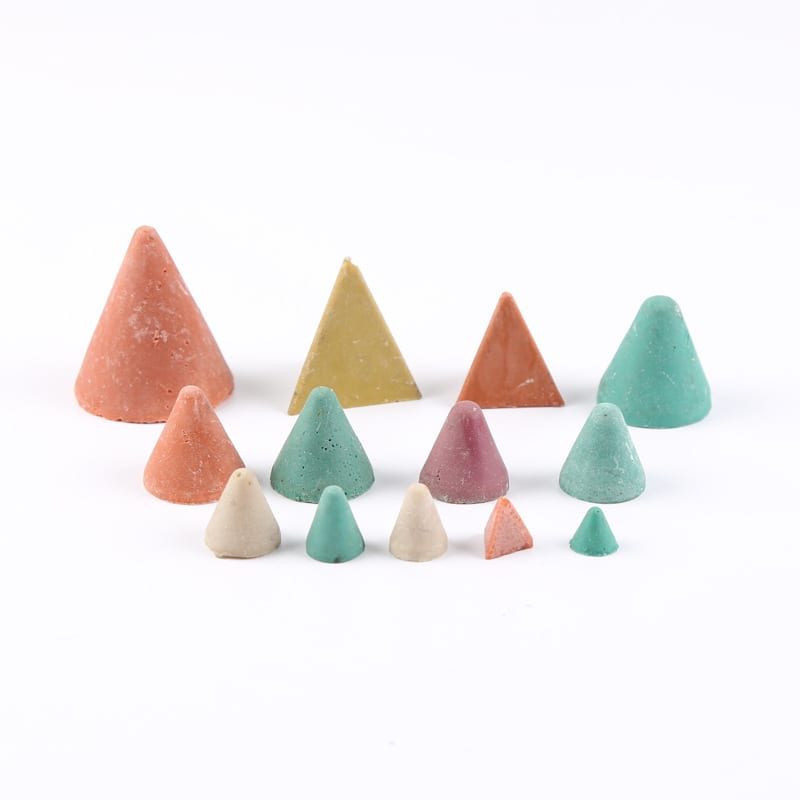
Fine resin-bonded plastic cones for casting skin
Raw castings need gentle cutting to erase investment skin and micro-step marks before any brightening begins. Fine resin-bonded plastic cones and pyramids cut smoothly without denting soft gold or silver edges. Never use coarse, heavy steel-grade ceramic triangles on thin gold castings.
High-alumina balls and stainless magnetic pins for burnishing
Once cast skin is smooth, non-abrasive high-alumina ceramic balls or fine magnetic stainless steel pins compress surface peaks into a bright, clean lustre with negligible metal removal. Magnetic pins work inside filigree and under prongs, while high-alumina balls roll gently over open curves. Burnishing media brightens metal by compressing peaks, not by grinding away stock.
Walnut shell and corn cob for final dry gold polish
For final dry brightening, crushed walnut shell and soft corn cob granules dressed with clean polishing cream lift a warm, streak-free gold polish across batches. Keep separate dedicated dry barrels for gold and silver so copper or silver fines never transfer onto high-karat white gold. Confirm corn cob mesh grade when ordering dry organic media for delicate settings.
Liquid compounds that brighten without staining
Run wet centrifugal, vibratory, and magnetic precious-metal cycles with clean water and verified liquid compounds such as compound-JTJ60 (fine metal polishing), compound-JTS5 (delicate thin-sheet finishing), or compound-HM3 (final polishing). We supply liquid compounds for wet media systems and select pastes for dry tumbling, while never designing custom chemical cleaning formulas.
Step-by-Step Batch Workflow for Finishing Gold and Silver
A consistent finishing gold line follows strict stage separation so coarse grit never contaminates final brightening barrels.
[DESIGN: Four-stage precious-metal workflow showing raw cast rings entering centrifugal plastic smoothing, magnetic pin brightening, clean spin drying, and dry corn cob finishing]
Stage 1: Sprue cleanup and ultrasonic or wash pre-cleaning
Clip sprues neatly and grind away heavy gate stubs upstream before loading any mass-finishing chamber, just as outlined in grinding and sanding marks. Wash away investment plaster residue and hand oils completely so the media bed stays clean. Leftover investment plaster scratches soft gold and clogs fine magnetic pins.
Stage 2: Gentle wet smoothing or magnetic pin cleanup
Load delicate castings into a centrifugal disc machine with fine plastic media for skin smoothing, or into a magnetic precision polisher (OBD / HBPG series) with fine stainless pins to clean recesses and bright-burnish filigree. Keep media-to-part volume generous so heavy rings never collide with each other. Test cycle time on a small batch first to protect delicate prongs and hallmarks.
Stage 3: Immediate clean rinse and centrifugal spin drying
Pulling sterling silver or rose gold out of a wet bath and leaving it to air-dry in baskets creates water spots and rapid tarnish rings. Rinse parts promptly in clean water and dry them inside a heat centrifugal spin dryer (35, 35A, 70, or 70A models). See our post-finishing separate wash and dry guide for why clean, rapid drying preserves bright metal tone.

Stage 4: Dry barrel brightening with walnut shell or corn cob
Transfer bone-dry parts into a dedicated dry rotary barrel loaded with pre-conditioned walnut shell or corn cob media and light polishing paste. Run until the surface reaches a crisp, uniform sheen, then screen media away cleanly. Never load damp parts into dry organic media, or the charge will clump and spot silver.
Common Defects When Finishing Gold and Silver—and Shop Fixes
When a precious-metal batch comes out cloudy, dinged, or tarnished, check these four shop-floor causes before changing machines.
| Defect Observed | Likely Root Cause | Immediate Check | Shop-Floor Fix |
|---|---|---|---|
| Orange-peel dimples on flat bands | Media too heavy or part-on-part collision | Inspect media-to-part volume and chip weight | Switch to lighter plastic cones or increase media cushion |
| Grey or yellowish film on silver | Spent compound, dirty water, or slow air drying | Check rinse water clarity and drying time | Flush bath, use fresh compound, and dry immediately in spin dryer |
| Stray stainless pins wedged in filigree | Pin length/diameter matches narrow setting slot | Inspect prongs and chain links under magnification | Switch pin gauge and use thorough rinse-and-screen recovery |
| Milky haze after dry corn cob tumbling | Damp parts entered dry barrel or spent organic media | Feel dry media for moisture or dark grey dust | Confirm parts are bone-dry first; replace saturated dry media |
[DESIGN: Close-up troubleshooting chart of four precious-metal defects: media bruising on a gold band, silver water-spot tarnish, wedged magnetic pin in a prong, and hazy corn cob film]
Stopping part-on-part dings on heavy rings and bangles
Heavy gold signet rings or solid silver bangles carry enough weight to dent each other inside a tumbling chamber if the media cushion is thin. Keep batch density conservative, maintain full media volume, or use compartmented barrels for heavy individual pieces. Protecting flat bands from collision marks saves hours of manual sanding.
Preventing dark tarnish spots on sterling silver
Sterling silver darkens rapidly when exposed to dirty rinse water or humid air inside wet baskets. Always rinse with clean water immediately after unloading, spin-dry completely, and store finished silver in dry, covered trays. Fast drying is the simplest defence against silver post-finish tarnish.
Eliminating wedged pins or media in chain links
Fine chain links and hollow clasp housings trap small plastic chips or magnetic pins easily. Always test media and pin dimensions against your tightest link opening before running full production. Remember that worn media shrinks over time and can wedge into openings that new media cleared.
Avoiding cross-contamination with base metals
Never finish gold or silver inside a barrel, vibratory bowl, or media charge that previously ran brass, steel, or aluminium. Embedded steel or brass dust scratches soft gold and triggers galvanic staining on silver. Dedicate separate chambers and media bins exclusively to precious metals—a core rule covered in job shop finishing.
How Xiamen Jin Tai Jin Builds Precious-Metal Finishing Lines
At Xiamen Jin Tai Jin Grinding Technology Co.,Ltd. (brand: Jings Polish), our workshop began in 1992 and our company was formally established in 2002, delivering over 200,000+ sets of grinding and polishing solutions to customers worldwide. Across our catalogue, we manufacture 21 machine platforms backed by 24 granted Chinese IP rights—including 1 invention patent, 17 utility model patents, and 6 design patents—under ISO 9001 certification 00726Q01571R001 (valid 2026-06-03 to 2029-06-02) and CE certifications M.2023.206.C88121 (Vertical, 8 models) and M.2023.206.C88120 (Horizontal, 13 models, including HBPG-01 and HBPG-02), valid until 2028-07-24.
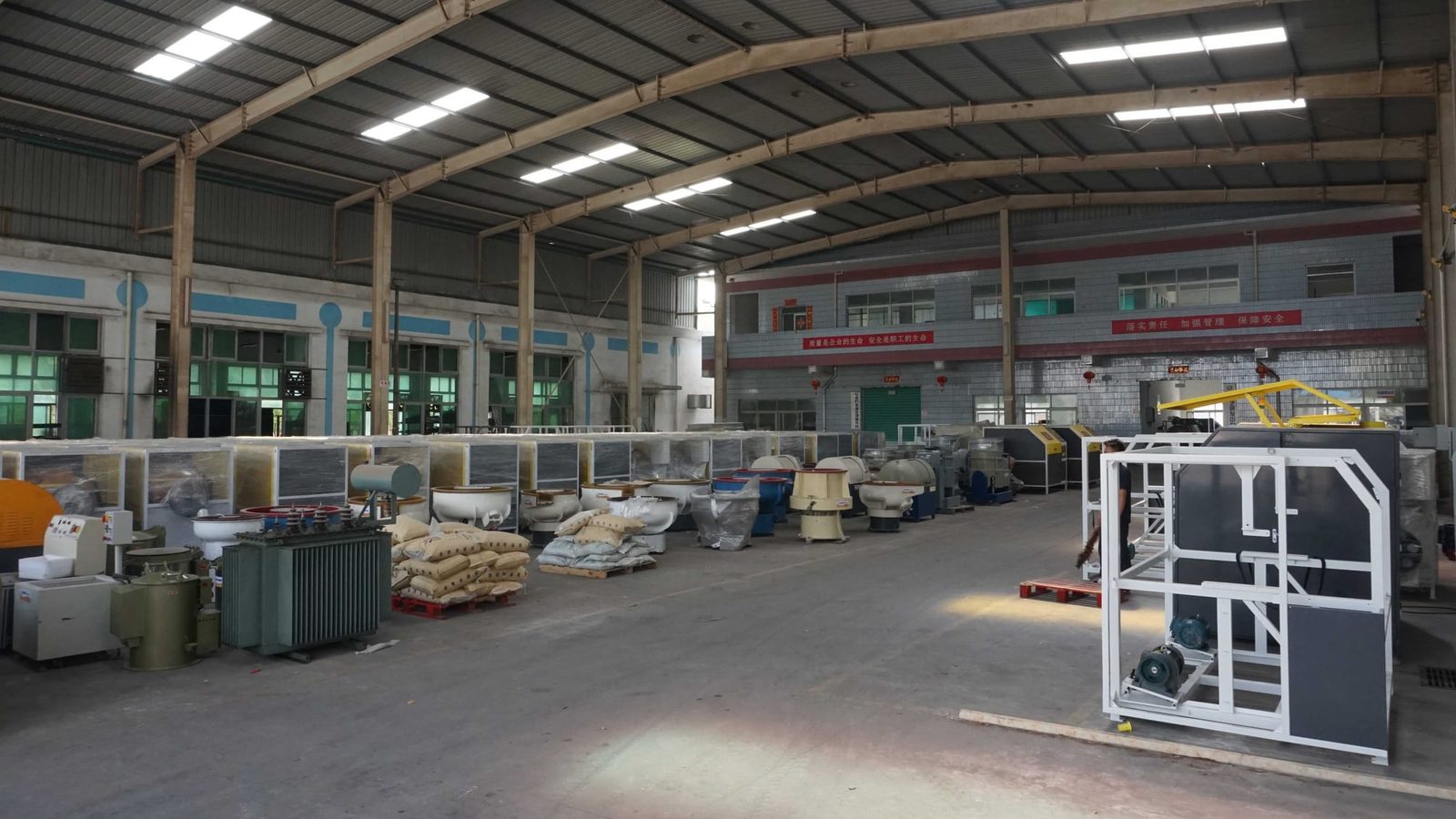
Equipment, media, and compounds we manufacture
We build magnetic precision polishers (OBD-30 through OBD-100 and OBD-HBPG / HBPG-01 / HBPG-02), centrifugal disc and barrel units (LLF120, LX series), double-barrel and double-deck dry polishing tumblers, vibratory bowls (ZL series), heat centrifugal spin dryers (35, 35A, 70, 70A), and media cleaners. We also supply resin-bonded plastic cones, high-alumina balls, walnut shell, corn cob, and verified liquid compounds (HM3, JTJ50, JTJ60, JTS5, etc.).
Honest boundaries on what we do not supply
In keeping with our choosing a mass finishing supplier policy, we state our scope clearly. We do not operate a contract job shop or polish customer gold and silver parts for hire; we do not sell cloth buffing wheels, solid rouge wax bars, handheld rotary tools, or chemical silver-dip baths; we do not offer gold plating, rhodium plating, passivation, or clear-coat lacquers; and we do not design custom chemical formulas.
Standard and custom lead times
Standard magnetic, centrifugal, dry barrel, and spin-drying equipment ships within a 25 to 35 day production lead time. Custom-configured lines and specialized multi-barrel layouts carry a 45 to 60 day build lead time.
Requesting an initial assessment with part photos
We do not promise free mail-in sample trials or guarantee cycle times without checking your workpiece. Send clear photos of your gold or silver castings, filigree openings, alloy type, and batch quantity via our custom polishing solution page—our engineers can provide an initial machine and media recommendation from photos and drawings, or help multi-material plants compare alongside aluminum finishes and stainless steel finishes.
Frequently Asked Questions
What is the best machine for finishing gold castings with intricate prongs?
A magnetic precision polisher (OBD or HBPG series) is the standard choice for intricate gold castings and filigree, because fine stainless pins swirl inside narrow recesses and under prongs without rounding outer setting edges or removing measurable gold weight.
Does a magnetic tumbler remove heavy sprue marks on gold and silver?
No. Magnetic pins clean light surface texture and lift brightness inside recesses, yet they do not grind away heavy sprue stubs or deep investment skin. Clip and dress sprues upstream, then use fine plastic media in a centrifugal disc machine before magnetic brightening.
Is chemical silver polish safe for production jewellery batches?
Liquid chemical dips strip surface tarnish rapidly, but they do not smooth scratches and can leave a porous, matte surface if over-used. Mass finishing with plastic media, magnetic pins, and dry corn cob smooths and burnishes silver mechanically without harsh acid dips.
How do I keep precious-metal loss minimal during batch tumbling?
Avoid aggressive cutting ceramic media on soft gold and silver. Use fine resin-bonded plastic cones only where casting skin needs levelling, and rely on non-abrasive magnetic pins, high-alumina burnishing balls, and dry walnut or corn cob media for brightening.
Why did my silver parts spot or tarnish right after wet polishing?
Silver spots rapidly when compound water dries slowly on the metal in open baskets. Rinse finished silver immediately in clean water and dry the load rapidly inside a heat centrifugal spin dryer (35 or 70 series) before packing.
What details should I send before ordering equipment for gold or silver finishing?
Send clear close-up photos of your castings or stampings showing filigree or hole openings, overall dimensions, alloy type, and daily batch volume. Our engineers can recommend the right chamber architecture and media grade from photos and drawings.
[DESIGN: Annotated buyer enquiry checklist showing casting close-ups, prong/filigree openings, and batch volume notes for gold and silver]
 +86-592-2381506


 IPv6 network supported
