
Glass Bead vs Aluminum Oxide Media: Separating Blasting Grit From Preformed Tumbling Media
Every week, manufacturing buyers searching for glass bead abrasive, aluminum oxide media, or glass bead vs aluminum oxide make an expensive ordering mistake: buying loose air-blast grit intended for sandblasting cabinets and pouring it into a vibratory bowl or rotary barrel. Loose blasting powder never cushions parts against collisions, blinds chamber drain screens within minutes, and turns water into abrasive mud that ruins seals.
The core thesis of this guide is simple and honest: glass bead abrasive and loose white aluminum oxide belong inside air-blast or wheel-blast cabinets—which we do not build or supply—whereas batch tumbling chambers require preformed, bonded ceramic or plastic tumbling media. This guide explains the physical difference between blasting grit and preformed aluminum oxide media, when each process fits your part, and how to select mass-finishing shapes without buying the wrong consumable. For preformed tumbling media selection, see tumbler media and finishing machine names.
Loose Blasting Grit vs Preformed Mass-Finishing Media
Before comparing glass bead vs aluminum oxide, separate the two completely different physical forms hiding behind the word "media."
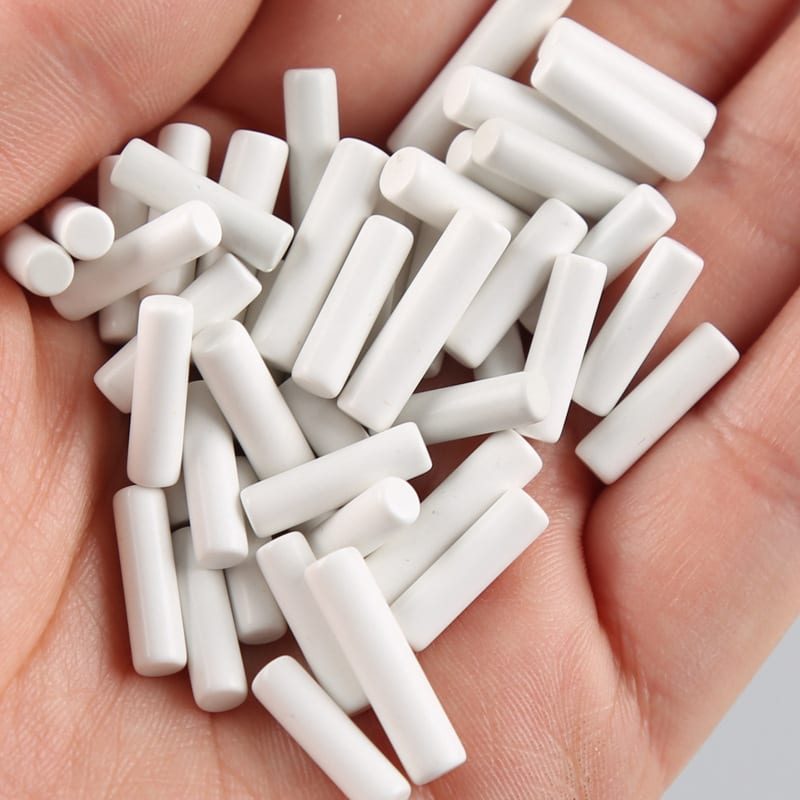
What glass bead abrasive actually does in a blast cabinet
Glass bead abrasive consists of tiny, loose soda-lime glass spheres propelled at high velocity by compressed air inside a sealed blast cabinet. Instead of cutting sharp grooves, glass beads peen the surface into a bright, uniform satin matte while cleaning light rust or heat discoloration. Glass bead abrasive is a loose pneumatic blasting consumable—never a preformed mass-finishing tumbling chip.
What loose white aluminum oxide grit does in blasting
White aluminum oxide blasting grit is sharp, angular, high-purity fused alumina powder used in air-blast rooms to etch metal, strip tough scale, or create an anchor profile before thermal spray or coating. Because every particle is a loose sharp crystal, it cuts aggressively in an airstream. Pouring loose blasting grit into a wet vibratory bowl destroys polyurethane drain screens and leaves parts nicked.
Why mass-finishing tumblers use preformed bonded ceramic shapes
Inside a vibratory finishing machine or rotary barrel, aluminum oxide media means something completely different: preformed triangles, angle-cut cylinders, cones, or spheres made by bonding fine aluminium oxide abrasive inside a ceramic or resin-bonded plastic matrix. Preformed shapes cushion parts apart, carry water and compound cleanly, and roll across edges without burying parts in mud.
Honest scope: what Xiamen Jin Tai Jin supplies—and does not supply
We state this boundary upfront so buyers never waste time requesting quotes for the wrong line: we do not manufacture sandblasting cabinets, shot-blasting machines, or loose blasting abrasives such as glass bead abrasive, garnet, or loose white aluminum oxide blasting grit. We manufacture preformed ceramic, plastic, high-alumina, steel, walnut shell, and corn cob tumbling media alongside industrial mass-finishing chambers.
Glass Bead vs Aluminum Oxide: Process Comparison Matrix
When deciding whether a part belongs in an air-blast cabinet (sourced from a blasting supplier) or a batch mass-finishing chamber, compare surface effect, edge rounding, and internal access side by side.
| Comparison Factor | Glass Bead Blasting (Loose Grit) | White Aluminum Oxide Blasting (Loose Grit) | Preformed Ceramic / Plastic Tumbling Media |
|---|---|---|---|
| Physical Action | High-velocity pneumatic peening | High-velocity sharp-crystal etching | Continuous multi-angle sliding & rubbing in chamber |
| Surface Texture | Bright, uniform peened satin matte | Rough, etched matte anchor profile | Smooth uniform matte, satin, or bright burnish |
| Deburring & Edge Rounding | Very weak — peens burrs flat without removing them | Etches edges slightly; leaves heavy burrs sharp | Strong — shears burrs and rounds corners evenly |
| Part-to-Part Throughput | Manual or indexed nozzle per piece | Manual or indexed nozzle per piece | Hundreds of small parts per unattended batch |
| Our Supply Scope | Not supplied (blasting consumable) | Not supplied (blasting consumable) | Supplied — preformed ceramic, plastic, alumina & steel |
[DESIGN: Four-panel comparison diagram contrasting air-blast peening, sharp grit etching, ceramic tumbling deburring, and high-alumina burnishing]
When glass bead blasting fits better than tumbling
If your drawing specifies a bright, non-reflective cosmetic satin on large welded stainless frames, oversized aluminium housings, or delicate thin-walled tubes that cannot tumble—or requires masking selective areas with tape—glass bead blasting inside an air cabinet is often the faster route.
When white aluminum oxide blasting fits better than tumbling
If a heavy forged steel weldment needs a deep mechanical anchor profile prior to thermal spray, heavy epoxy primer, or ceramic coating, loose white aluminum oxide blasting grit cuts a sharp etched profile far faster than wet tumbling.
When preformed tumbling media beats air blasting completely
If you run batches of stamped brackets, machined fasteners, CNC valve sleeves, or laser-cut plates that need burrs removed, sharp corners rounded, and uniform metal smooth finish without an operator holding a blast gun for hours, batch mass finishing inside a vibratory bowl or rotary barrel wins immediately. Tumbling removes burrs that air blasting only bends sideways.
Why you can never pour loose blasting powder into a vibratory bowl
Even if an operator buys a bag of glass bead abrasive or white aluminum oxide grit hoping to "polish faster" inside a vibratory bowl, the fine powder settles straight to the bottom, packs around drain screens, and fails to separate parts from banging together. Always keep loose blasting powder out of mass-finishing chambers.
Preformed Aluminum Oxide Ceramic & High-Alumina Tumbling Media
Inside our grinding media portfolio, aluminium oxide appears in two completely different preformed tumbling bodies: cutting ceramic media and non-abrasive high-alumina burnishing media.

Ceramic oxide cutting media for heavy steel deburring
Cutting ceramic media blends fine aluminium oxide or silicon carbide abrasive grains into a vitrified clay-ceramic bond, pressed and fired into triangles, angle-cut triangles, cylinders, and cones. As the ceramic wears slowly against steel burrs, fresh micro-grains expose continuously to keep cutting speed steady. Preformed ceramic oxide media shears tough carbon steel and stainless burrs cleanly without turning into mud.
High-alumina ceramic media for non-abrasive burnishing
High-alumina ceramic media (spheres and cylinders) uses dense, sintered alumina with virtually no loose cutting grit. Instead of grinding away base metal, its high weight and glassy surface compress microscopic metal peaks flat into a bright lustre—ideal for isotropic finishing and stainless steel brightening after rough burrs are already cleared.

Resin-bonded plastic cones for soft aluminium and brass
Aluminium housings, brass fittings, and zinc die-castings bruise under heavy ceramic triangles and pit if blasted with coarse steel grit. Resin-bonded plastic cones embed fine abrasive inside a lighter polymer matrix, delivering a clean, metal smooth satin finish without orange-peel bruising. See our aluminum finishes and copper alloy finishing guides for alloy-safe selection.
Matching media shape to holes, slots, and threads
Every part's smallest slot, bore, or thread dictates chip geometry. Angle-cut cylinders and acute triangles reach into narrow corners, whereas cones and pyramids resist flat-stacking and bridging across round holes. Always size preformed tumbling media against worn-chip dimensions so shrinking chips never wedge inside bores.
Step-by-Step Transition From Air Blasting to Batch Tumbling
Many fabrication shops switch from manual glass bead abrasive or white aluminum oxide blast cabinets to automated vibratory bowls to eliminate operator fatigue and airborne dust. Following these four steps makes the transition clean.
Step 1: Audit whether your print needs matte anchor profile or smooth edge rounding
Before ordering any chamber, check the engineering drawing carefully against your downstream process. If the part requires a rough anchor profile for thermal spray, heavy epoxy, or weld-seam blending, keep air blasting. If the part needs sharp burrs removed, perimeter corners rounded, or a metal smooth finish across hundreds of stamped brackets, batch tumbling is the stronger, lower-labour route.
Step 2: Match preformed media body to alloy hardness
Replace loose blasting powder with preformed shapes tailored to alloy softness: dense ceramic triangles or angle-cut cylinders for carbon steel and stainless steel, resin-bonded plastic cones for aluminium, zinc, and brass, and smooth high-alumina ceramic balls when bright non-directional burnishing is required after deburring.
Step 3: Meter liquid compound and keep drains clear
Never run preformed aluminum oxide media or ceramic chips in plain tap water, which glazes abrasive pores and flash-rusts carbon steel. Meter verified liquid compounds (MC8, LC10, JTJ20, JTJ50, JTJ60, JTS5, HM3) steadily so dislodged metal swarf flushes cleanly out the drain rather than coating finished parts.
Step 4: Screen worn media and dry parts rapidly
Inspect media size regularly over a sizing screen to discard broken fragments before they wedge in narrow slots, and dry wet-tumbled parts immediately inside a heat centrifugal spin dryer (35, 35A, 70, or 70A models) so bare carbon steel never flash-rusts in open baskets.

Pouring loose blasting grit into a vibratory bowl
Loose sandblasting grit lacks the size and mass to cushion heavy parts apart, settles into dense mud at the bowl floor, and chokes drain screens within minutes. Only load preformed, bonded tumbling shapes into vibratory or barrel machines so parts stay suspended and water drains freely.
Using coarse cutting ceramic where gentle plastic is needed
Dumping aluminium housings or brass fittings into heavy ceramic oxide triangles hammers flat surfaces into an orange-peel texture and bends thin cooling fins. Route soft non-ferrous metals strictly to resin-bonded plastic cones and neutral compounds (JTJ60, JTS5, HM3).
[DESIGN: Side-by-side comparison of bruised aluminium from heavy ceramic triangles versus smooth plastic-tumbled aluminium]
Buying media by brand-new size without checking worn size
Ceramic cutting chips shrink steadily every shift as they shear steel burrs. Always check your part's narrowest slot or hole against worn-media dimensions so aging chips never lodge inside critical bores—and screen out broken fragments regularly before loading slotted hardware.
Mixing ferrous and non-ferrous media charges
Running carbon steel brackets in ceramic media and then loading 304 stainless or aluminium parts into the same charge embeds free iron into the non-ferrous metal, causing corrosion spots later. Keep media bins strictly separated by alloy family—a core rule in job shop finishing.
Matching Chambers, Compounds, and Dryers to Preformed Media
Preformed aluminum oxide media and plastic cones only perform at peak speed when paired with the right chamber from our machines line and verified liquid compounds.
| Chamber Architecture | Best Media Pairing | Best Part Families | Key Automation Benefit |
|---|---|---|---|
Vibratory Bowl (ZL Series) |
Ceramic triangles, plastic cones, high-alumina balls | Stamped brackets, valves, hinges, flatware | Separates parts from media automatically on screen |
Rectangular Trough (L1300–L1800) |
Ceramic triangles or plastic cones with dividers | Long shafts, tubes, connecting rods, extrusions | Prevents long or heavy parts from jamming or colliding |
| Rotary Barrel Tumbler | Ceramic, plastic, or dry walnut shell / corn cob | Fasteners, forgings, brass, eyewear/acrylic | Quiet cascading pressure; multi-stage dry/wet drums |
| Centrifugal Disc / Drag Finisher | High-density ceramic or high-alumina spheres | Gears, turbine blades, compact precision hardware | Rapid high-pressure cut or zero-collision spindle finish |

Vibratory bowls and troughs for ceramic and plastic media
A vibratory finishing machine (ZL series) keeps preformed ceramic or plastic media rolling in a lively spiral, flushing dislodged metal swarf straight out the drain screen. Models with integrated separation decks (ZL100C through ZL900C) divide parts from media automatically, while long rectangular troughs (L1300, L1500, L1800) accommodate elongated bars and tubes.
Rotary barrels and centrifugal units for targeted pressure
When tough steel forgings need quiet, heavy cascading pressure, choose a drum from our barrel finishing machines line. When compact precision parts need rapid cut-down, centrifugal disc (LLF120) and centrifugal barrel machines multiply effective media weight inside sealed chambers.
Verified Jings Polish compounds for wet tumbling
Never run preformed ceramic or high-alumina media in plain tap water, which glazes media pores and flash-rusts carbon steel. Match our verified liquid compounds:
compound-MC8&compound-LC10: Rust/mill-scale stripping and heavy deburring on steel parts.compound-JTJ20&compound-JTJ25: Coarse cutting support for stainless steel and general metal smoothing.compound-JTJ50&compound-JTJ60: Stainless brightening and fine metal polishing across mixed alloys.compound-JTS5&compound-HM3: Thin-sheet precision finishing and final brightening support.
We supply liquid compounds for wet media systems and select pastes for dry tumbling, while never designing custom chemical cleaning formulas.
Rapid centrifugal spin drying after wet ceramic runs
Even clean parts pulled from wet ceramic tumbling spot or flash-rust if left wet in open baskets. Rinse finished batches promptly in clean water and dry them inside a heat centrifugal spin dryer (35, 35A, 70, or 70A models). Check our post-finishing separate wash and dry guide for clean cell layout.
[DESIGN: Heat centrifugal spin dryer unloading spot-free metal hardware immediately after wet ceramic tumbling]
Common Mistakes When Choosing Between Blasting and Tumbling Media
Avoid these four purchasing errors when sourcing glass bead abrasive or aluminum oxide media for your shop.

Pouring loose blasting grit into a vibratory bowl
Loose sandblasting grit lacks the size and mass to cushion heavy parts apart, settles into dense mud at the bowl floor, and chokes drain screens. Only load preformed, bonded tumbling shapes into vibratory or barrel machines.
Using coarse cutting ceramic where gentle plastic is needed
Dumping aluminium housings or brass fittings into heavy ceramic oxide triangles hammers flat surfaces into an orange-peel texture. Route soft non-ferrous metals strictly to resin-bonded plastic cones and neutral compounds (JTJ60, JTS5, HM3).
Buying media by brand-new size without checking worn size
Ceramic cutting chips shrink steadily every shift. Always check your part's narrowest slot or hole against worn-media dimensions so aging chips never lodge inside critical bores—and screen out broken fragments regularly.
Mixing ferrous and non-ferrous media charges
Running carbon steel brackets in ceramic media and then loading 304 stainless or aluminium parts into the same charge embeds free iron into the non-ferrous metal, causing corrosion spots later. Keep media bins strictly separated by alloy family—a core rule in job shop finishing.
How Xiamen Jin Tai Jin Supports Preformed Media & Machine Lines
At Xiamen Jin Tai Jin Grinding Technology Co.,Ltd. (brand: Jings Polish), our workshop started in 1992 and our company was formally established in 2002, delivering over 200,000+ sets of grinding and polishing solutions to customers worldwide. Across our catalogue, we manufacture 21 machine platforms backed by 24 granted Chinese IP rights—including 1 invention patent, 17 utility model patents, and 6 design patents—under ISO 9001 certification 00726Q01571R001 (valid 2026-06-03 to 2029-06-02) and CE certifications M.2023.206.C88121 (Vertical, 8 models) and M.2023.206.C88120 (Horizontal, 13 models), valid until 2028-07-24.

Preformed media, compounds, and machines we manufacture
We manufacture circular vibratory bowls (ZL series), rectangular troughs (L1300, L1500, L1800), barrel finishing machines, centrifugal disc and barrel units (LLF120, LX series), drag finishers, magnetic polishers (OBD and HBPG series), heat centrifugal spin dryers (35, 35A, 70, 70A), and media cleaners. Alongside equipment, we manufacture preformed ceramic, plastic, high-alumina, steel, walnut shell, and corn cob dry finishing media plus our verified liquid compounds.
Honest boundaries on blasting abrasives and contract work
In keeping with our choosing a mass finishing supplier policy, we state our limits plainly. We do not supply loose sandblasting or shot-blasting abrasives—including glass bead abrasive, garnet, steel shot, or loose white aluminum oxide blasting grit—nor do we build sandblasting cabinets; we do not operate a contract job shop; we do not sell cloth buffing wheels, solid wheel wax bars, or handheld grinders; and we do not offer plating, anodizing, passivation, or custom chemical formula design.
Standard and custom build lead times
Standard vibratory, barrel, centrifugal, and spin-drying equipment ships within a 25 to 35 day production lead time. Custom-engineered troughs, compartmented dividers, and integrated separation lines carry a 45 to 60 day build lead time.
Requesting an initial assessment from part photos
We do not promise free mail-in sample trials or guarantee cycle times before inspecting your workpiece. Send clear close-up photos of your parts showing burrs, surface marks, smallest slots or holes, alloy grade, and daily batch volume via our custom polishing solution page—our engineers can recommend the right preformed media and chamber setup directly from photos and drawings, or tell you honestly if air blasting fits better.
Frequently Asked Questions
Do you sell loose glass bead abrasive or white aluminum oxide blasting grit?
No. Glass bead abrasive and loose white aluminum oxide grit are pneumatic blasting consumables for air-blast cabinets, which we do not manufacture or supply. We manufacture preformed ceramic, plastic, high-alumina, steel, and organic tumbling media for batch mass-finishing chambers.
What is the difference between glass bead vs aluminum oxide in surface finishing?
In air blasting, glass bead abrasive peens metal into a bright satin matte without heavy etching, whereas white aluminum oxide cuts an aggressive, rough anchor profile. Neither removes heavy stamping burrs cleanly like preformed ceramic tumbling media inside a vibratory bowl.
Can I put aluminum oxide blasting grit into a vibratory tumbler?
No. Loose blasting powder lacks the size to keep parts separated, settles into abrasive mud, and clogs vibratory drain screens. Vibratory tumblers require preformed bonded ceramic or plastic aluminum oxide media shapes such as triangles, cones, and cylinders.
Which preformed tumbling media replaces harsh blasting on aluminium parts?
Resin-bonded plastic cones and pyramids paired with neutral fine-metal compound (JTJ60 or JTS5) smooth CNC steps and remove light burrs on aluminium housings cleanly without bruising soft metal or leaving dark smut.
When should I use high-alumina ceramic media instead of cutting ceramic?
Use cutting ceramic triangles to remove burrs, laser dross, and heavy tool marks first. Switch to non-abrasive high-alumina ceramic balls (compound-JTJ50 or JTJ60) when you want to burnish already-smooth stainless or steel parts to a bright lustre.
What photos should I send before ordering preformed tumbling media or a machine?
Send clear close-up photos showing current burrs or tool marks, smallest slots or holes, overall part dimensions, alloy type, target finish, and daily batch volume. Our engineers can recommend the right preformed media shape and chamber size from photos and drawings.
[DESIGN: Annotated buyer enquiry checklist showing part photo angles, slot dimensions, and daily batch volume notes]
 +86-592-2381506


 IPv6 network supported
