
Steel Shot Abrasive vs. Stainless Burnishing Media: Zero-Loss Peening in Mass Finishing
Buyers typing steel shot abrasive into a search bar are often looking at two completely incompatible processes. In a blast cabinet, angular or round cast-steel shot is hurled at high velocity to strip rust, remove mill scale, and roughen metal before painting. In a mass-finishing bowl or barrel, hardened stainless steel balls, cones, ballcones, and magnetic pins burnish metal—compressing surface peaks under wet compound lubrication to create a bright, work-hardened sheen with virtually zero dimensional stock loss.
Confusing blasting grit with mass-finishing steel burnishing media leads to ruined tolerances, pitted aluminum, or rust-stained batches. This guide clarifies the physics of wet steel burnishing, how to match media geometry and chamber format, and when steel media should not be used. For a wider look at all tumbling bodies, see our tumbler media selection matrix.
Steel Shot Abrasive vs. Stainless Burnishing Media: Two Opposite Processes
The shared phrase "steel shot" hides a fundamental mechanical divide between high-velocity impact blasting and low-pressure wet burnishing.

Blast-Cabinet Steel Shot Strips and Roughens
Cast-steel blasting shot or angular steel grit is propelled by compressed air or centrifugal wheels at high kinetic energy. Its job is destructive cleaning: fracturing brittle mill scale, stripping paint, and creating an anchor profile for coatings. It does not produce a bright mirror finish—it leaves a matte, textured surface. If your goal is scale removal before finishing rather than blasting, see our mill scale on steel guide.
Mass-Finishing Stainless Media Compresses Peaks Without Metal Removal
In a wet vibratory bowl or rotary barrel, 304 or magnetic stainless steel burnishing media slides and rolls gently across the workpiece under a thick film of burnishing compound. Instead of cutting chips away, the smooth steel spheres and cones apply localized contact pressure that flattens microscopic surface peaks into valleys, brightening the part while preserving critical thread pitches and tight tolerances.
Why Stainless Steel Replaces Carbon Steel in Wet Bowls
Plain carbon steel shot rusts rapidly in water-based compounds, turning the bath brown and staining stainless or brass parts. Production mass finishing uses stainless steel media (typically 304 austenitic for non-magnetic vibratory/rotary burnishing, or magnetic stainless pins for magnetic tumblers) so the charge stays bright and corrosion-free across thousands of hours of service.
| Parameter | Blast-Cabinet Steel Shot Abrasive | Mass-Finishing Stainless Burnishing Media |
|---|---|---|
| Primary Action | High-velocity impact stripping & roughening | Wet rolling/sliding peak compression (burnishing) |
| Surface Result | Matte, textured anchor profile | Bright, compressed, reflective sheen |
| Stock Removal | Measurable erosion / scale fracture | Near-zero dimensional stock loss |
| Rust Risk | High (carbon/cast steel) | Corrosion-resistant (304 / magnetic stainless) |
| Equipment | Air-blast or wheel-blast cabinet (not supplied by us) | Vibratory bowl, rotary barrel, or magnetic tumbler |
[DESIGN: Four-panel comparison showing blast-cabinet impact roughening vs. wet steel ball burnishing peak compression]
Burnishing Shapes: Balls, Ballcones, Cones, Diagonals, and Pins
Steel media is not just round balls. Geometry controls whether the media reaches fillets, stamped grooves, and blind holes without lodging.

Round Steel Balls for Open Surfaces and Simple Curves
Smooth spheres deliver the highest point-contact pressure per unit weight, producing rapid brightening on flat plates, spoon bowls, coin blanks, and simple castings. Their limitation is obvious: a round ball cannot reach sharp inside corners or tight internal fillets.
Ballcones and Satellites for Corner and Fillet Access
A ballcone combines a spherical center with a tapered rim or flange. While the spherical belly burnishes broad faces, the narrow rim reaches into grooves, bezel steps, and stamped ribs that round balls bridge over.
Cones and Diagonals for Slots and Recessed Edges
Diagonal-cut cylinders and double cones combine flat faces, curved flanks, and tapered tips. They pack tightly in the chamber, resist rolling straight across flat parts, and reach into stepped recesses on brass valves, hardware latches, and flatware.
Stainless Magnetic Pins for Blind Holes and Intricate Bores
Fine stainless steel pins driven by a rotating magnetic field inside a magnetic tumbler reach inside threaded bores, cross-holes, and intricate castings where vibratory balls never enter. When parts also need edge smoothing before brightening, pair magnetic pin cycles with ceramic or plastic pre-finishing.
Matching Steel Burnishing Shapes to Part Geometry
Selecting the wrong steel profile either misses internal corners or jams inside slots. Use this geometry matrix to narrow down the right burnishing body before loading a full batch:
| Steel Burnishing Shape | Contact Pattern | Best Workpiece Features | Watch-Out / Lodging Risk |
|---|---|---|---|
| Round Steel Balls | Single-point high pressure | Flat stampings, spoon bowls, coin blanks | Bridges over sharp inside fillets |
| Ballcones & Satellites | Rolling belly + tapered rim | Stepped bezels, stamped ribs, flanged hardware | Flange rim can wedge in narrow slots |
| Cones & Diagonals | Line + tapered tip contact | Valve bodies, latches, slotted hardware | Can jam if diagonal width matches slot |
| Magnetic Stainless Pins | High-frequency needle sweep | Blind bores, cross-holes, fine engraving | Too light to flatten heavy CNC lines |
Equipment Formats That Can Handle Heavy Steel Media
Because stainless steel has a bulk density roughly three times higher than ceramic media, chamber selection is a structural decision—not just a process preference.

Reinforced Vibratory Bowls for Continuous Brightening
Standard light-duty hobby bowls crack springs or stall motors under a full charge of steel balls. Industrial vibratory bowls built for steel burnishing use heavy-wall polyurethane linings, high-torque drive motors, and reinforced suspension springs to circulate dense steel charges smoothly. See our vibratory grinder guide for bowl vs. trough sizing.
Octagonal Rotary Barrels for Maximum Load Weight and Quiet Rolling
For heavy stainless castings, stamped cutlery, and thick brass hardware, an octagonal rotary barrel lifts and cascades steel media gently without high-frequency vibration. Rotary barrels handle heavy steel charges efficiently and impart strong peening pressure with lower motor strain. Compare barrel formats in our tumbler polishing machine guide.
Magnetic Tumblers for Micro-Pins on Intricate Parts
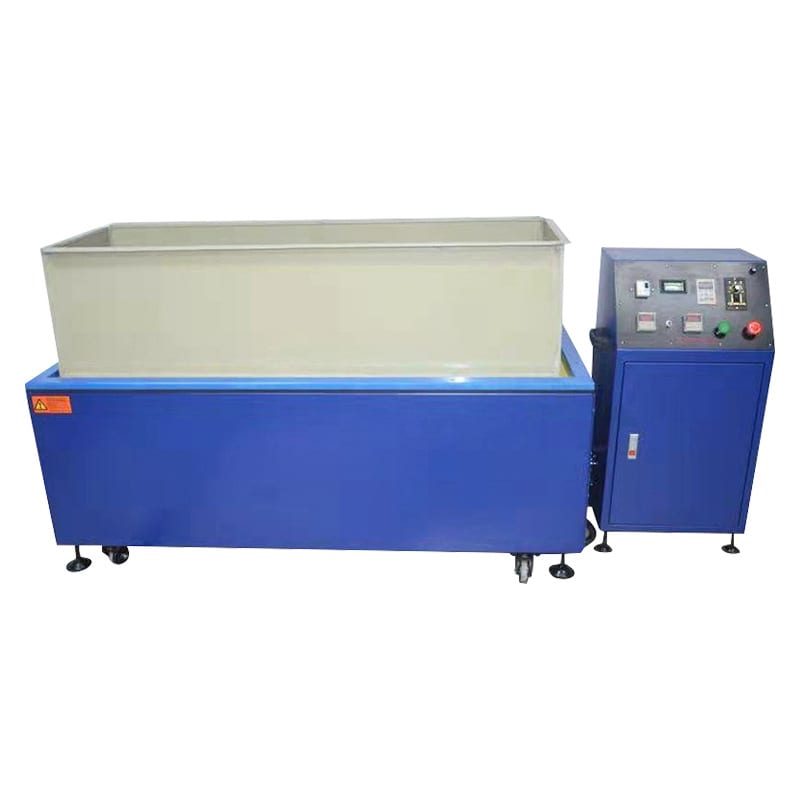
When parts have deep cross-holes, thin walls, or delicate engraving that heavy steel balls would dent, a magnetic polishing machine (circular bowl or wide-table OBD format) uses lightweight stainless pins driven by magnetic flux rather than gravity weight. Because magnetic pins carry almost no downward impact mass, they reach inside threads and knurled pockets on small brass, stainless, or precious-metal hardware without rounding crisp edges or flattening stamped lettering.
Why Media-to-Part Ratio Matters More With Steel
With ceramic media, a moderate media-to-part ratio works for most deburring jobs. With dense stainless burnishing media, running too low a media ratio causes heavy parts to slam into each other at the bottom of the bowl, leaving severe "orange peel" bruising—especially on brass, copper, and aluminum. Keep parts well cushioned in a generous media bed at all times. In rotary barrels, keeping the total charge near the horizontal centerline ensures a smooth cascading slide rather than violent free-fall drops from the top of the drum; in vibratory bowls, maintaining full media depth keeps parts suspended in the toroidal roll rather than skittering across bare polyurethane liner walls.
Understanding Work-Hardening vs. Surface Smearing
True wet burnishing plastically deforms microscopic asperities into a smoother, denser skin—which is why burnished brass and stainless parts often resist minor scratching better than raw buffed surfaces. However, if a shop skips the wet cutting stage and tries to "burnish away" deep grinding scratches, the steel balls simply smear adjacent metal over the scratch valleys without erasing them. Under bright inspection light, smeared surfaces look hazy or streaky rather than crisply reflective. Always verify that incoming roughness is uniform before transferring parts to the steel charge.
[DESIGN: Four-stage wet steel burnishing sequence: pre-deburr, clean rinse, wet steel burnishing with compound, and centrifugal spin-drying]
Burnishing Compounds and Water Control
Running steel burnishing media in plain tap water ruins both the parts and the media. Wet steel burnishing relies on compound chemistry to lubricate, brighten, and keep soil suspended.

Lubrication Film Prevents Galling and Media Welding
Stainless steel sliding against stainless steel or titanium under dry or under-lubricated conditions can gall, smear, and leave dull gray streaks. Burnishing compounds (JTJ50 for bright stainless, JTS5 for non-ferrous and general brightening) create a high-lubricity cushion so steel balls glide cleanly across peaks.
Soil Suspension Keeps the Media Charge Bright
As steel media burnishes, microscopic oxide films and stamping oils lift off the parts. Without active surfactant compound flow-through, that dark film redeposits onto the steel balls and turns the entire batch gray. Continuous or periodic fresh compound dosing carries lifted soil out through the drain screen so the steel spheres remain mirror-bright and ready for the next load.
Storage and Idle-Bowl Protection for Steel Charges
Even 304 stainless steel burnishing media can develop surface discoloration if left sitting for days in stagnant, contaminated alkaline water or acidic residue after a shift ends. Whenever a steel-charged bowl or barrel sits idle over a weekend or holiday, flush the charge with clean water and a light neutralizer or rust-preventive compound film, then drain or cover the chamber cleanly. Never store mixed carbon-steel hardware in the same basket as stainless media, because iron transfer particles will spot the stainless spheres and leave rust marks on subsequent batches.
When Pre-Cleaning With MC8 or LC10 Is Mandatory
Never dump oily, heat-treated, or scale-covered parts straight into a clean steel burnishing bowl. Remove heavy cutting oil, rust, or mill scale first using MC8 derusting or LC10 deburring chemistry in a ceramic-media pre-stage so the expensive steel charge stays uncontaminated. Skipping pre-cleaning forces operators to spend hours stripping tarred cutting oil off thousands of steel balls before normal brightening can resume.
Post-Burnish Rinsing and Spin-Drying
Immediately after steel burnishing, flush parts with clean water and spin-dry them in a heated centrifugal dryer—or wipe in warm corncob media—before residual compound dries into cloudy spots. Fast drying is especially critical for brass, copper, and martensitic stainless steel fasteners that stain rapidly if wet soap film evaporates slowly in open shop air.

Four Common Steel Burnishing Failure Modes and How to Diagnose Them
Because steel media does not wear away like ceramic, problems in steel burnishing almost always come from contamination, bruising, lodging, or wrong expectations.
Failure Mode 1: Dark, Gray, or Cloudy Steel Media
If your stainless steel balls look dull charcoal instead of mirror-silver, compound concentration is too low, flow-through water is blocked, or oily parts contaminated the charge.
Diagnostic rule: If parts emerge darker than they entered, rub a handful of steel balls on a clean white paper towel—if dark gray or black residue transfers onto the towel, flush the bowl with fresh compound and run a clean-up cycle before loading more parts.
Failure Mode 2: Peened "Orange Peel" Dents on Aluminum or Soft Brass
Heavy steel balls falling onto soft alloys or thin sheet stampings dent the surface faster than they smooth it.
Diagnostic rule: If close inspection shows tiny circular dimples across flat faces rather than scratches, the steel ball size or chamber impact energy is too high for the alloy—switch to smaller balls, raise the compound foam cushion, or move soft alloys to high-alumina porcelain spheres or resin-bonded plastic media.
Failure Mode 3: Wedged Cones or Pins in Slots and Blind Holes
Once a steel cone wedges into a slot, it can damage downstream tooling or fail final inspection.
Diagnostic rule: Size every steel ball, cone, or diagonal so its minimum dimension is either comfortably larger than the widest hole or comfortably smaller than the narrowest opening.
Failure Mode 4: Expecting Steel Burnishing to Remove Milling Marks
Steel burnishing cannot remove heavy CNC tool marks, parting lines, or sharp saw burrs. Rolling steel balls over a sharp burr simply folds the burr edge over onto the face, creating a folded flap that breaks off later in service.
| Symptom | Root Cause | Corrective Action |
|---|---|---|
| Dark/gray parts and dull media | Contaminated oil/soil film or low compound | Flush bowl; clean charge with fresh compound |
| Circular dimples ("orange peel") | Ball size/density too heavy for soft alloy | Switch to smaller balls, higher foam, or porcelain media |
| Folded-over burrs on edges | Skipped wet abrasive deburring stage | Pre-deburr with ceramic/plastic media + LC10 first |
| Wedged balls/cones in slots | Media size matches slot opening | Resize steel shape larger or smaller than slot width |
[DESIGN: Diagnostic decision matrix separating contamination, impact bruising, folded burrs, and media lodging]
Material Suitability: Stainless, Brass, Cartridge Cases, and Aluminum
Knowing which alloys thrive in stainless steel burnishing media—and which ones suffer—keeps scrap rates low across mixed-metal shops.

Stainless Steel Cutlery, Surgical Clips, and Fasteners
Austenitic and martensitic stainless steel parts respond exceptionally well to wet stainless steel ball and ballcone burnishing with JTJ50 compound. After prior smoothing in ceramic or plastic media, a steel burnish produces a dense, bright, corrosion-resistant luster across spoon bowls, fork tines, surgical forceps, and stamped brackets without cutting into thin edges. See our repolish stainless steel guide for restoration workflows.
Brass Cartridge Casings, Valves, and Switch Contacts
Brass casings, valve stems, and electrical contacts gain a bright, work-hardened finish in wet stainless pin or small-ball cycles, provided parts are rinsed thoroughly and spin-dried immediately afterward to prevent tarnish rings or spotted water marks. For brass hardware that also requires pre-plate smoothing, compare against isotropic finishing.

Aluminum and Zinc Die-Castings: Handle With Caution
Soft aluminum alloys and zinc die-castings bruise easily under heavy steel media. Unless parts are thick-walled and run in small balls with high-cushion compound, high-alumina porcelain media or plastic media is safer for aluminum brightening. Never load thin-walled sheet metal stampings into heavy steel ball charges without testing cushioning first.
Honest Capability Boundaries and Production Standards
What We Supply and What We Do Not Supply
At Xiamen Jin Tai Jin Grinding Technology Co.,Ltd. (brand: Jings Polish), our workshop roots date back to 1996 and our company was formally established in 2009, delivering over 200,000+ sets of grinding and polishing solutions worldwide. Across our catalogue, we manufacture 21 machine platforms backed by 24 granted Chinese IP rights (1 invention patent, 15 utility model patents, and 8 design patents), under ISO 9001 certification 00726Q01571R001 (valid 2026-06-03 to 2029-06-02) and CE certifications M.2023.206.C88121 (Vertical, 8 models) and M.2023.206.C88120 (Horizontal, 13 models), valid until 2028-07-24.
To state our boundaries clearly: we supply stainless steel burnishing media (balls, cones, ballcones, magnetic pins), industrial burnishing chambers (heavy-duty vibratory bowls, octagonal rotary barrels, magnetic tumblers), and liquid compounds (JTS5, LC10, MC8, JTJ50); we do NOT supply air-blast or wheel-blast steel shot/grit, shot-blasting cabinets, or contract job-shop blasting/peening services.
Honest Lead Times and Engineering Review
Standard machines ship in 25–35 days, while custom heavy-duty steel-burnishing lines require 45–60 days. Because alloy hardness, wall thickness, and hole sizes dictate media weight and chamber format, we do not promise free sample trials by mail or guarantee cycle times without inspecting your workpiece—send clear photos of your parts, alloy grade, and target finish via our custom polishing solution page for an engineering assessment.
Frequently Asked Questions
Is stainless steel burnishing media the same as steel shot abrasive used in sandblasters?
No. Steel shot abrasive for blast cabinets is typically cast carbon steel hurled at high speed to strip scale and roughen metal before coating. Stainless steel burnishing media (304 balls, cones, or magnetic pins) runs wet inside a vibratory bowl, rotary barrel, or magnetic tumbler to compress peaks and brighten parts with near-zero stock loss.
Can steel burnishing media remove CNC milling marks or heavy burrs?
No. Steel burnishing media does not cut metal; running it on un-deburred parts simply folds burrs over. Always remove burrs and tool lines first with ceramic or resin-bonded plastic media, then switch to stainless steel media for final brightening.
Why did my brass or aluminum parts come out dimpled after steel ball tumbling?
Dimpling ("orange peel") happens when heavy steel balls strike soft alloys with too much impact energy or too little compound cushion. Reduce ball size, increase compound concentration, raise the media-to-part ratio, or switch soft aluminum to high-alumina porcelain spheres.
Why are my stainless steel balls turning dark gray in the bowl?
Dark balls indicate oil carryover, dirty rinse water, or insufficient compound flow-through to keep lifted soils suspended. Degrease oily parts beforehand, check compound dosing, and flush the steel charge clean before resuming production.
Can a standard plastic-media vibratory bowl run a full load of steel balls?
Only if the bowl frame, drive motor, suspension springs, and polyurethane liner are rated for steel-media density, which is roughly three times heavier than ceramic. Overloading a light-duty bowl with steel media can crack springs or overload the motor.
What details should I share before ordering steel burnishing media or a burnishing machine?
Send clear photos of your parts showing any holes, slots, or thin walls, along with the alloy grade, incoming surface condition, target brightness, and hourly batch weight. Our engineers can match the right steel shape, compound, and machine platform from your photos and drawings.
[DESIGN: Annotated buyer enquiry checklist showing part photos, slot/hole clearances, alloy type, and batch weight]
 +86-592-2381506


 IPv6 network supported
