
Vibrating Bowl Deburring in Production: Industrial Tumbler Sizing, Separation Decks, and Continuous Flow-Through
Plant engineers and procurement teams searching for a vibrating bowl (or heavy-duty industrial tumbler) often compare machines solely by overall tub diameter or floor footprint. On the production floor, that shortcut causes costly bottlenecks: a bowl with a narrow channel pinches longer stamped brackets against the center column, light-duty springs sag under dense high-alumina or steel-ball loads, and manual hand-sorting replaces automated separation when screen decks are skipped.
The central thesis of this guide is clear: reliable vibrating bowl deburring at industrial throughput depends on matching channel width and curved vs. flat-bottom geometry to part diagonal, specifying steel-rated coil springs and thick cast polyurethane linings, automating unloading via pneumatic separation flaps and perforated screen decks, and maintaining continuous wet flow-through LC10 or MC8 chemistry before 35A/70A centrifugal drying. For related equipment comparisons, see our vibratory deburring machine guide, vibro polishing machine guide, and metal parts tumbler guide.
How an Industrial Vibrating Bowl Works vs. Other Tumblers
Understanding the three-dimensional helical roll inside a circular vibrating bowl clarifies why it remains the backbone of automated metal finishing.
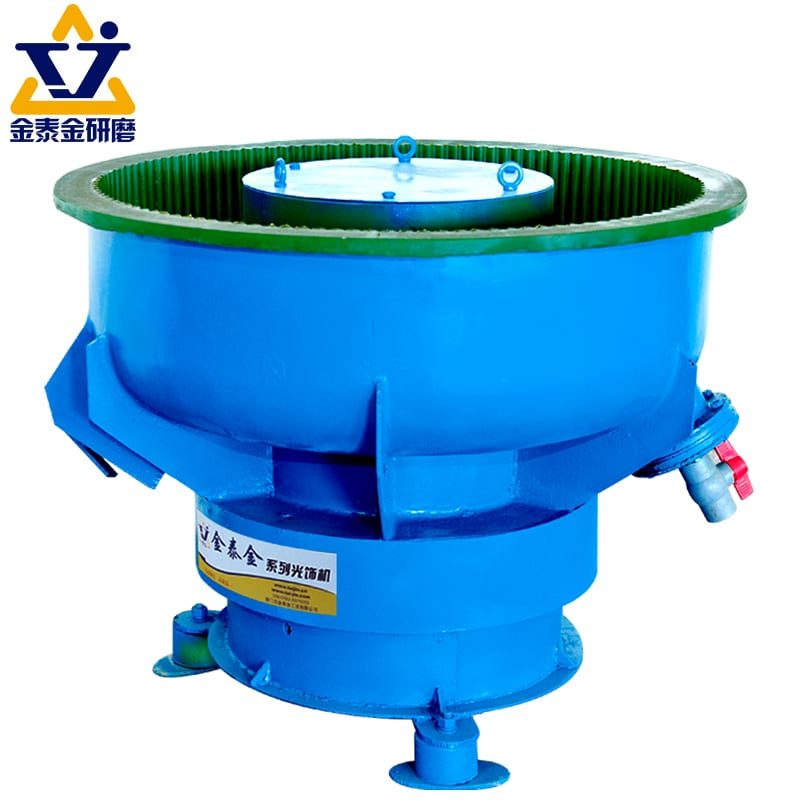
Three-Dimensional Helical Turnover Driven by Eccentric Weights
At the heart of every circular vibrating bowl sits a vertical vibratory motor mounted inside the central column, fitted with adjustable upper and lower eccentric counterweights. As the motor spins, the phase lead angle between those two weights converts rotary force into a three-dimensional corkscrew roll: media and parts spiral around the toroidal channel while simultaneously rolling inward from the outer wall toward the center dome. Adjusting that lead angle lets operators tune the cycle from aggressive heavy burr shearing to gentle edge cushioning. Even small incremental changes in counterweight lead angle noticeably shift how fast parts climb the outer wall and fold back into the center bed.
Why Circular Vibrating Bowls Outperform Closed Rotary Barrels on Inspection
Unlike a closed octagonal rotary barrel—which must be stopped, unlatched, and emptied onto a screen just to check progress—an open-top vibrating bowl lets operators pick up a sample gear, spring, or valve sleeve at any moment mid-cycle without halting the machine. That continuous visibility prevents over-tumbling tight tolerances and speeds up process qualification when setting up new CNC or stamping part numbers.
When a Linear Trough or Centrifugal Disc Replaces a Circular Bowl
Circular vibrating bowls cover the broadest range of compact-to-medium hardware, yet two boundaries apply. Long shafts, extruded rails, and fragile aerospace brackets that exceed circular channel clearance belong in L1300–L1800 divided linear troughs, while tiny high-volume belt buckles, pins, and spark-plug terminals finish faster in LLB50 or LLF120 centrifugal disc machines. Knowing when to step up to a divided trough or down to a centrifugal disc keeps your vibrating bowl focused on the geometries it runs most economically. See our ceramic wheel and rotary polisher guide and stone tumbler machine guide for cross-platform trade-offs.
| Industrial Tumbler Platform | Rolling Motion | Best Part Profile | Unloading & Inspection | Primary Advantage |
|---|---|---|---|---|
Circular Vibrating Bowl (ZL450 / ZL900C) |
Continuous 3D helical roll | Gears, springs, valve sleeves, stampings | Live mid-cycle check; pneumatic screen deck | Lowest labor per batch with auto separation |
Linear Trough (L1300 / L1500 / L1800) |
Straight-wall lateral roll | Long bars, fragile housings, large castings | End gate or overhead basket hoist | Optional PU dividers eliminate part-on-part dings |
Centrifugal Disc Finisher (LLB50 / LLF120) |
High-speed vortex compression | Tiny buckles, pins, chain links, fasteners | Fast tilt-bowl discharge | Rapid cycle times on compact parts |
| Octagonal Rotary Barrel | Slow cascading slide | Rugged forgings, thick blades, gas valves | Stop & dump onto manual screen | Quiet, heavy-impact descaling |
Sizing Channel Width, Tub Capacity, and Polyurethane Linings
Selecting the right vibrating bowl size starts with part diagonal and alloy weight—not just how many pieces fit into a basket.

ZL450 class) built for medium-to-heavy stamped and machined batchesMatching Channel Width to Part Diagonal (ZL450 vs. ZL900C vs. Wide-Channel)
To tumble freely around a circular vibrating bowl without wedging between the inner dome and outer wall, the working channel width must comfortably exceed the longest diagonal of your workpiece. Compact gears and helical springs roll smoothly in ZL450-class bowls, whereas larger castings, wide brackets, and high-throughput automotive batches require high-capacity ZL900C or wide-channel bowls (ZL250W / ZL900W) so parts never bridge across the curve.
Curved-Bottom vs. Flat-Bottom Channel Geometry
Curved toroidal channels promote tight, smooth helical rolling for compact cylindrical or spherical parts and light-to-medium media loads. Flat-bottom, straight-walled bowl profiles increase total media bed contact area and help keep heavy steel components or flat stampings from shingling against the outer wall.
Cast Polyurethane (PU) Lining Durability and Steel-Rated Springs
High-rebound cast polyurethane (PU) linings protect parts from steel-on-steel impact, dampen shop noise, and resist abrasion from vitrified ceramic triangles and LC10/MC8 compounds. Underneath the tub, heavy-duty calibrated coil springs must be rated for dense ceramic and 304 steel-ball loads so the bowl never bottoms out or loses amplitude under full production batches.
Scheduled Media Replenishment and Wear-Fragment Screening
As preformed ceramic triangles or plastic cones gradually wear down over repeated production shifts, the active bed height drops and smaller worn chips can begin lodging inside gear teeth or spring coils. Topping up fresh media to the working fill line and running a scheduled screen check to purge undersized fragments keeps cycle times consistent from week to week.

ZL900C class) equipped with pneumatic separation flap and perforated screen deckAutomated Pneumatic Separation Flaps and Screen Decks
Manual hand-picking out of a vibrating bowl destroys labor efficiency. Automated separation turns a single operator into a multi-machine line tender.
How the Pneumatic Separation Flap Works During Unloading
Inside an automated circular vibrating bowl, a hinged polyurethane-coated flap sits flush against the channel floor during the deburring cycle, letting media and parts roll uninterruptedly underneath or past it. When the timer finishes, a dry compressed-air cylinder swings the flap down into the media stream, ramping the rising helical flow up onto the inclined perforated separation deck.
Selecting Perforated Screen Mesh for Clean Media Drop-Through
The separation screen deck must retain every finished workpiece while letting tumbling media fall cleanly back into the bowl. Choose a screen aperture slightly smaller than the shortest dimension of your smallest part—and comfortably larger than the largest media cross-section—so parts ride cleanly to the discharge chute while ceramic or plastic stones drop straight through.
Integrated Spray Rinse Bars on the Separation Deck
Mounting a clean-water spray rinse bar directly above the separation screen washes residual LC10 or JTJ50 slurry off parts as they vibrate across the deck. That instant on-deck rinse prevents dirty sump film from drying onto parts before they enter the centrifugal dryer. Separating the spray rinse feed from the main bowl dosing line also guarantees only clean fresh water touches finished surfaces during unloading.
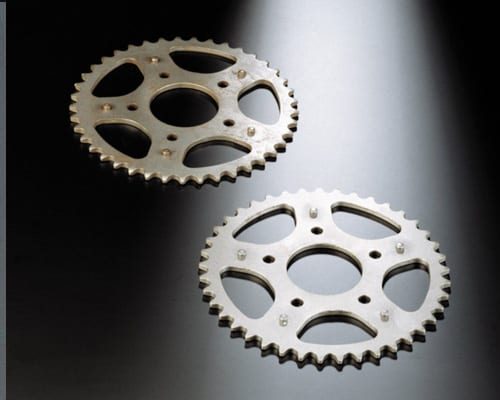
Media and Flow-Through Chemistry Inside a Vibrating Bowl
A vibrating bowl delivers consistent edge break and surface finish only when media geometry and liquid chemistry work together.
Preformed Ceramic vs. Resin-Bonded Plastic vs. High-Alumina Media
Match media to alloy hardness and finishing stage:
- Vitrified
high-frequencyceramic (triangles, angle-cut cylinders, tri-stars): shears machining burrs, laser dross, and mill scale on carbon steel, stainless valve sleeves, and titanium. - Resin-bonded plastic cones and pyramids: removes CNC tool marks and casting flash on soft
6061/7075aluminum,Zamakzinc, and brass without edge bruising. - Dense
high-aluminaspheres and304steel balls: performs non-abrasive Stage 2 bright burnishing on stainless hinges, cutlery, and pre-cut castings. See our ceramic grinding media guide and steel shot burnishing media guide for full media selection charts.
Non-Lodging Media Sizing for Helical Springs and Gear Teeth
Helical springs, slotted contacts, and gear teeth easily trap undersized stones. Always size preformed ceramic or plastic media so every piece either bridges cleanly across the widest gap or passes straight through without touching opposite coils or teeth. Screen out worn fragments regularly before broken tips wedge inside critical slots.

Continuous Flow-Through With LC10, MC8, JTJ20, and JTJ50
Never run ceramic or plastic media dry or in a stagnant puddle inside a vibrating bowl. Meter fresh water and liquid compound continuously via a peristaltic dosing pump (compound-LC10 for standard deburring, MC8 for heavy rust/scale, JTJ20 for coarse stainless, JTJ50 for bright stainless, HM3 or JTJ60 for fine non-ferrous polishing) while spent slurry drains through the bottom screen into a multi-baffle settling tank. See our compound for aluminum guide and surface finish Ra vs Rz guide for chemical stage matching.
| Finishing Stage | Target Hardware | Recommended Media | Flow-Through Compound | Post-Bowl Step |
|---|---|---|---|---|
| Heavy Descale & Deburr | Carbon-steel forgings, stamped blades | Fast-cut ceramic triangles | compound-MC8 |
Clean rinse + 35A/70A spin-dryer |
| Precision Gear & Valve Deburr | Stainless sleeves, gears, contacts | Fine ceramic or angle cylinders | compound-LC10 |
Stage 2 burnish or 35A dryer |
| Aluminum & Brass Smoothing | Cast fan wheels, brass bezels | Resin-bonded plastic cones | compound-LC10 / JTJ60 |
35A dryer → dry corncob buff |
| Bright Stainless Burnish | Hinges, cutlery, marine fittings | High-alumina or 304 steel balls |
compound-JTJ50 |
Heated 35A/70A centrifugal dryer |
Building a Complete Multi-Station Vibrating Bowl Line
Linking the vibrating bowl to upstream washing and downstream drying eliminates manual handling bottlenecks and protects surface quality.

Upstream Pre-Degreasing for Oily Stampings and Turned Parts
Machining coolants and stamping lubricants transferred straight from presses into a vibrating bowl coat ceramic stones and cause heavy foaming. An upstream alkaline pre-wash keeps LC10 flow-through clean and prevents glazed media.
Multi-Baffle Settling Tanks and Shift-Start Drain Screening
Continuous flow-through discharges fine mineral and metal swarf that quickly plugs municipal or plant floor drains. Routing the bowl drain into a multi-baffle settling tank traps heavy sludge for periodic cleanout while letting clearer water overflow safely. Brushing the bottom bowl drain screen at shift start prevents water buildup inside the channel.
Heated Centrifugal Spin-Drying (35A / 70A) and Organic Polishing
Ferrous parts flash-rust rapidly if left damp in catch baskets, and aluminum or stainless parts develop chalky water spots. Convey rinsed parts straight from the separation screen into a heated centrifugal spin-dryer (35A or 70A class) or a dry corncob / walnut shell (8#-80#) polishing stage to absorb trace moisture cleanly. See our corn cob vs walnut media guide and corncob and cob media guide for dry-stage setups.
Cushioning Discharge Chutes to Protect Finished Edges
Hard drops off the separation screen deck onto bare metal baskets dent soft brass, aluminum, and heavy stainless edges. Fit resilient polyurethane chute liners and padded or submerged catch baskets to keep Rz and edge uniformity intact after unloading.
Troubleshooting Common Vibrating Bowl Bottlenecks
When turnover slows, parts jam, or finishes turn dull mid-shift, inspect loading, counterweight angles, and drain flow systematically.
Stalled Media Roll From Overloading Heavy Steel Parts
If the helical roll slows to a crawl or stops entirely, the bowl is overloaded with heavy steel parts or dense steel shot relative to spring capacity. Reduce part batch weight, restore the proper media-to-part volume cushion, and check coil springs for fatigue.
Parts Slipping Underneath the Pneumatic Separation Flap
When thin flat stampings bypass the separation screen and stay inside the bowl, the polyurethane flap seal is worn or not seating flush against the channel floor. Inspect air-cylinder stroke pressure and replace worn flap edges promptly.
Glazed Ceramic Media and Slow Cycle Times
Slick, slow-cutting ceramic stones indicate starved LC10 compound dosing or clogged drain screens trapping metal swarf inside the tub. Brush the drain screen, verify peristaltic pump calibration, and flush the multi-baffle settling tank.
Shingling Flat Washers or Stamped Plates Against the Outer Wall
Flat, thin stampings can stick together or plaster against the curved outer PU wall under wet surface tension. Lower the liquid level slightly so parts stay suspended in media, adjust the eccentric lead angle for greater vertical turnover, or use textured plastic pyramids that break flat suction.
Acoustic Hoods and Floor Anchor Isolation for Multi-Bowl Cells
When multiple circular vibrating bowls operate side by side in a high-volume finishing cell, fitting hinged acoustic covers and checking floor-isolation pads keeps shop noise comfortable for operators while protecting nearby precision CNC inspection benches from transmitted floor vibration.
What lead time applies to circular vibrating bowls and multi-station lines?
Standard circular vibrating bowls, centrifugal disc finishers, and 35/35A/70/70A centrifugal spin-dryers ship in 25–35 days, while custom multi-stage automated lines ship in 45–60 days under ISO 9001 (00726Q01571R001) and CE certification.
Can one vibrating bowl handle both rough ceramic deburring and bright steel-ball burnishing?
While a cast polyurethane-lined vibrating bowl can physically run both ceramic media and 304 stainless steel balls—provided the bowl is rated for heavy steel-shot loads—dedicated machines or thorough washouts are mandatory between stages so stray abrasive ceramic grit never contaminates the Stage 2 burnishing charge.
How do operators keep small springs or stamped contacts from tangling in a vibrating bowl?
Load springs and tangled-prone contacts slowly into an already-running media bed rather than dumping an entire dry basket in one spot, maintain a generous media-to-part volume cushion, and choose non-lodging media shapes that separate adjacent coils during helical turnover. Adding compound solution before parts enter also lubricates contact points so intertwined legs slip apart early instead of locking together under dry friction.
What inspection routine catches bowl liner wear before steel shell damage occurs?
Inspect the polyurethane bowl bottom, dam edge, and discharge ramp at every media changeout for soft spots, radial grooves, or exposed backing plates. Tracking compound color changes in the drain water helps too, because sudden dark discoloration or grit buildup often signals liner thinning along high-impact zones. Scheduling liner recasting or bowl replacement before steel exposure protects the drive motor and keeps cycle performance steady.
Sourcing & Factory Capabilities: Verified Mass Finishing Supply
Xiamen Jin Tai Jin Grinding Technology Co.,Ltd. has engineered and manufactured industrial mass finishing equipment since 1992, accumulating 200,000+ workpiece finishing solutions across 21 machine platforms—including circular vibrating bowls (ZL450, ZL900C, ZL250W, ZL900W), L1300/L1500/L1800 linear troughs, centrifugal disc finishers (LLB50, LLF120), octagonal rotary barrels, OBD magnetic polishers, and 35/35A/70/70A centrifugal dryers—supported by high-frequency ceramic, high-alumina, resin-bonded plastic, 304 steel, corncob, and walnut shell (8#-80#) media plus LC10, MC8, JTJ20, JTJ50, JTJ60, and HM3 compounds.
Every machine line operates under ISO 9001 (00726Q01571R001), holds CE vertical (M.2023.206.C88121) and horizontal (M.2023.206.C88120) compliance, and incorporates 24 granted Chinese IP rights. Standard machines ship in 25–35 days, with custom automated lines delivered in 45–60 days. Honest boundaries apply: we do not supply dry sandblasting cabinets, loose blasting grit, or hobby rock-polishing tumblers.
Send sample parts, alloy specs, and hourly throughput targets to surface-polish.com or call +86 189 6582 7080 for a free sample trial and vibrating bowl sizing recommendation.
Frequently Asked Questions About Vibrating Bowl Deburring
How do I size an industrial vibrating bowl for my metal parts?
Ensure the working channel width comfortably exceeds the longest diagonal of your workpiece so parts tumble freely without bridging against the center dome, and select tub capacity so the media-to-part volume cushion prevents part-on-part impingement at your target batch size.
What is the advantage of a vibrating bowl with a pneumatic separation deck?
A pneumatic separation flap and perforated screen deck let a single operator unload and rinse finished parts automatically in seconds while media drops straight back into the bowl, cutting manual sorting labor dramatically.
Can a vibrating bowl run dry with ceramic or plastic media?
No. Ceramic and plastic abrasive media must always run wet with continuous flow-through LC10 or MC8 compound to prevent dust, overheating, and stone glazing. Reserve dry vibrating bowl cycles strictly for organic corncob or walnut shell polishing after centrifugal drying.
Why are my flat stamped parts sticking to the inside wall of the vibrating bowl?
Flat stampings shingle or stick to the curved PU wall when water volume is too high or media turnover is too flat. Reduce excess water, steepen the eccentric counterweight lead angle for stronger vertical roll, or switch to pyramids/cones that break flat surface tension.
What lead time applies to circular vibrating bowls and multi-station lines?
Standard circular vibrating bowls, centrifugal disc finishers, and 35/35A/70/70A centrifugal spin-dryers ship in 25–35 days, while custom multi-stage automated lines ship in 45–60 days under ISO 9001 (00726Q01571R001) and CE certification.
 +86-592-2381506


 IPv6 network supported
