
Vibro Polishing Machine in Production: Choosing Bowl Geometry, PU Linings, and Two-Stage Burnishing Lines
Plant managers and manufacturing buyers searching for a vibro polishing machine often treat every vibrating bowl on the market as interchangeable—judging machines purely by catalog liter volume and motor horsepower while overlooking channel width, cast polyurethane lining thickness, integrated screen separation, and whether the drive suspension can actually carry dense stainless steel burnishing shot.
The central thesis of this guide is clear: specifying the right vibro polishing machine depends on matching chamber geometry (circular bowl vs. divided rectangular trough), drive suspension rating (ceramic/plastic vs. heavy steel shot), poured-cast polyurethane lining durability, and automated screen separation to your worst-case part length, alloy fragility, and daily throughput. Buying an undersized bowl or un-rated suspension causes part-on-part denting, channel bridging, and stalled media flow. For related machine comparisons, see our vibratory grinder guide, tumbler polishing machine guide, and surface treatment line guide.
Circular Bowl vs. Divided Rectangular Trough: Which Chamber Fits Your Parts?
The very first decision when buying a vibro polishing machine is whether workpieces can tumble freely in a continuous ring or must be isolated inside straight compartments.
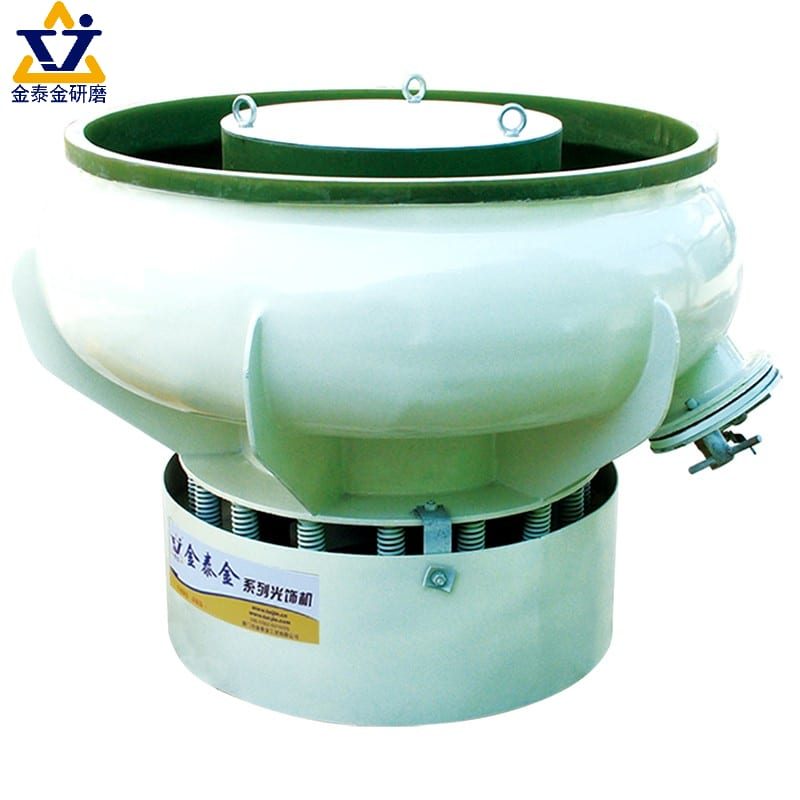
Circular Vibratory Bowls for Compact-to-Medium Batch Flow
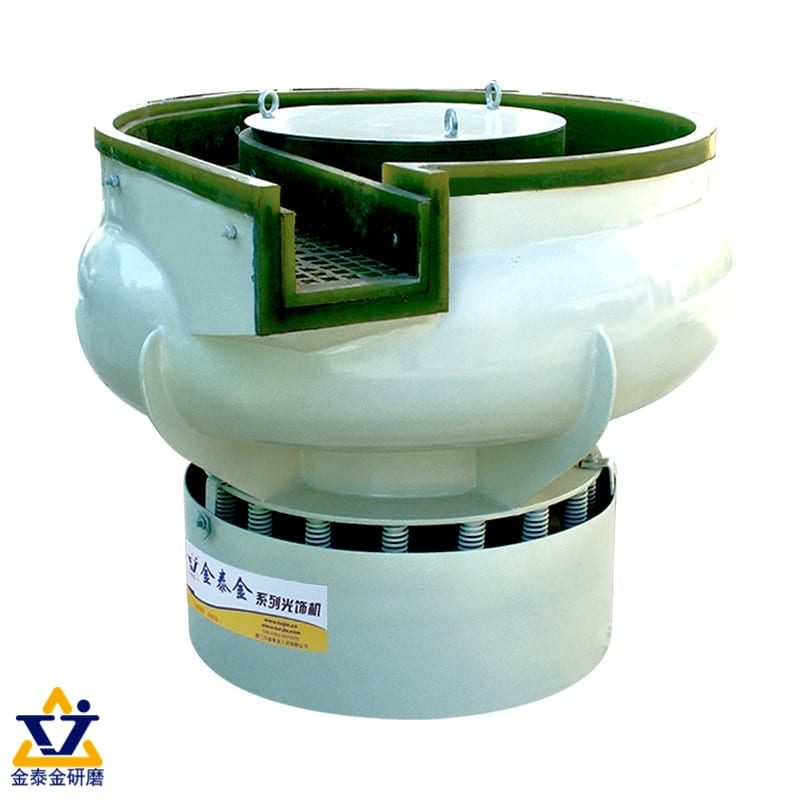
A circular polyurethane-lined vibratory bowl generates a smooth, continuous three-dimensional toroidal roll—lifting media and parts up the outer wall and rolling them inward toward the center dome. Integrated pneumatic separation flaps and vibrating screen decks let one operator unload finished batches cleanly in seconds without manual shoveling.
Wide-Channel Straight-Wall Bowls for Medium Rings and Simulators
Standard curved-wall bowls narrow near the center column, causing medium-sized rings or wide stampings to wedge. Wide-channel circular designs open up radial clearance so larger stainless wheel trim rings and stamped covers circulate smoothly.
Divided Rectangular Vibratory Troughs for Long Rails, Shafts, and Collision-Sensitive Parts
Whenever part diagonal length approaches bowl channel width—or when heavy forged connecting rods, sequential transmission gears, and long CNC brackets would batter each other—step directly into a rectangular vibratory trough fitted with removable polyurethane-lined dividers (one part per bay).
| Chamber Geometry | Best Part Envelope | Part-on-Part Collision Risk | Unloading & Separation |
|---|---|---|---|
| Standard Circular Vibro Bowl | Small-to-medium brackets, castings, hardware | Low-Medium (media-cushioned) | Integrated pneumatic flap + screen deck |
| Wide-Channel Circular Bowl | Medium rings, covers, 304 cutlery |
Low-Medium | Integrated flap + screen deck |
| Divided Rectangular Trough | Long rails, shafts, heavy wheels, con-rods | Zero (compartmentalized) | Hoist / bay-by-bay unload |
| Fixtured Drag Finisher (Alt) | High-value CNC impellers, dog rings, hubs | Zero (spindle-clamped) | Automated spindle lift |
Drive Motor, Eccentric Weights, and Cast Polyurethane Linings
What sits under the bowl—and what coats the inside wall—determines how long a vibro polishing machine survives daily industrial shifts.

Adjustable Eccentric Weights Control Roll Speed vs. Impact Intensity
Industrial vibratory motors carry adjustable upper and lower eccentric flyweights. Adjusting the lead angle between top and bottom weights tunes how aggressively media climbs the bowl wall versus rolling forward—letting engineers dial back impact force for delicate brass or aluminum while boosting shear for heavy steel deburring.
Heavy-Duty Suspension Springs for Dense 304 Stainless Steel Shot
If your goal is mirror burnishing with stainless steel tumbler media, remember that steel balls weigh roughly three times more per liter than ceramic or plastic cones. A bowl built strictly for light plastic or ceramic loads will bottom out springs and stall under steel shot; always specify a steel-rated drive motor and heavy-duty suspension upfront.
Poured-Cast Polyurethane Linings vs. Thin Spray Coatings
Thin spray-on elastomer coatings peel and tear quickly under sharp laser-cut steel brackets. Thick poured-cast polyurethane linings absorb heavy impacts quietly, resist tearing across years of service, and prevent bare carbon-steel shell rust from staining aluminum or 304 stainless parts.
Integrated Screen Separation, Flow-Through Dosing, and Noise Control
Modern vibro polishing machines eliminate manual media-shoveling and dirty closed-tank water.

Pneumatic Separation Flaps and Inclined Vibrating Screen Decks
Flipping the pneumatic or manual separation dam lifts the rolling media-and-part stream up onto a perforated vibrating screen deck. Media drops cleanly through the screen slots back into the working bowl while finished parts ride forward into rinse baskets—cutting changeover labor dramatically.
Flow-Through LC10, MC8, and PL10 Compound Dosing
Steady fresh-water and liquid compound (LC10 for general cut, MC8 for oxide scale, PL10 for mirror burnishing, JTS5 for aluminum brightening) flow-through flushes abraded metallic fines straight out of the drain screen—preventing glazed ceramic stones and gray slurry staining.
Acoustic Lids When Machines Sit Near Assembly or Inspection Stations
Un-lidded vibratory bowls running heavy ceramic stones generate steady shop noise. Specifying hinged acoustic sound-reduction covers drops decibel levels noticeably when machines operate inside mixed machining or assembly halls.
Pairing the Right Media and Compounds With Your Vibro Machine
Even the strongest vibro polishing machine cannot deliver mirror gloss from coarse ceramic or cut heavy burrs with smooth steel balls.
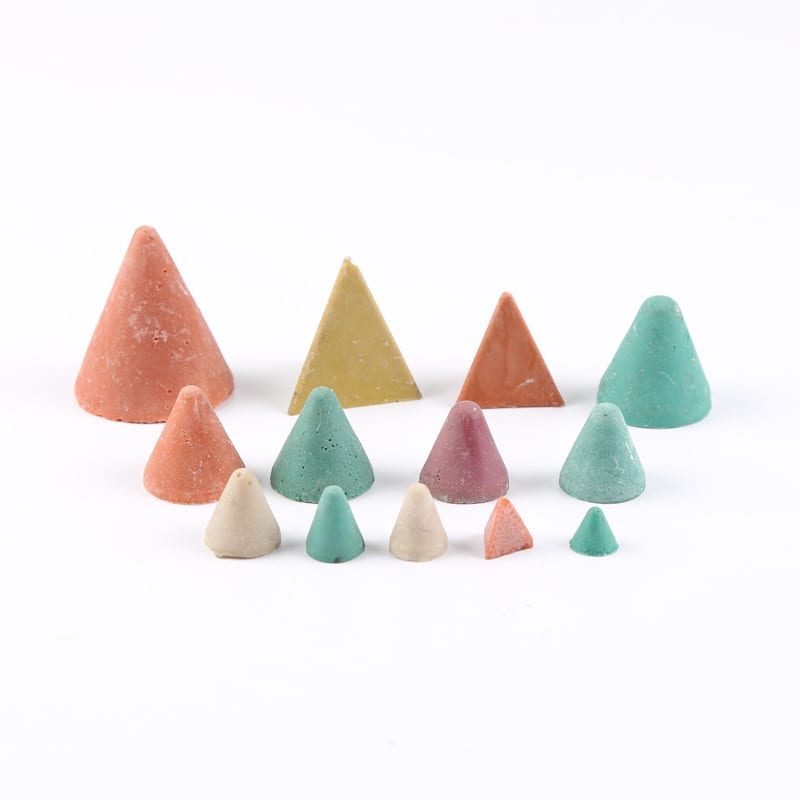
Stage 1: Ceramic or Resin-Bonded Plastic Cutting (Deburr & Level)
Use preformed ceramic media with LC10 or MC8 for steel, stainless, and titanium burrs or laser scale—or lightweight resin-bonded plastic cones with neutral LC10/JTS5 for 6061 aluminum, brass, and zinc die castings.
Stage 2: 304 Steel Burnishing Balls or High-Alumina Porcelain (Shine & Plateau)
Once rough marks are uniformly leveled, transfer clean parts into a dedicated Stage 2 bowl charged with 304 stainless steel balls/cones (PL10) for bright mirror compression—or smooth porcelain spheres for isotropic plateauing.
Stage 3: Heated Corncob or Centrifugal Spin-Drying (Spot-Free Unload)
Couple your vibro bowl discharge directly to a heated centrifugal dryer or heated corncob media vibratory dryer so carbon steel never flash-rusts (add JTJ50 rinse) and mirror stainless or aluminum never develops hard-water rings.
| Finishing Goal | Recommended Machine Setup | Media & Compound | Mandatory Post-Unload Step |
|---|---|---|---|
| Steel deburring & laser descaling | Circular bowl + LC10/MC8 dosing |
Ceramic triangles / cylinders | JTJ50 rust-inhibited rinse + heated spin-dry |
Aluminum 6061 / A380 smoothing |
Divided trough or circular bowl | Plastic cones + neutral JTS5/LC10 |
Softened clean rinse + heated spin-dry |
304 Stainless mirror burnishing |
Steel-rated bowl + screen deck | 304 steel balls/cones + PL10 |
Softened rinse + heated corncob dryer |
| Hardened gear isotropic finishing | Divided trough or drag finisher | High-alumina porcelain + conversion | Alkaline neutralization (LC10/PL10) + spin-dry |
When a Vibro Polishing Machine Needs Support—or Another Platform
Understanding boundary limits keeps capital investment aligned with real part geometry.
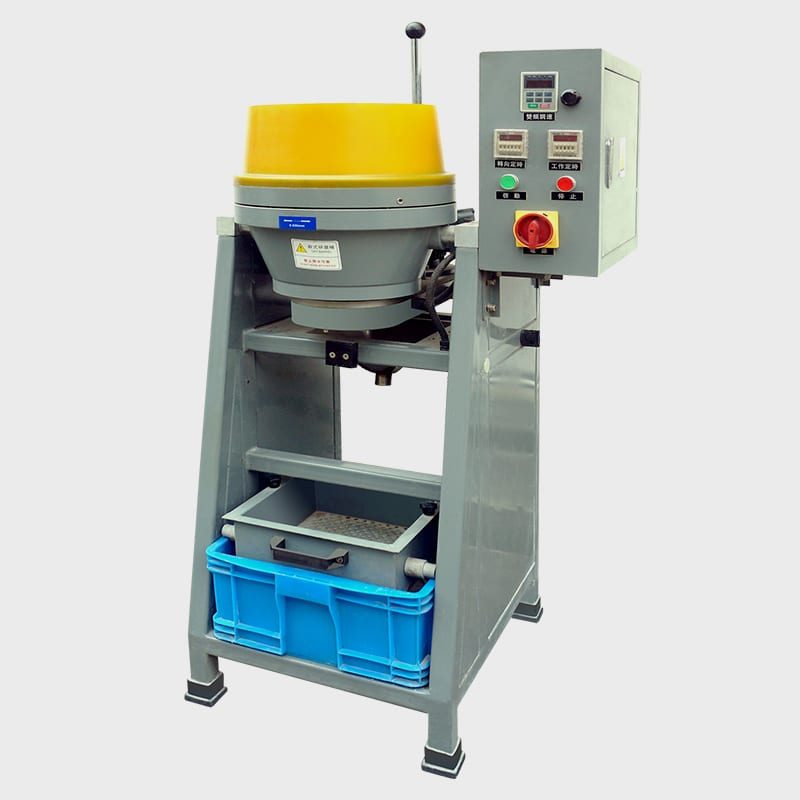
Deep Internal Cross-Bores Need Wide-Table OBD Magnetic Tumblers
Standard vibratory tumbling circulates ceramic stones poorly inside tiny intersecting hydraulic cross-holes. Pair your vibro line with a translating OBD magnetic tumbler using fine 304 stainless pins for internal bore deburring on non-ferrous and 304 parts.
Ultra-Fast Compact Throughput Favors Centrifugal Disc Finishers
When floor space is tight and compact rigid parts need high-speed heavy cutting, a centrifugal disc finisher delivers faster cycle times via high-pressure toroidal shear.
Optical Acrylic Edges Fit Multi-Tier Dry Rotary Barrels Best
While cushioned vibro bowls can run Stage 1 wet plastic pre-cut on thick CNC acrylic blocks, final Stage 2/3 optical gloss on acrylic edges and eyewear frames belongs inside dry wood-peg rotary barrels.
Common Failure Modes in Vibro Polishing Machines
Fixing these four setup mistakes restores peak machine performance immediately.
Stalled Media Roll From Overloading Parts or Heavy Steel Shot
Stuffing too many heavy parts into a bowl—or loading steel balls into a ceramic-rated bowl—kills toroidal circulation. Verify drive capacity and keep media-to-part volume ratios generous.
Clogged Drain Screens Causing Dirty Slurry Overflow
Worn ceramic chips and stamping slugs block bowl drain screens, forcing dirty metal-loaded water to pool inside the chamber. Brush drain screens clean at every shift start and route effluent into a multi-baffle settling tank.
Media Bridging Inside Narrow Bowl Channels
Long brackets wedge across narrow circular channels and hammer the center dome. Move long parts into divided rectangular vibratory troughs.
Premature Polyurethane Wear From Running Dry or Low Water Flow
Running sharp ceramic stones dry without LC10 lubrication abrades cast polyurethane linings rapidly and glazes stones smooth. Maintain steady water and compound flow-through throughout every wet cycle.
Skipping Shift-Start Inspection of Separation Screens and Drain Ports
If worn ceramic fragments wedge inside drain slots or separation screen perforations, dirty slurry backs up into the bowl and parts mix back into media during unload. A quick shift-start visual check keeps separation clean and drain flow unobstructed.

Honest Boundaries: What We Do and Do Not Supply
At Xiamen Jin Tai Jin Grinding Technology Co.,Ltd. (brand: Jings Polish), our workshop roots date back to 1996 and our company was formally established in 2009, delivering over 200,000+ sets of grinding and polishing solutions worldwide. Across our catalogue, we manufacture 21 machine platforms backed by 24 granted Chinese IP rights (1 invention patent, 15 utility model patents, and 8 design patents), under ISO 9001 certification 00726Q01571R001 (valid 2026-06-03 to 2029-06-02) and CE certifications M.2023.206.C88121 (Vertical, 8 models) and M.2023.206.C88120 (Horizontal, 13 models), valid until 2028-07-24.
Equipment, Media, and Compounds—Not Contract Vibro Polishing
We manufacture and supply circular vibro polishing machines, divided rectangular troughs, fixtured drag finishers, centrifugal disc finishers, octagonal rotary barrels, OBD magnetic tumblers, heated centrifugal and corncob dryers, tumbling media, and flow-through compounds. We do not run a contract job-shop polishing service, and we do not supply dry sandblasting cabinets, electroplating lines, or hand-held angle grinders. Standard machines ship in 25–35 days, while custom divided troughs and automated lines require 45–60 days.
Engineering Review Before Machine Sizing
Because part diagonal length, single-piece weight, alloy sensitivity, narrowest slot/hole width, and hourly throughput govern chamber selection and suspension rating, we do not promise free mail-in sample trials or guarantee cycle times before inspecting your workpiece—send clear photos and part dimensions via our custom polishing solution page for an engineering assessment.
Buyer Checklist & FAQ for Vibro Polishing Machines
Review these practical benchmarks before ordering a vibro polishing machine.
How do I know if a circular vibro polishing machine channel is wide enough for my part?
Measure the longest diagonal dimension of your part and ensure the bowl's clear radial channel width comfortably exceeds it—otherwise parts will bridge across the channel and collide. Long rails and shafts belong in divided rectangular vibratory troughs.
Can one vibro polishing machine handle both ceramic deburring and steel ball burnishing?
Only if the machine's drive motor and suspension springs are rated for dense steel shot—and even then, running two dedicated chambers (Stage 1 ceramic cut + Stage 2 steel burnish) eliminates daily media swaps and stray-grit scratching.
Why did my vibro bowl stop separating parts cleanly over the screen deck?
Either worn undersized media chips wedged inside the screen perforations, or the screen mesh opening was not matched cleanly between the shortest part dimension and the working media size.
Do I need a settling tank behind a flow-through vibro polishing machine?
Yes. Flow-through ceramic cutting discharges fine abrasive mud and metallic fines that clog shop floor drains quickly; a simple multi-baffle settling tank traps sediment cleanly before discharge.
Why do flat stamped washers or laser-cut plates stick together inside a vibro polishing machine?
Smooth flat stampings trap thin films of compound water between adjacent parts and ride around the bowl as doubled-up stacks—leaving inner mating faces completely unpolished. Solve this by raising the media-to-part volume ratio, keeping water flow moderate rather than flooded, and feeding flat parts gradually onto the moving media crest.
How does cast polyurethane lining thickness affect machine life on sharp laser-cut steel?
Sharp oxygen-cut steel edges and coarse ceramic triangles steadily abrade chamber walls over multi-shift operation. Heavy poured-cast polyurethane absorbs metallic impacts quietly and resists tearing far longer than thin spray-on coatings—and periodic thickness checks let maintenance teams service linings before bare structural steel is ever exposed.
Can I run both 304 stainless steel and 6061 aluminum brackets in the same vibro polishing machine?
Only if you maintain completely separate labeled media charges (ceramic + steel shot for stainless vs. plastic cones + porcelain for aluminum), scrub the polyurethane bowl and drain screen thoroughly between runs, and isolate neutral aluminum chemistry (LC10/JTS5) from ferrous steel descaling compounds.
What happens if a vibro polishing machine runs with too little LC10 compound or water flow?
Insufficient liquid lubrication causes abraded metal dust to pack into ceramic stone pores—glazing the media smooth and collapsing cutting speed halfway through the shift. Steady fresh-water and compound flow-through keeps ceramic stones crisp and parts bright.
How do I size a heated centrifugal dryer or corncob dryer to match my vibro polishing machine?
Match the dryer's working basket capacity and thermal power to the peak single-batch discharge weight of your vibro bowl so wet carbon steel never sits waiting in holding baskets where it flashes orange rust.
Can a vibro polishing machine replace a manual cloth-wheel buffer on 304 stainless trim?
Yes, for batch-sized trim rings, cutlery, and hardware—provided Stage 1 ceramic cutting (LC10/MC8) removes all die draw lines first, followed by Stage 2 PL10 stainless steel ball burnishing and heated corncob drying.
How much floor space and utility prep does a new vibro polishing machine require?
Beyond three-phase electrical power matched to the vibratory drive motor, plan a clean fresh-water supply line with flow-control valves for LC10/PL10 dosing, compressed air for pneumatic separation flaps, floor drainage routed through a multi-baffle settling tank, and hoist or forklift clearance for loading heavy media drums.
Why do small threaded fasteners suffer thread crest flattening in oversized vibro bowls?
Running heavy fasteners at high eccentric lead angles with too little media cushion lets parts hammer each other's exposed threads. Lower the lead angle slightly for gentler roll, raise the media-to-part volume ratio, or process delicate threaded blocks inside divided compartments or fixtured drag spindles.
What is the difference between a standard circular vibro bowl and a wide-channel curved bowl?
Standard curved-wall circular bowls work efficiently for compact stampings, fasteners, and small castings, whereas wide-channel straight-wall bowls provide extra radial clearance so medium-sized rings, wheel covers, and wider brackets roll smoothly without wedging against the center column.
How often should operators inspect eccentric drive bearings and suspension springs?
Listen for unusual metallic knocking during startup and inspect coil springs and rubber mounts during routine monthly maintenance. Keeping media loads within rated capacity and maintaining proper spring tension prevents uneven bowl tilt and extends drive motor bearing life across years of shifts.
Can a vibro polishing machine run dry organic media like walnut shell or corncob?
Yes—heated vibratory bowls filled with dry corncob media are the standard industrial method for spot-free drying and final residue wiping after wet burnishing, while multi-stage dry walnut or wood-peg brightening can also run in dedicated dry bowls or multi-tier rotary barrels depending on part geometry.
Why do some workshops install an acoustic lid over their vibro polishing machine?
Open-top vibratory bowls running heavy ceramic triangles or dense stainless steel balls generate steady mechanical noise across open shop floors. Adding a hinged acoustic lid dampens operating noise substantially when the polishing cell sits close to assembly benches or quality inspection stations.
What happens if heavy forged parts are dumped all at once into a running vibro polishing machine?
Dumping a full basket of heavy steel forgings onto a single spot on the media bed forces parts to strike each other before toroidal rolling separates them. Feed heavy parts steadily into the moving media stream so each piece sinks cleanly into a protective cushion of ceramic or plastic media.
How long does a vibro polishing machine typically take to ship and commission?
Standard circular vibro polishing machines, heated centrifugal dryers, and OBD magnetic tumblers ship in 25–35 days, while custom divided rectangular troughs and fixtured drag-finishing lines require 45–60 days. Preparing three-phase power, clean water supply, compressed air, and a settling tank beforehand enables fast startup.
Why should I avoid dumping dirty compound tank water back into a vibro polishing machine?
Recirculating spent tank water indefinitely concentrates dark metallic wear mud, residual cutting oil, and broken ceramic grit inside the bowl—glazing ceramic stones smooth and dulling bright stainless or aluminum surfaces. Continuous fresh-water and compound flow-through keeps media pores clean and finishes consistent shift after shift.
What details should I share before requesting a vibro polishing machine quote?
Send clear photos of your parts showing raw burrs or scale, alloy grade, overall part dimensions and weight, narrowest hole or slot size, target finish (deburr, pre-anodize, or mirror), and hourly batch output via our custom polishing solution page. Also note whether oily CNC coolant is present before loading, whether acoustic noise lids are required, whether parts carry fragile threads or thin ribs, and whether heated drying equipment is needed downstream. Our engineers will size the exact circular bowl or divided rectangular trough, steel-rated suspension if burnishing, non-lodging media grades, multi-baffle settling tank, and flow-through compound dosing tailored reliably to your shop floor and daily output to eliminate manual deburring, channel bridging, and water spots across every production shift with predictable cycle times and clean heated drying.

 +86-592-2381506


 IPv6 network supported
