
Aluminum Polishing Machine Selection: Designing a Bruise-Free Surface Finishing Process for Aluminium
Aluminium looks easy to cut on a CNC mill, yet it punishes careless mass finishing faster than stainless steel. Drop die-cast housings or milled 6061 brackets into heavy steel-grade ceramic triangles or alkaline steel soap inside the wrong aluminum polishing machine, and within minutes the batch exits covered in orange-peel dimples, dark grey oxidation, and bruised corners.
Getting a clean, metal smooth finish on aluminium requires matching chamber motion, lightweight media, neutral chemistry, and fast drying into one controlled surface finishing process. This guide explains how to choose an aluminum polishing machine for cast, stamped, and CNC-machined batches—and where loose tumbling yields to wheel buffing or anodizing vendors. For alloy-specific finish grades, see aluminum finishes and finishing machine names.
Why Aluminium Fails in Standard Steel-Grade Tumblers
Aluminium is soft, lightweight, and chemically reactive. Every shop rule that works on carbon steel or stainless steel fails when applied blindly to aluminium alloys.

Low density and softness invite orange-peel bruising
Heavy ceramic triangles and hardened steel balls work well on tough stainless steel because they carry high impact momentum. On soft 6061, 5052, or die-cast aluminium, that same heavy media hammers flat faces into a dimpled orange-peel skin and mushrooms sharp edges. An effective aluminum polishing machine relies on lightweight resin-bonded plastic media and controlled chamber action rather than heavy ceramic impact.
Alkaline steel compounds turn aluminium dark grey
Standard steel deburring soaps run at high pH to prevent ferrous rust—yet high-alkaline chemistry etches bare aluminium rapidly, leaving a blotchy dark-grey or black oxide film across the entire batch. Always use neutral or aluminium-safe liquid compounds rather than ferrous steel cleaners.
Light aluminium parts float or bridge in thick media
Because aluminium weighs far less than steel or brass, thin stamped aluminium brackets or hollow die-castings tend to ride on top of dense media beds instead of staying submerged in the active cut zone. Proper media-to-part volume, compound lubrication, and chamber geometry keep light parts circulating evenly through the load.
Never share media charges between aluminium and steel
Running aluminium parts inside a vibratory bowl or media bin that previously processed carbon steel or iron castings embeds microscopic steel dust into the soft aluminium surface. Those trapped iron specks trigger galvanic pitting and corrosion spots later. Dedicate separate media charges and clean chambers strictly for non-ferrous aluminium work.
Four Industrial Aluminum Polishing Machine Architectures
Across our machines portfolio, four chamber architectures handle aluminium castings, extrusions, and CNC parts cleanly without bruising.
| Machine Architecture | How Media & Parts Move | Best Aluminium Part Types | Key Operational Advantage |
|---|---|---|---|
Vibratory Bowl (ZL Series) |
Gentle spiral flow in polyurethane-lined bowl | Die-cast housings, stamped brackets, heatsink plates | Open inspection; built-in separation deck prevents hand sorting |
Long Rectangular Trough (L1300, L1500, L1800) |
Linear tub vibration with optional dividers | Long extrusions, rail frames, heavy milled manifolds | Dividers stop heavy aluminium blocks from colliding |
Centrifugal Disc / Barrel (LLF / LX) |
High-G rotation with lightweight plastic cones | Small CNC connectors, camera bezels, precision clips | Rapid cut-down on lightweight parts that float in bowls |
Magnetic Precision Polisher (OBD / HBPG) |
Non-magnetic bowl with spinning stainless pins | Intricate housings with blind threads and cooling fins | Cleans internal pockets without denting thin outer ribs |

Vibratory bowls for die-castings and stamped brackets
A vibratory finishing machine (ZL series) with a smooth cast polyurethane lining cushions aluminium parts while rolling them gently through resin-bonded plastic cones. Models with integrated separation decks (ZL100C, ZL200C, ZL300C, ZL600C, ZL900C) divide finished parts from plastic media automatically at cycle end, saving operators from hand-picking delicate castings out of wet media. See our vibratory finishing guide for how spiral motion keeps flat aluminium plates separated.
Rectangular troughs for long extrusions and milled frames
Extruded aluminium rails, architectural brackets, and long CNC manifolds cannot turn around the centre column of a circular bowl without wedging sideways. Long rectangular troughs (L1300, L1500, L1800) accommodate elongated parts straight along the tub, while removable polyurethane-lined dividers isolate heavy milled blocks so sharp corners never nick adjacent faces during long smoothing runs. Divided troughs let shops process heavy billet manifolds in batches without individual spindle fixtures.
Centrifugal disc units for tiny lightweight parts
Miniature aluminium fasteners, drone spacers, and thin stamped clips lack enough weight to sink inside a slow vibratory bowl. A centrifugal disc unit (LLF120) or centrifugal barrel from our barrel finishing machines line multiplies effective media pressure gently using lightweight plastic cones, smoothing burrs cleanly in compact batches.
Magnetic polishers for blind threads and thin fins
Because aluminium is non-magnetic, a magnetic precision polisher (OBD-30 through OBD-100 or OBD-HBPG series) drives fine stainless steel pins directly inside narrow screw holes, blind pockets, and thin cooling fins without battering outer dimensions. Keep magnetic cycles brief and well-lubricated with neutral compound so soft aluminium stays bright rather than peened.

Cast vs CNC-Machined vs Extruded vs Stamped Aluminium
Not all aluminium parts respond identically inside an aluminum polishing machine. Matching your surface finishing process to how the part was originally formed prevents warped thin flanges and uneven pore spotting.
| Aluminium Form | Typical Surface Defect | Recommended Media & Action | Key Caution |
|---|---|---|---|
| High-Pressure Die-Castings | Parting-line flash, gate stubs, porous skin | Resin-bonded plastic cones in vibratory bowl (ZL) |
Avoid over-cutting thin dense skin into spongy core |
| CNC-Machined Billet Parts | Step-over tool marks, exit burrs, sharp corners | Plastic cones first; high-alumina or drag tub for bright finish | Isolate heavy billet blocks in divided troughs |
| Extruded Profiles & Rails | Die-line striations and saw-cut end burrs | Long rectangular trough (L1300, L1500, L1800) |
Keep parts aligned straight so ends never collide |
| Stamped Sheet & Thin Clips | Flat-to-flat sticking and razor-sharp blanking edges | Open vibratory bowl or centrifugal disc (LLF120) |
Maintain generous media cushion to prevent bending tabs |
Die-cast aluminium housings and porous skin limits
High-pressure die-castings form a dense outer skin over slightly more porous interior metal. Aggressive cut-down wears straight through that dense outer skin, exposing tiny subsurface gas pinholes that trap compound and bubble during downstream anodizing or powder coating. Use gentle plastic media and short cut-down timers on die-castings so the dense outer skin stays intact.
CNC-machined 6061 and 7075 billet brackets
Milled billet parts carry sharp step-over ridges from ball-nose endmills and tough exit burrs along cross-drilled holes. Resin-bonded plastic cones level milling steps cleanly into a metal smooth satin base, while heavy billet manifolds belong in divided rectangular troughs (L1300, L1500, L1800) or high-speed drag finishers so sharp corners never nick adjacent blocks. Clean upstream toolpaths keep tumbling cycles brief and edges crisp.
Extruded aluminium rails, channels, and heatsinks
Long extrusions carry lengthwise die lines and rough bandsaw burrs at both cut ends. Circular vibratory bowls jam long rails against the centre dome, whereas rectangular troughs (L1300, L1500, L1800) finish straight channels smoothly along a linear bed. Check fin spacing on extruded heatsinks against worn plastic media dimensions so cones never wedge between cooling fins.
Thin stamped aluminium plates and lightweight clips
Thin stamped brackets stick together flat-to-flat in slow rotary barrels and float to the surface of dense ceramic charges. An open vibratory finishing machine or centrifugal disc unit (LLF120) keeps lightweight clips submerged and separated inside plastic media, rounding sharp sheared edges evenly without bending delicate tabs.
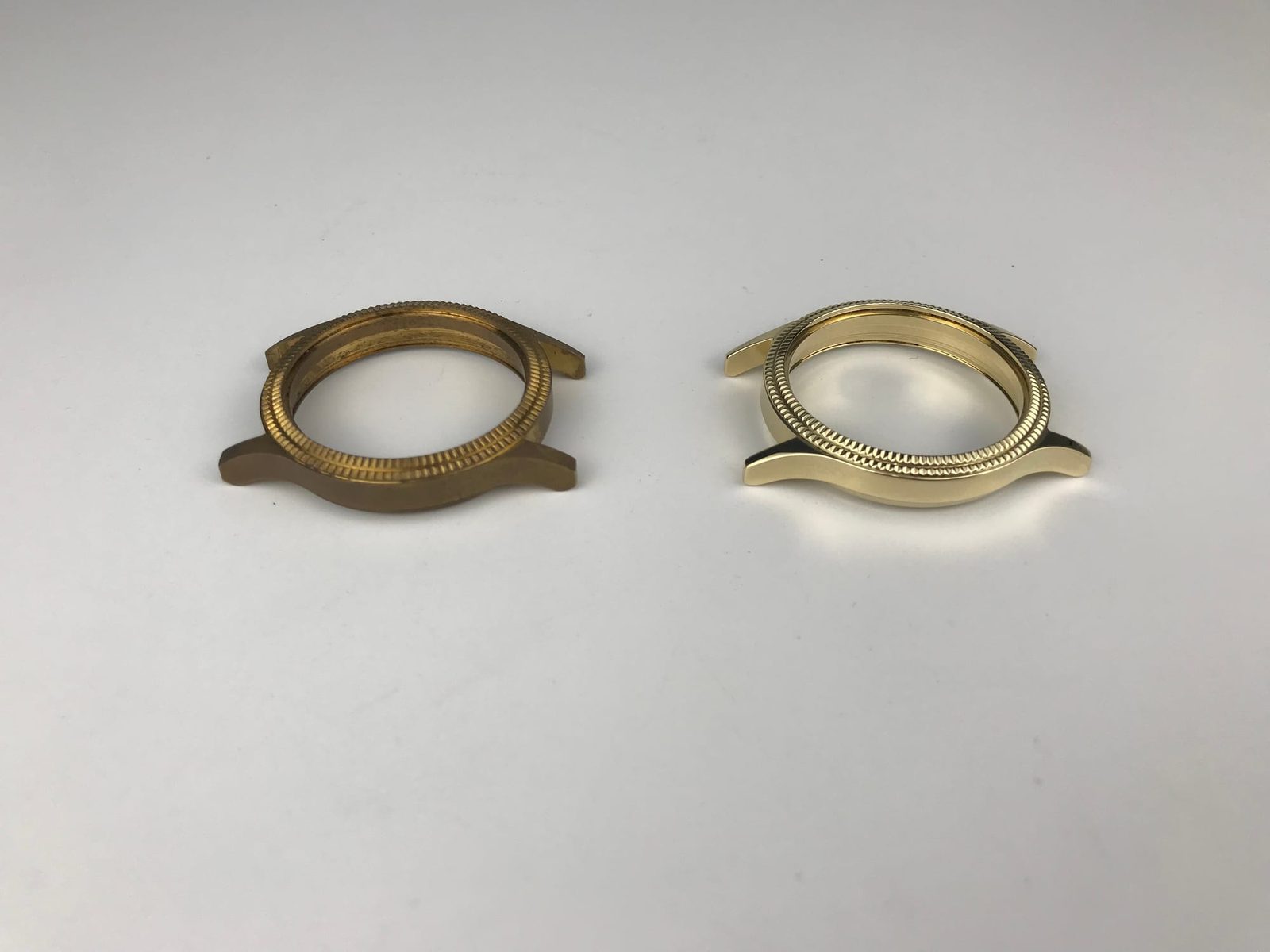
Designing a Bruise-Free Surface Finishing Process for Aluminium
A repeatable surface finishing process on aluminium separates rough burr removal from bright smoothing, keeping every stage cool, clean, and well-cushioned.
[DESIGN: Five-step aluminium surface finishing process diagram showing raw CNC-milled cavity, plastic-media cut-down, clean rinse, bright burnishing, and spin-dried finish]
Stage 1: Degrease machining coolant and inspect burrs
CNC flood coolant and die-cast release agents coat plastic media immediately, turning abrasive cones into slick, non-cutting shapes. Wash oily parts clean before loading any aluminum polishing machine, and trim oversized gate stubs or heavy saw flash upstream. Check grinding and sanding marks for why levelling deep mechanical marks upstream saves hours inside the tumbler.
Stage 2: Resin-bonded plastic media cut-down
Load preformed resin-bonded plastic cones or pyramids from our grinding media range—never heavy cutting ceramic—to erase CNC milling steps, parting lines, and sharp burrs. Plastic media shares a softer matrix closer to aluminium, cutting cleanly while leaving a uniform, metal smooth matte base ready for brightening or anodizing prep.
Stage 3: Non-abrasive burnishing or dry organic brightening
When drawings call for a bright lustre rather than uniform matte, follow plastic cut-down with high-alumina ceramic balls or gentle dry organic tumbling in walnut shell and corn cob from our dry finishing media line. Dry corn cob dressed with light polishing cream lifts a clean, warm sheen across pre-smoothed aluminium hardware. Confirm corn cob mesh grade when ordering dry organic media.
Stage 4: Immediate clean rinse and centrifugal spin drying
Residual compound water dries quickly into white mineral rings and dark water stains on bare aluminium. Rinse finished batches promptly in clean water and dry them inside a heat centrifugal spin dryer (35, 35A, 70, or 70A models). See our post-finishing separate wash and dry guide for proper rinse-and-dry cell layout.

Media, Compounds, and Honest Boundaries on Aluminium
Choosing consumables and knowing where our equipment stops prevents unexpected defects or downstream anodizing failures.
| Finishing Stage | Media Choice | Compound / Action | Key Aluminium Guardrail |
|---|---|---|---|
| Burr & CNC Step Removal | Resin-bonded plastic cones / pyramids | Neutral liquid compound (JTJ60 / JTS5 / HM3 support) |
Avoid heavy ceramic triangles on soft alloys |
| Bright Burnishing | Smooth high-alumina spheres or steel balls | Lubricating brightening compound | Cushion heavy parts so balls do not peen flat faces |
| Dry Final Sheen | Conditioned walnut shell or corn cob | Dry barrel polishing paste | Parts must be bone-dry before entering organic media |
| Anodizing / Plating / Clear Coat | Handled by specialist vendor downstream | Not supplied by us | We deliver bare mechanical finish only |

Matching plastic media shape to holes and cooling fins
Aluminium heatsinks, sensor housings, and valve blocks carry tight slots and threaded holes. Cones and pyramids lack parallel flat faces, so they resist bridging across narrow slots better than cubes. Always size plastic media against your smallest hole using worn-chip dimensions so shrinking cones never wedge inside bores.
Verified Jings Polish compounds for non-ferrous metals
Never run aluminium in plain tap water or harsh steel-rust strippers. Use verified fine-metal and brightening compounds—such as compound-JTJ60 (fine metal polishing), compound-JTS5 (thin-sheet precision finishing), and compound-HM3 (final polishing)—to lubricate plastic media and keep fine aluminium swarf suspended until flushed out the drain. We supply liquid compounds for wet media systems and select pastes for dry tumbling, while never designing custom chemical cleaning formulas.
Honest limits: anodizing, plating, and wheel buffing
Many buyers ask whether an aluminum polishing machine replaces bright-dip anodizing, chemical polishing, or cloth wheel buffing. Mass finishing delivers a uniform, metal smooth, non-directional matte, satin, or burnished mechanical finish. We do not offer anodizing, chemical polishing, electropolishing, plating, clear-coat sealing, cloth buffing wheels, or handheld buffers—and we do not operate a contract job shop.
Avoiding silicon-carbide dark smut before anodizing
If your aluminium parts go to decorative anodizing after tumbling, tell your media supplier upfront. Certain heavy abrasive grits leave microscopic dark smut embedded in soft aluminium pores that shows up as cloudy streaks after anodizing. Clean resin-bonded plastic cones paired with thorough rinsing keep aluminium bright and ready for downstream anodizers.
Common Mistakes When Polishing Aluminium in Batches
Avoid these four shop-floor errors when running an aluminum polishing machine across production shifts.
[DESIGN: Troubleshooting matrix showing four aluminium finishing defects: heavy ceramic bruising, dark alkaline staining, wedged plastic cones in screw holes, and white water-spot rings]
Using steel-grade ceramic triangles on thin castings
Trying to speed up aluminium deburring by dumping parts into coarse steel-cutting ceramic triangles bruises corners, batters thin ribs, and leaves deep scratches that take twice as long to smooth out afterward. Always start aluminium cut-down with resin-bonded plastic media matched carefully to alloy softness and part wall thickness. Once a flat face is peened by heavy ceramic, plastic cones cannot lift dents back out.
Running dirty compound water that turns into grey mud
Aluminium fines oxidize rapidly in dirty, recirculated compound water, coating parts in a dull grey film that looks stained even when smooth. Keep bowl drains clear, maintain steady fresh water-and-compound flow, and clean plastic media periodically so the charge stays bright and free of greasy aluminium sludge.

Overloading heavy milled blocks without dividers
Even inside plastic media, heavy billet-machined aluminium manifolds slam into each other if loaded too densely into an open vibratory bowl. Maintain generous media volume or use compartmented rectangular troughs (L1300, L1500, L1800) to keep heavy parts separated cleanly from load to unload. Conservative batch density prevents tumbling dings.
Letting wet aluminium air-dry in stacked baskets
Water trapped between stacked aluminium plates creates white hydroxide water stains within hours. Transfer rinsed loads straight into a heat centrifugal spin dryer (35, 35A, 70, or 70A models) before packing or shipping to anodizing.
How Xiamen Jin Tai Jin Builds Aluminium Finishing Lines
At Xiamen Jin Tai Jin Grinding Technology Co.,Ltd. (brand: Jings Polish), our workshop started in 1992 and our company was formally established in 2002, delivering over 200,000+ sets of grinding and polishing solutions to customers worldwide. Across our catalogue, we manufacture 21 machine platforms backed by 24 granted Chinese IP rights—including 1 invention patent, 17 utility model patents, and 6 design patents—under ISO 9001 certification 00726Q01571R001 (valid 2026-06-03 to 2029-06-02) and CE certifications M.2023.206.C88121 (Vertical, 8 models) and M.2023.206.C88120 (Horizontal, 13 models), valid until 2028-07-24.
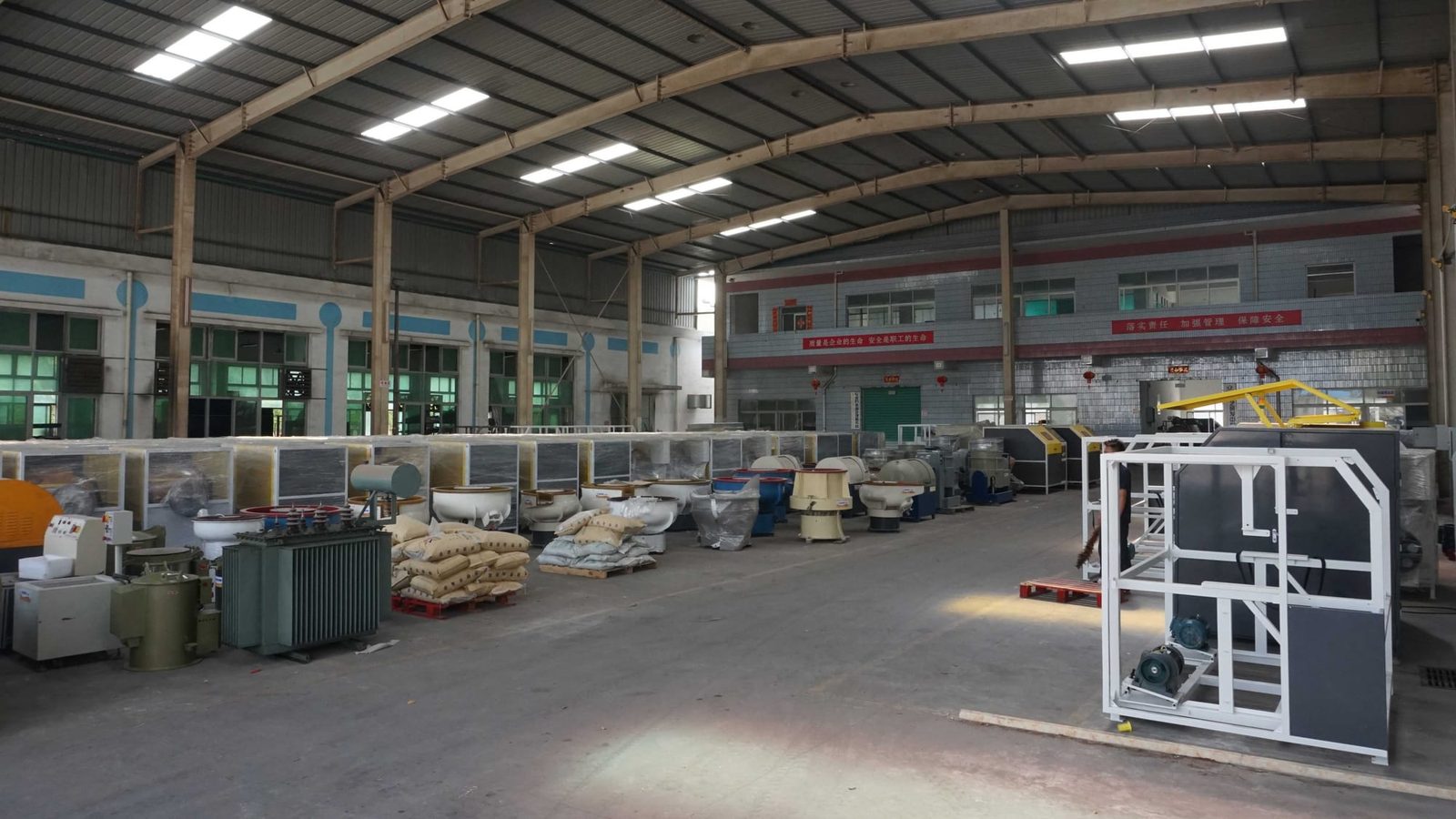
Equipment, plastic media, and compounds we manufacture
We manufacture circular vibratory bowls (ZL series with separation decks), rectangular troughs (L1300, L1500, L1800), barrel finishing machines, centrifugal disc and barrel units (LLF120, LX series), magnetic precision polishers (OBD and HBPG series), drag finishers, heat centrifugal spin dryers (35, 35A, 70, 70A), and media cleaners for automated shop cells. We also manufacture resin-bonded plastic media, high-alumina balls, walnut shell, corn cob, and verified JTJ60, JTS5, HM3, and LC10 compounds for non-ferrous and multi-metal workflows.
Clear boundaries on what we do not supply
In keeping with our choosing a mass finishing supplier and job shop finishing standards, we state our scope plainly. We do not operate a contract job shop or run paid customer parts; we do not offer anodizing, chemical polishing, electropolishing, plating, passivation, or clear-coat sealing; we do not sell cloth buffing wheels, handheld buffers, belt sanders, or blasting abrasives; and we do not design custom chemical cleaning formulas or supply solid wax bars for wheels.
Standard and custom build lead times
Standard aluminum polishing machine configurations ship within a 25 to 35 day production lead time once specifications are confirmed. Custom-engineered rectangular troughs, compartmented dividers, and integrated separation and drying lines require 45 to 60 days to build and test.
Requesting an initial assessment from part photos
We do not promise free mail-in sample trials or guarantee surface roughness values before reviewing your workpiece. Send clear close-up photos of your aluminium parts showing machining marks, thin ribs, hole sizes, alloy grade, target finish, and daily batch target via our custom polishing solution page—our engineers can evaluate your photos and drawings to recommend the right machine and plastic media workflow, including alongside copper alloy finishing or stainless steel finishes.
Frequently Asked Questions
What is the best aluminum polishing machine for CNC-machined housings?
A polyurethane-lined circular vibratory bowl (ZL series) with resin-bonded plastic cones is the standard choice for CNC-machined aluminium housings because it keeps parts cushioned and separates them automatically at unload. For heavy billet blocks that cannot touch each other, use a divided rectangular trough (L1300, L1500, L1800) or a drag finisher.
Why did my aluminium parts turn black or dark grey in the tumbler?
Dark staining happens when aluminium is tumbled with strongly alkaline steel compounds, dirty compound water loaded with oxidized metal mud, or media contaminated with carbon steel dust. Switch to neutral aluminium-safe liquid compound, flush drains cleanly, and keep non-ferrous media strictly separated from ferrous steel charges.
Can an aluminum polishing machine create a mirror finish without a buffing wheel?
Mass finishing with high-alumina balls or dry corn cob produces a clean, bright, non-directional burnished lustre across complex contours and pockets. However, for distortion-free optical mirror reflection on large flat sheets, dedicated cloth wheel buffing (which we do not manufacture) is still required.
What tumbling media makes aluminium smooth without denting corners?
Resin-bonded plastic cones and pyramids deliver a metal smooth matte finish without denting soft aluminium edges or thin cooling fins. Avoid heavy steel-cutting ceramic triangles on thin or soft non-ferrous parts, and size cones against worn-chip dimensions so they never wedge.
How do I prevent water spots on aluminium after wet tumbling?
Rinse finished parts immediately in clean water after unloading and dry them rapidly inside a heat centrifugal spin dryer (35 or 70 series) rather than letting compound water air-dry in open baskets or stacked trays.
What photos should I send before ordering an aluminum polishing machine?
Send clear close-up photos showing current CNC marks or die-cast flash, smallest holes or cooling fin gaps, overall dimensions, part weight, alloy grade, target finish, and daily batch volume. Our engineers can recommend the right chamber architecture and plastic media grade from photos and drawings before quoting.
[DESIGN: Annotated buyer enquiry checklist showing aluminium part photo angles, fin gap measurements, and alloy grade notes]
 +86-592-2381506


 IPv6 network supported
