
Tumbler Media Selection Matrix: Matching Media Body, Grade, and Mass Finishing Compounds
Selecting tumbler media is not about picking the hardest grit on the shelf. In batch mass finishing, the media body, bond strength, shape, and mass finishing compounds work together to cut burrs, protect soft alloys, and keep parts from denting each other inside the chamber. Buying the wrong media for tumbler lines leads directly to lodged chips inside blind holes, bruised flat faces, or slow cycles that stall production.
This guide organizes tumbler media into a practical material-by-grade matrix, clarifies where oxide media, cob media, and polishing rouge fit (and where they do not), and explains how compounds keep the cut open. For machine chamber selection, see our finishing machine names and vibratory finishing guides.
What Tumbler Media Actually Does Inside a Chamber
Every charge of tumbler media performs three physical jobs at the same time inside a vibratory bowl, rotary barrel, or centrifugal unit. Understanding all three stops buyers from treating media like loose sandpaper.
[DESIGN: Cutaway diagram of a vibratory bowl showing tumbler media cushioning parts, carrying compound film, and sliding past internal edges]
Separating parts so they never collide
Inside an active tumbling chamber, parts must stay suspended inside a dense cushion of media. Without enough media volume, heavy metal stampings or machined brass fittings crash against each other, leaving crescent dings that no later polishing stage can hide. The media bed acts as a moving shock absorber that keeps every workpiece isolated.
Carrying water, compound, and cut swarf away
Media surfaces do not cut cleanly on their own; they carry a thin film of water and liquid compound across the metal. As microscopic metal burrs and worn abrasive grains shear off, the spaces between media shapes let water flush swarf toward the drain screen. If media breaks down into mud or packs tightly, swarf recirculates and scratches the batch.
Delivering controlled cutting or burnishing pressure
Heavy ceramic or steel shapes push hard against burrs and sharp edges, while lightweight resin-bonded plastic or dry organic granules glide gently over soft alloys and plastics. Choosing media for tumbler workloads means matching media density to part hardness and wall thickness. Too heavy a media bruises soft metal; too light a media skates over tough steel burrs.
Reaching slots, threads, and recessed corners
A part's smallest hole, slot, or groove sets a hard boundary on media shape and size. Angle-cut cylinders and sharp triangles reach into internal fillets and corners, whereas spheres and cones roll past slots without wedging. Sizing media by the smallest feature on your drawing prevents hours of manual pin-picking after unloading.
The Material × Grade Matrix for Tumbler Media
Across our grinding media and dry finishing media lines, industrial tumbler media falls into five main material families. Each family spans grades from aggressive deburring to gentle final burnishing.
| Media Material Family | Density & Impact Feel | Available Shapes | Typical Grade Focus | Best Workpiece Materials |
|---|---|---|---|---|
| Ceramic & Oxide Media | High density, firm cut | Triangles, angle-cut cylinders, balls | Heavy deburring to fine pre-plate smoothing | Stainless steel, carbon steel, cast iron, hard alloys |
| Plastic (Resin-Bonded) | Medium-light, gentle cushion | Cones, pyramids, triangles | Light deburring, pre-polish before bright stages | Aluminium, brass, zinc die-castings, acrylic |
| High-Alumina Ceramic | Very high density, non-abrasive | Spheres, cylinders | Pure burnishing and surface compression | Stainless steel, brass, copper, forged steel |
| Hardened Steel Media | Maximum weight, zero wear | Balls, pins, satellites, cones | Bright burnishing and peening | Stainless hardware, zinc, copper alloys, brass |
| Walnut Shell & Cob Media | Very light, dry organic | Granular particles | Dry polishing, oil/moisture absorption, final sheen | Acrylic, eyewear acetate, brass, jewellery, stainless |

Ceramic and oxide media for heavy steel deburring
When buyers search for oxide media, they often encounter two completely different products: loose aluminium oxide grit sold for sandblasting cabinets, and preformed aluminium-oxide-bearing ceramic media used in mass-finishing chambers. We do not sell loose sandblasting or shot-blasting abrasives—we manufacture preformed ceramic tumbling chips bonded with aluminium oxide and silicon carbide grits. Ceramic oxide media cuts tough burrs and machining marks on steel and stainless batches while holding its shape across long cycles.
Resin-bonded plastic media for aluminium and soft metals
Aluminium, zinc die-castings, and brass fixtures dent easily if tumbled in heavy ceramic triangles. Resin-bonded plastic cones and pyramids embed fine abrasive grains inside a lighter polymer matrix, cushioning impacts while smoothing machining steps cleanly. See our aluminum finishes and copper alloy finishing guides for how plastic media prevents orange-peel bruising.
High-alumina ceramic for non-abrasive burnishing
Unlike cutting ceramic, high-alumina ceramic media contains virtually no loose cutting grit; instead, it relies on extreme density and smooth, glassy surfaces to compress microscopic metal peaks into a bright lustre. It runs quietly in vibratory bowls and centrifugal discs without contaminating stainless steel with iron fines. High-alumina balls and cylinders bridge the gap between satin smoothing and bright steel burnishing.
Hardened steel media for bright peening lustre
Hardened steel balls, cones, and magnetic pins apply high localized weight to roll surface peaks flat without removing base metal. Because steel media does not wear down into abrasive mud, it keeps water clean and produces bright, reflective hardware. Steel media requires corrosion-inhibiting compound and dedicated rust-free storage between runs.
Walnut shell and cob media for dry brightening
Dry finishing uses crushed walnut shell and cob media (granulated corn cob) inside rotary barrels or heated vibratory dryers. Walnut shell carries slightly more bite for intermediate dry smoothing, while softer cob media absorbs residual moisture, oil, and paste to lift a crisp final sheen—with corn cob mesh grades confirmed per order. Dry organic media never replaces wet deburring; it brightens surfaces that are already smooth.

Choosing Media Shape and Size Without Jamming
Even the right material family fails if the chip shape bridges across a slot or wedges inside a threaded bore. Check these four geometry rules before ordering media for tumbler production.
[DESIGN: Engineering comparison showing a triangle chip wedged inside a slotted bracket versus an angle-cut cylinder and cone clearing the same slot cleanly]
Triangles and angle-cut triangles for flat faces and corners
Straight triangles expose flat faces to planar surfaces while their corners reach into sharp inside fillets. Angle-cut triangles and angle-cut cylinders add sharp acute tips that slice into narrow slots without flat-stacking against each other. When parts have long flat plates alongside tight corner burrs, angle-cut shapes resist sticking better than straight cubes.
Cones and pyramids for curved contours and blind holes
Conical and pyramidal shapes lack parallel flat sides, so they rarely bridge across round bores or stick face-to-face on stamped sheet metal. Plastic cones are the default choice for die-cast housings, valve bodies, and decorative trim with curved recesses. Cones wear evenly from tip to base, keeping their rolling action predictable as the charge ages.
Cylinders and balls for open bores and burnishing
Cylinders tumble smoothly without snagging thin wire forms, while spheres roll freely through open channels and concave dishes without gouging soft metal. Balls provide uniform point-contact burnishing on spoons, buckles, and bearing cages. If a part has round holes near the media diameter, avoid balls that can plug the bore permanently.
Sizing against worn media rather than brand-new chips
Every cutting chip shrinks steadily as it works. A ceramic triangle sized slightly larger than a part's slot when brand new will shrink enough within weeks to wedge tightly inside that very slot. Always size media so that even near the end of its usable life, it either clears the hole easily or remains safely larger than the widest opening.

Mass Finishing Compounds vs Polishing Rouge
Many buyers ask whether they should drop a bar of polishing rouge into a tumbler alongside ceramic or corn cob media. The short answer is no—solid wax bars belong on spinning cloth wheels, not inside mass-finishing chambers.
| Consumable Type | Physical Form | Intended Equipment | Shop-Floor Role |
|---|---|---|---|
| Wet Mass Finishing Compounds | Liquid concentrate diluted in water | Vibratory bowls, centrifugal units, wet barrels | Lubricates media, suspends metal swarf, prevents rust |
| Dry Tumbling Polishing Paste | Cream or paste pre-blended into dry media | Double-barrel and double-deck dry tumblers | Coats walnut or cob media evenly for dry brightening |
| Traditional Polishing Rouge | Solid wax/fatty binder bar | Stationary or handheld cloth buffing wheels | Transfers dry abrasive onto spinning fabric wheels |

Why solid polishing rouge fails inside wet tumblers
Traditional polishing rouge uses tallow, stearic acid, and wax binders designed to melt under friction heat against a fast-spinning cotton wheel. Inside a cool, water-flooded vibratory bowl, solid rouge bars never melt evenly; they smear sticky grease onto ceramic chips, blind the abrasive pores, and choke drainage screens. We do not sell cloth buffing wheels or solid wax bars for cloth wheels.
What liquid mass finishing compounds actually do
Modern mass finishing compounds are water-soluble liquids metered continuously or added per batch to control friction, pH, and cleanliness. They keep metal fines suspended in water so they flush away instead of staining parts grey, protect ferrous metals from flash rust, and cushion media-to-part contact. Running ceramic or steel media in plain tap water ruins both finish clarity and media cut rate.
Verified Jings Polish compound codes by job
We supply verified liquid compounds for wet media systems and select pastes for dry media tumbling routes, while never designing custom chemical cleaning formulas. Match our real compound codes directly to your metal and stage:
compound-LC10: Heavy deburring and rapid edge-breaking cycles.compound-MC8: Rust, scale, and heavy oxide removal on ferrous parts.compound-JTJ20: Coarse cutting and smoothing on stainless steel.compound-JTJ25: General metal coarse polishing and cut-down.compound-JTJ50: Brightening and lustre development on stainless steel.compound-JTJ60: Fine metal polishing across mixed alloy batches.compound-JTS5: Fine polishing tailored for thin-sheet metal parts.compound-HM3: Final polishing and clean brightening support.
Dry polishing pastes for walnut shell and cob media
For dry barrel brightening of acrylic, brass, or pre-smoothed hardware, specialized polishing creams coat dry organic granules cleanly without gumming. Always pre-blend paste with walnut shell or cob media alone before adding parts so every granule carries an even micro-film. Dumping paste directly onto dry parts packs waxy residue into threads and engraved logos.

Matching Tumbler Media to Metal and Plastic Families
Different workpiece materials fail for completely different reasons inside a tumbling barrel. Use these four material rules to pair tumbler media safely with your parts.

Stainless steel and carbon steel hardware
Hard steels resist cutting and easily swallow light abrasive grains without changing roughness. Pair tough ceramic or oxide media with compound-JTJ20 or compound-LC10 for deburring, then switch to high-alumina ceramic or steel media with compound-JTJ50 for brightening. See our stainless steel finishes and buffing stainless steel guides for stage sequencing.
Aluminium and zinc die-castings
Soft non-ferrous castings bruise quickly under heavy ceramic chips and turn dark grey if compound chemistry is too alkaline. Use lightweight resin-bonded plastic cones with neutral liquid compound for cut-down, keeping media-to-part volume generous so castings never strike one another. Never run aluminium and steel parts in the same media charge, or embedded iron will pit the aluminium.
Brass, copper, and bronze fittings
Copper alloys tarnish rapidly if left wet or exposed to aggressive acids, yet brighten quickly when supported by gentle plastic cut-down followed by steel burnishing or dry cob media. After wet tumbling, rinse and dry immediately in a centrifugal spin dryer to lock in clean golden tone. Check our copper alloy finishing guide for stain prevention.
Acrylic, eyewear acetate, and machined plastics
Plastic parts demand gentle plastic wet-cut media followed by dry walnut shell and cob media dressed with clean polishing paste. Heat buildup smears PMMA, while metal dust left in shared barrels scratches transparent faces instantly. Dedicate separate barrels and media charges strictly to plastic and acrylic production.
Media Maintenance, Cleaning, and Replacement Signals
Even the best media for tumbler systems loses cutting speed when pores load up with metal mud or worn fines. Simple housekeeping keeps cycle times predictable week after week.
Screening out undersized fines before they lodge
As ceramic and plastic chips wear, broken fragments and undersized chips accumulate at the bottom of the charge. Those fragments wedge into slots that full-sized chips could never enter and cushion impact unevenly. Run the charge over a sizing screen regularly to discard undersized fines and top up with fresh media.
Washing glazed ceramic and fouled steel media
Ceramic media glazed with dried compound dust skates across burrs instead of cutting, while steel balls coated in oil film leave greasy parts. Running an empty wash cycle with clean water and compound—or using a dedicated media cleaning machine—strips embedded grime and restores cut rate. Clean media cuts faster and leaves brighter parts than an overloaded charge of dirty chips.
Preventing cross-contamination between alloys
Switching a vibratory bowl from carbon steel to stainless steel—or from brass to aluminium—without changing and thoroughly washing the chamber transfers iron dust and dark oxides into the next batch. Dedicate separate media bins for ferrous, non-ferrous, and plastic lines. One contaminated media charge can ruin an entire shift of corrosion-resistant stainless parts.
Knowing when to retire spent walnut and cob media
Dry walnut shell and cob media do not wear out by chipping; they saturate with polishing paste, fine dust, and ambient humidity. Once dry media looks dark grey, feels damp, or leaves a hazy film on parts, no amount of extra paste will restore it. Retire spent dry organic charges on schedule rather than chasing haze with more compound.
Common Tumbler Media Buying Mistakes
Avoid these four purchasing traps when sourcing tumbler media and mass finishing compounds for a new or expanding finishing cell.
[DESIGN: Four-panel defect chart illustrating lodged ceramic chips in a valve hole, bruised aluminium corners, glazed dirty media, and clumped wet cob media]
Buying one universal chip grade for every part
Trying to deburr heavy laser-cut steel and smooth delicate brass stampings with a single medium-grade ceramic chip guarantees slow steel cycles and dented brass. Stock separate cutting ceramic and gentle plastic media grades matched to your active part families. Two properly matched media charges cost less in scrap than one compromised universal chip.
Confusing blasting grit with preformed tumbling media
Ordering loose oxide media meant for air-blast cabinets and dumping it into a vibratory bowl creates thick abrasive mud that ruins seals, blinds drains, and fails to cushion parts. Mass finishing relies on preformed bonded shapes—triangles, cones, cylinders, and balls—engineered to roll and separate parts. Always specify preformed mass-finishing media rather than loose blasting grit.
Running dry cob media straight after wet tumbling
Pulling wet parts out of a vibratory rinse and tossing them directly into dry cob media turns the corn cob into sticky clumps within minutes. Always separate wet cutting from dry brightening with a clean water rinse and full drying step—see our post-finishing separate wash and dry guide for proper cell layout.
Skipping upstream grinding mark checks
Media polishing cannot erase deep bandsaw chatter or heavy belt scratches without rounding precision edges beyond tolerance. Check incoming surface state before loading the tumbler, just as outlined in our grinding and sanding marks guide. Level heavy mechanical marks upstream so your tumbling media can focus on edges and finish grade.
How Xiamen Jin Tai Jin Supports Complete Media & Machine Lines
At Xiamen Jin Tai Jin Grinding Technology Co.,Ltd. (brand: Jings Polish), our workshop began in 1992 and our company was formally established in 2002, delivering over 200,000+ sets of grinding and polishing solutions to customers worldwide. Across our machines and consumables catalogue, we manufacture 21 machine platforms backed by 24 granted Chinese IP rights—including 1 invention patent, 17 utility model patents, and 6 design patents—under ISO 9001 certification 00726Q01571R001 (valid 2026-06-03 to 2029-06-02) and CE certifications M.2023.206.C88121 (Vertical, 8 models) and M.2023.206.C88120 (Horizontal, 13 models), valid until 2028-07-24.

Media, compounds, and machines built together
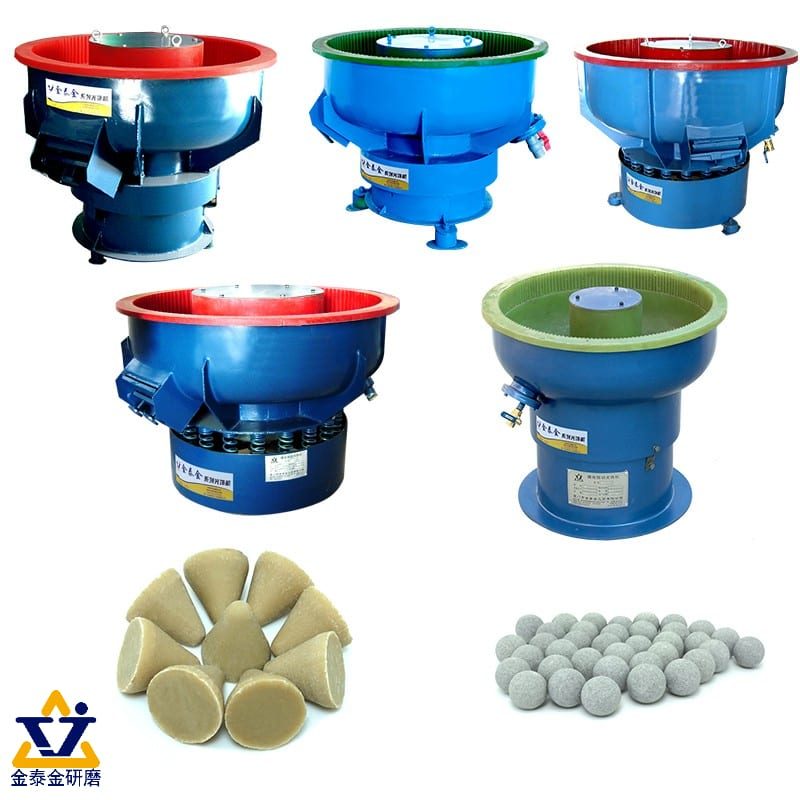
We manufacture vibratory bowls and tubs (ZL and L series), barrel finishing machines, centrifugal disc and barrel units, drag finishers, magnetic polishers, heat centrifugal spin dryers, and media cleaners. Alongside equipment, we supply ceramic, plastic, high-alumina, steel, walnut shell, and cob media, paired with our verified HM3, JTJ20, JTJ25, JTJ50, JTJ60, JTS5, LC10, and MC8 compounds.
Honest boundaries on what we do not supply
In keeping with our choosing a mass finishing supplier checklist, we state our limits clearly. We do not supply loose sandblasting or shot-blasting abrasives (such as blasting glass bead, garnet, or loose grit); we do not sell cloth buffing wheels, solid polishing rouge wax bars for wheels, or handheld grinders; we do not design custom chemical cleaning formulas; and we do not operate a contract job-shop polishing service.
Standard and custom lead times
Standard equipment and media configurations carry a 25 to 35 day production lead time, while custom-engineered finishing lines and specialized separation layouts require 45 to 60 days. Always confirm corn cob mesh grade and part-specific media sizing when finalizing your order.
Requesting an initial media and process assessment
We do not promise free mail-in sample trials or guarantee cycle times before reviewing your workpiece. Instead, send clear photos of your parts showing burrs, holes, slots, and target finish via our custom polishing solution or job shop finishing resources—our engineers can make an initial media and machine recommendation directly from clear photos and drawings.
Frequently Asked Questions
What is the best all-around tumbler media for metal parts?
There is no single media for every metal. Ceramic or oxide media handles hard steel and stainless deburring, resin-bonded plastic cones protect soft aluminium and brass, and high-alumina ceramic or hardened steel media delivers bright burnishing. Match the media family to your alloy hardness and target finish.
What is cob media used for in mass finishing?
Cob media (granulated corn cob) is a lightweight dry organic medium used inside rotary barrels or heated vibratory dryers for final brightening, moisture absorption, and removing trace oil or compound film from pre-smoothed metal, brass, and acrylic parts.
Can I put solid polishing rouge bars into a vibratory tumbler?
No. Solid polishing rouge wax bars are formulated to melt onto high-speed cloth buffing wheels. Inside a water-cooled tumbler, solid wax smears sticky buildup across media pores and clogs drains; use water-soluble liquid mass finishing compounds for wet tumbling or dedicated pastes for dry organic media.
How do I stop tumbler media from getting stuck in part holes?
Measure the smallest hole, slot, or thread on your part drawing and choose a media shape and size that either stays safely larger than the opening—even after normal wear—or passes straight through without wedging. Avoid spherical media when parts have circular holes close to the ball diameter.
 +86-592-2381506


 IPv6 network supported
