
Mass Finishing for Aerospace Components: Zero-Collision Finishing, Traceable Recipes, and Honest Compliance Boundaries
Aerospace manufacturing engineers searching for mass finishing for aerospace or itar compliant surface finishing face much tighter constraints than general commercial hardware shops. Turbine blades, titanium structural brackets, landing-gear linkages, and Inconel fasteners cannot tolerate part-on-part collision dings, embedded carbon-steel dust, uncontrolled edge rounding, or undocumented "operator-feel" recipes—and buyers also need straight answers on what an equipment manufacturer supplies versus what certified aerospace job shops handle under defense-export programs.
The central thesis of this guide is direct and honest: aerospace mass finishing delivers repeatable fatigue-life smoothing, burr-free lightening pockets, and zero-collision surface refinement when built around fixtured drag finishing, divided troughs, alloy-dedicated media, and documented process parameters—while formal ITAR registration, NADCAP special-process accreditation, and contract job-shop processing remain the responsibility of the aerospace prime or its accredited domestic subcontractor. For related precision workflows, see our drag finishing guide and aluminum isotropic finishing guide.
Why Aerospace Parts Require Zero-Collision Mass Finishing
Aerospace structures push strength-to-weight ratios to the limit, leaving zero margin for surface stress risers or handling nicks.

Eliminating CNC Step-Over Cusps Without Thinning Structural Webs
Five-axis milled 7075 aluminum ribs and Ti-6Al-4V titanium brackets carry thin pockets next to critical bearing bores. Removing directional ball-mill cusps lowers notch sensitivity and extends fatigue life, provided media size and cycle time smooth peaks without thinning structural walls or violating edge-radius blueprints. Keeping Stage 1 plastic or fine ceramic cycles calibrated against first-article wall-thickness checks ensures fatigue smoothing never compromises structural margins.
Why Free-Tumbling Open Bowls Fail on Heavy Flight Hardware
Dumping precision machined titanium housings, turbine blades, or hardened actuator shafts loose into an open circular bowl guarantees part-on-part collision nicks. A single bright crescent ding on a turbine airfoil or sealing flange scraps an expensive multi-axis component. Even raising media-to-part ratios cannot fully protect heavy, asymmetric flight parts inside an un-divided circular bowl—fixtured drag finishing or padded divided troughs are required whenever zero collision is mandatory.
Alloy Segregation Against Galvanic and Foreign-Object Contamination
Embedded carbon-steel particles on titanium or aluminum, or stray broken ceramic chips lodged inside blind hydraulic ports, create catastrophic corrosion and foreign-object damage (FOD) risks in flight hardware. Strict media segregation and post-cycle bore inspection are non-negotiable. Color-coding every media drum, screen deck, rinse basket, and spin-dryer liner by alloy family keeps ferrous dust completely away from flight aluminum and titanium.
Protecting Thin Trailing Edges on Blades and Impellers
Compressor blades and centrifugal impellers taper down to delicate trailing edges that erode rapidly if hit head-on by heavy media. In planetary drag finishing, orienting blade fixtures and programming gentle spindle rotation ensures media flows smoothly along the airfoil chord rather than hammering thin trailing edges out of contour.
Handling Additive-Manufactured (3D-Printed) Aerospace Brackets
Laser-sintered titanium and Inconel aerospace brackets arrive with rough partially sintered powder skin and internal support-mark stubs. High-density preformed ceramic media in a drag finisher or cushioned vibratory bowl smooths accessible exterior skins cleanly—though deep internal lattice channels that loose stones cannot physically enter still require upstream machining or specialized internal flow work.
Pre-Anodize and Pre-FPI Surface Hygiene
Fluorescent penetrant inspection (FPI) and aerospace anodizing fail immediately if residual tumbling soap, silicone wax, or heavy metal smut lingers inside surface pores. Always use clean flow-through water, neutral or dedicated non-smutting chemistry, and heated centrifugal spin-drying before moving flight parts to inspection or surface-treatment baths.
| Aerospace Component | Primary Finishing Objective | Collision / FOD Risk if Mishandled | Controlled Mass-Finishing Solution |
|---|---|---|---|
| Turbine blades & compressor airfoils | Directional cusp removal & plateau finish | Airfoil leading-edge nicks & profile distortion | Planetary fixtured drag finishing in fine plastic/porcelain |
7075 / 6061 structural ribs & brackets |
Burr removal & anodize-ready smooth skin | Wall thinning, high-pH etching, iron pitting | Divided trough + neutral chemistry + dedicated plastic cones |
| Titanium & Inconel fasteners / clips | Tough burr removal & thread-root clean | Galling, thread crest peening, embedded steel | Cushioned vibratory bowl + high-density ceramic + LC10 |
| Hydraulic manifold & actuator housings | Internal cross-bore feather-burr removal | Lodged ceramic slivers in fluid passages | Wide-table OBD magnetic tumbler + pin recovery check |
[DESIGN: Four-panel comparison showing CNC cusp stress risers, collision nicks, iron contamination, and zero-collision drag finishing]
Equipment Platforms for Aerospace Mass Finishing
Selecting the right chamber isolates high-value components and keeps process energy repeatable across shifts.

Fixtured Drag Finishing for Blades, Impellers, and Critical Rotors
In a drag finishing machine, each blade, impeller, or actuator shaft locks onto an individual rotating spindle on a planetary head and sweeps cleanly through stationary fine ceramic, plastic, or porcelain media. Zero part-on-part contact occurs, while spindle immersion depth and RPM stay programmable per part number.
Divided Rectangular Vibratory Troughs for Large Structural Ribs
Long aerospace wing ribs, bulkhead frames, and heavy landing-gear brackets require a rectangular vibratory trough fitted with polyurethane-lined dividers. Individual padded cells allow media and neutral compound to circulate evenly around lightening pockets without adjacent parts colliding.
Wide-Table OBD Magnetic Polishers for Internal Fluid Passages
Aerospace hydraulic blocks and fuel-control fittings contain intersecting drillings where loose ceramic cones bridge or lodge. A wide-table OBD magnetic tumbler drives fine 304 stainless pins into internal bores to strip machining fuzz cleanly—always followed by bright-light bore inspection and magnetic recovery sweeps.
Reinforced Vibratory Bowls for Compact Aerospace Fasteners and Clips
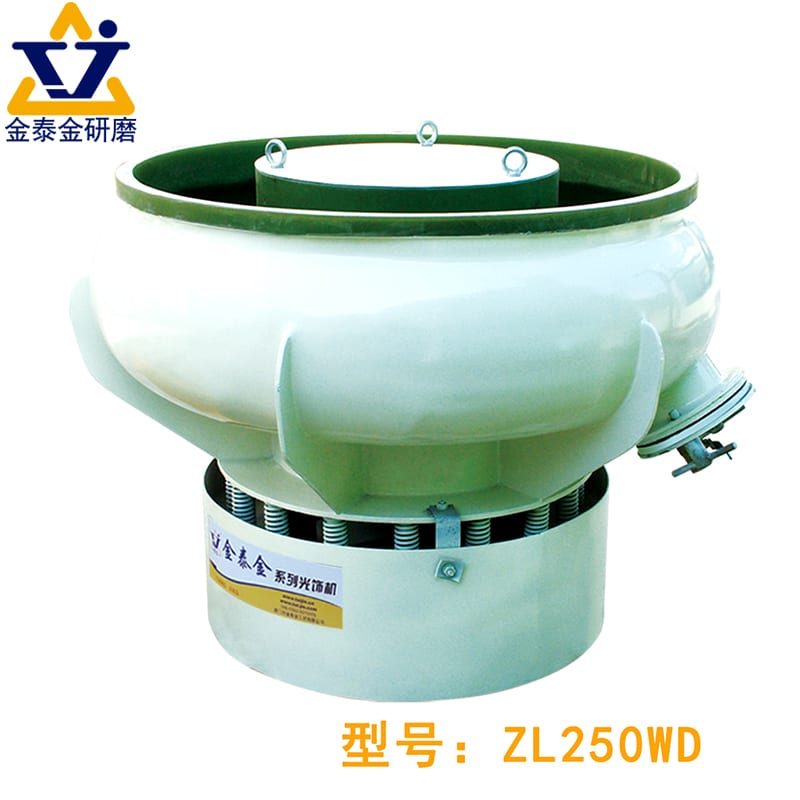
High-volume aerospace rivets, nut plates, and stamped clips run reliably in polyurethane-lined vibratory bowls equipped with metered flow-through dosing and dedicated screen decks, provided media-to-part volume stays generous to protect thread pitch. See our bolt and fastener tumbling guide.

Media Selection and Alloy Segregation Discipline
Aerospace alloys—titanium, Inconel, 17-4PH stainless, and 7075 aluminum—respond differently to media hardness and bulk density.
[DESIGN: Preformed ceramic triangles, resin-bonded plastic cones, and high-alumina porcelain spheres]
High-Density Ceramic vs. Resin-Bonded Plastic by Alloy
Hard nickel-base superalloys (Inconel), titanium forgings, and 17-4PH stainless steel require dense preformed ceramic media paired with LC10 compound to cut tough burrs effectively. By contrast, 6061/7075 aluminum and magnesium housings require low-density resin-bonded plastic cones with neutral chemistry (JTS5 / neutral LC10) to prevent edge bruising and chill-skin erosion. Compare media families in our tumbler media selection matrix.
High-Alumina Porcelain Spheres for Plateau Superfinishing
After Stage 1 removes tool cusps and sharp burrs, rinsed aerospace components transition into smooth high-alumina porcelain spheres to lower peak-to-valley roughness cleanly without tearing metal—supporting superfinishing and Ra reduction targets.
Strict Drum, Screen, and Basket Segregation by Alloy
Never run titanium or 7075 aluminum in media charges, screen decks, or spin-dryer baskets that ever touched carbon steel or brass. Dedicated, color-coded media drums and rinse stations eliminate iron-transfer pitting before anodizing or fluorescent penetrant inspection.
Screen-Deck Purging to Prevent Media Fragment Lodging
Schedule deck checks to purge worn undersized ceramic or plastic chips before broken slivers approach the width of lightening slots or hydraulic ports. Keeping fresh, full-size media in the chamber ensures predictable cutting pressure and clean separation.

Chemistry, Rinsing, and Traceable Process Control
Aerospace quality teams need documented, repeatable parameters—not operator guesswork.

Metered Flow-Through Dosing vs. Recirculated Sump Slurry
Recirculating dirty sump water coats aerospace alloys in gray metallic sludge and varies cut rate across the shift. Pair vibratory bowls and drag cells with metered fresh-water and liquid-compound dosing pumps so lifted fines flush continuously out the drain.
Neutralizing and Clean Rinsing Prior to NDT or Anodizing
Residual alkaline soap or descaler left inside blind pockets interferes with fluorescent penetrant inspection (FPI), anodizing, and chemical conversion coatings. Flush parts immediately in clean water—using filtered or deionized final rinse water where plant water is hard—and dry them inside a heated centrifugal spin dryer.
Locking Down Recipe Sheets: Media Grade, Speed, Time, and Dosing
Every aerospace part number should run under a locked recipe card specifying media shape/grade, chamber fill level, VFD speed, compound dilution rate, cycle duration, and post-cycle bore-inspection checks so batches stay repeatable across operators and shifts.
Honest Compliance Boundaries: ITAR, NADCAP, and Export Control
Buyers searching itar compliant surface finishing must separate finishing machinery supply from regulated defense-article processing:
| Responsibility Area | What Equipment Manufacturer Supplies | What Aerospace Prime / Accredited Shop Owns |
|---|---|---|
| Industrial mass-finishing machinery & media | Drag finishers, divided troughs, bowls, media, compounds | Installing & qualifying equipment inside controlled facility |
| Data & technical-drawing security | Standard machine quoting from unclassified photos/dimensions | ITAR export-control compliance, controlled drawings, domestic processing |
| Special-process certifications | ISO 9001 (00726Q01571R001) & CE machine certs |
Aerospace prime special-process accreditation & flight-lot signoff |
| Non-destructive & chemical testing | Clean mechanical deburring & surface smoothing | FPI, acid passivation, anodizing, shot-peening, and lab certification |
[DESIGN: Heated centrifugal spin dryer removing moisture from precision alloy components]
Four Common Aerospace Mass Finishing Failures and How to Diagnose Them
Failure Mode 1: Micro-Nicks on Precision Airfoils or Sealing Flanges
Expensive machined parts exit with tiny crescent dings on sharp edges.
Diagnostic rule: If crescent dings appear on heavy or delicate flight parts, free-tumbling collision occurred—move parts immediately from open bowls into fixtured drag finishing spindles or padded divided troughs.
Failure Mode 2: Embedded Iron Pitting Revealed During Anodizing or Humidity Checks
7075 aluminum or titanium brackets develop dark corrosion specks downstream.
Diagnostic rule: If pitting appears after anodizing or storage, media or rinse baskets were contaminated with carbon-steel iron dust—purge contaminated media and enforce dedicated alloy-only drums, screens, and dryers.
Failure Mode 3: Over-Rounded Edge Chamfers Before Pocket Cusps Clear
Outer edges exceed blueprint maximum radius while deep milling scallops remain visible.
Diagnostic rule: If outer corners round faster than internal pockets smooth, media shape is too large/aggressive or cycle ran too long—step down to smaller plastic/ceramic grades and isolate internal bore burrs to magnetic pin cycles.
Failure Mode 4: Lodged Media Chips or Stray Pins Inside Hydraulic Ports
Bores fail clean-air or pin-gauge FOD checks after unloading.
Diagnostic rule: If particles lodge inside ports, cap critical holes before tumbling, size media strictly larger than openings, and run bright-light bore inspection plus magnetic sweep checks at unload.
| Symptom on Flight Part | Root Cause | Immediate Fix |
|---|---|---|
| Crescent dings on edges | Free-tumbling part collision | Switch to drag fixtures or divided trough |
| Iron pitting after anodize | Carbon-steel cross-contamination | Enforce dedicated alloy-only media & baskets |
| Over-rounded outer corners | Oversized media / long Stage 1 cut | Step down media size; split internal bore pin clean |
| Lodged media / stray FOD | Unmasked ports or worn undersize media | Mask bores; purge undersize media; inspect bores |

Honest Capability Boundaries and Production Standards
What We Supply and What We Do Not Supply
At Xiamen Jin Tai Jin Grinding Technology Co.,Ltd. (brand: Jings Polish), our workshop roots date back to 1996 and our company was formally established in 2009, delivering over 200,000+ sets of grinding and polishing solutions worldwide. Across our catalogue, we manufacture 21 machine platforms backed by 24 granted Chinese IP rights (1 invention patent, 15 utility model patents, and 8 design patents), under ISO 9001 certification 00726Q01571R001 (valid 2026-06-03 to 2029-06-02) and CE certifications M.2023.206.C88121 (Vertical, 8 models) and M.2023.206.C88120 (Horizontal, 13 models), valid until 2028-07-24.
To state our aerospace boundaries with complete transparency: we supply industrial mass finishing machinery (drag finishers, divided rectangular vibratory troughs, vibratory bowls, centrifugal disc finishers, wide-table OBD magnetic tumblers, heated centrifugal spin dryers), tumbling media, and catalog compounds (LC10, MC8, JTJ50, JTS5); we do NOT hold ITAR registration or aerospace special-process service accreditation, we do NOT supply acid passivation, anodizing, or shot-peening lines, and we do NOT provide contract job-shop aerospace finishing services. Aerospace facilities buy our machines to operate inside their own controlled, accredited manufacturing cells.
Integrating Mass Finishing Into Aerospace Manufacturing Cells
Installing a drag finisher or divided trough inside a controlled aerospace plant requires clean floor planning, waste settling, and repeatable inspection gates.
Floor Layout, Settling Tanks, and Clean Rinse Stations
Wet deburring of titanium, Inconel, and 7075 aluminum generates fine metallic and ceramic slurry. Route chamber drains through dedicated multi-baffle settling tanks—keeping aluminum settling separate from steel/titanium tanks—and place clean-water rinse stations plus heated centrifugal spin dryers right beside unload chutes so parts never sit damp in open baskets.
First-Article Qualification and Edge-Radius Verification
Before locking any aerospace part number into production, run documented first-article trials checking three physical gates: confirm edge-radius growth stays inside drawing limits on an optical comparator, verify directional CNC scallops are gone perpendicular to feed marks, and confirm zero residual media particles or stray pins remain inside hydraulic ports or blind bores. For related precision engine and gear workflows, see our gear and crankshaft polishing guide and propeller and turbo polishing guide.
Maintaining Media Charge Consistency Across Multi-Shift Production
In aerospace cells, media wear changes cutting pressure gradually over weeks. Track media size via scheduled screen-deck purges to drop undersize chips out before they reach hole-lodging dimensions, and top up with fresh full-size ceramic, plastic, or porcelain media so cycle times remain identical from Monday morning through Friday afternoon. Comparing centrifugal disc finishing against fixtured drag finishing also helps plants match throughput cleanly across small clips versus heavy blades.
Protecting Finished Flight Hardware During Packaging and Transit
Even a flawless drag-finished titanium bracket or aluminum housing can pick up handling scratches if tossed loose into bulk metal totes. Transfer dried components directly into clean, compartmentalized foam-lined trays with lot-traceability tags attached before moving batches to FPI, anodizing, or final assembly.

Honest Lead Times and Unclassified Engineering Review
Standard machines ship in 25–35 days, while custom drag-finishing fixtures and divided troughs require 45–60 days. Because we never ask buyers to send export-controlled drawings or physical flight hardware across borders, we do not promise free sample trials by mail or guarantee cycle times without reviewing part geometry—send unclassified photos or basic overall dimensions of representative test shapes and target roughness via our custom polishing solution page for an initial equipment recommendation.
Frequently Asked Questions
What is the safest mass finishing machine for aerospace turbine blades and impellers?
A planetary drag finishing machine is the safest choice because each blade or impeller mounts on its own rotating spindle, eliminating part-on-part collision while delivering uniform media flow across airfoils.
Do you provide ITAR compliant surface finishing as a contract service?
No. We manufacture and supply industrial mass finishing machines, media, and compounds for customers to install inside their own controlled facilities—we do not provide contract job-shop finishing, and we do not hold ITAR or NADCAP service accreditation.
How do you prevent foreign-object damage (FOD) from tumbling media inside hydraulic manifolds?
Cap critical ports with fitted plugs before tumbling, choose media strictly larger than unmasked openings, screen out worn undersize media fragments regularly, and inspect all internal bores under bright task lighting after spin-drying.
Can aluminum and titanium aerospace parts share the same vibratory media charge?
While both require zero carbon-steel iron contamination, keep 7075 aluminum (which needs soft plastic cones and neutral chemistry) separate from titanium or Inconel (which often require harder ceramic cutting media) so neither alloy suffers cross-contamination or bruising.
Does mass finishing replace shot peening or acid passivation on aerospace parts?
No. Mass finishing removes burrs and lowers surface roughness mechanically, whereas certified fatigue shot peening, ASTM acid passivation, and anodizing are separate downstream special processes.
Why do thin-walled aerospace brackets warp or lose flatness during bulk tumbling?
Long, slender ribs and thin milled webs deflect whenever heavy ceramic media piles onto unsupported spans in a deep bowl or rotary barrel. If a bracket bends even slightly under media weight, post-finishing CMM inspection will reject it for out-of-profile distortion even if every burr is gone. Prevent deflection by switching heavy-walled brackets to lighter plastic cones, shortening free-fall drop in rotary drums, or mounting thin structural components on dedicated drag-finishing spindles where parts slice cleanly through the media bed without colliding against each other.
How do maintenance and MRO teams avoid damaging turbine-engine dovetail roots during refurbishment?
During overhaul cleaning and light edge blending, dovetail roots and fir-tree serrations cannot tolerate aggressive stock removal that alters dimensional fit or induces uneven compressive stress. Instead of coarse cutting stones, MRO facilities pair gentle, non-abrasive plastic or fine ceramic media in divided vibratory tubs or drag finishers with controlled neutral compounds. Every media charge must be screened regularly so fractured ceramic chips cannot wedge into tight cooling slots or score critical root radii.
What separates an aerospace-ready finishing cell from a standard commercial job-shop vibratory tub?
Beyond alloy-segregated PU linings and stainless-steel hardware, an aerospace-ready finishing cell emphasizes repeatable process control: dedicated media storage bins per alloy family, closed-loop compound dosing pumps, inline media-screening separators that reject undersized fragments automatically, and forced hot-air drying in centrifugal or cob dryers immediately after rinsing to stop water spotting before fluorescent penetrant or ultrasonic inspection.
What unclassified details should I share before requesting a quote for aerospace finishing equipment?
Send unclassified representative photos or overall envelope dimensions, alloy family, minimum bore/slot sizes, target surface roughness, and hourly throughput. Also note whether any thin ribs, threaded bosses, or bearing journals require masking plugs or fixture clamping before processing. Our engineers can recommend the right drag finisher, divided trough, and media setup without requiring controlled prints, and can arrange wet or dry trial validation on non-controlled sample coupons before you commit to full-line machine commissioning.
[DESIGN: Annotated buyer enquiry checklist showing unclassified part envelope, alloy family, bore sizes, and hourly throughput]
 +86-592-2381506


 IPv6 network supported
