
Polishing Valves and Fluid Fittings in Production: Protecting Sealing Seats While Deburring Bodies
Valve manufacturers and fluid-control shops searching for polishing valves face a tough geometric paradox: the outer body and wrench flats need aggressive deburring and bright cosmetic finishing, while precision seating lands, O-ring grooves, and internal threads cannot tolerate even minor edge rounding or media impact. Dumping raw valve bodies into an oversized vibratory bowl with heavy ceramic stones strips burrs quickly—and destroys sealing seats in the same cycle.
The central principle of this guide is simple: successful valve finishing separates body smoothing from seat protection, matching chamber motion, divider geometry, and non-lodging media to the valve's most fragile sealing feature. For related hardware workflows, see our pipe edge finishing equipment guide and gear and crankshaft polishing guide.
Why Valve Bodies and Engine Valves Fail in Generic Tumblers
Fluid-control valves, gas valves, flush sleeves, and poppet engine valves all share high-precision mating zones right next to rough-cast or machined exteriors.
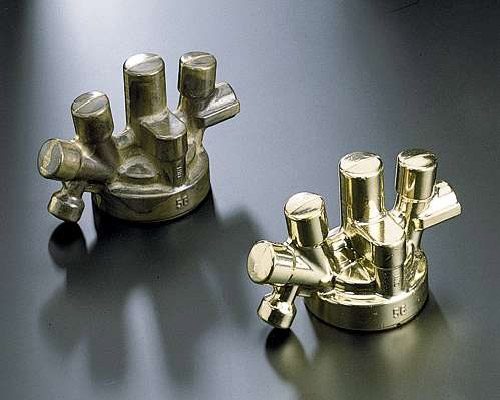
Precision Valve Seats Lose Flatness Under Heavy Impact
Conical seating faces and lapped poppet margins rely on crisp contact geometry. Heavy ceramic triangles or large steel balls rolling freely against unmasked seats introduce micro-nicks and edge chamfering that cause pressure-test leaks.
Threaded Ports and Cross-Drillings Trap Wedged Media
Valve blocks contain NPT threads, O-ring grooves, and intersecting flow bores. Media stones sized close to port diameters wedge tightly inside threads, requiring slow manual picking or risking downstream fluid contamination.
Heavy Brass and Stainless Bodies Bruise Part-on-Part
Solid brass valve bodies and thick stainless sleeves carry substantial weight. When loaded too densely into an open bowl, heavy castings slam against neighboring threads and dent wrench flats before the cycle ends.
| Valve Component Type | Critical Feature to Protect | Typical Tumbling Failure | Controlled Mass-Finishing Fix |
|---|---|---|---|
| Brass gas / fluid valve body | NPT threads & sealing seats | Thread nicking and lodged triangles | Divided trough + oversize plastic/ceramic + magnetic pins |
| Stainless flush valve sleeve | Thin wall roundness & bore | Out-of-round denting | Polyurethane-lined bowl + porcelain spheres + JTJ50 |
| Poppet / engine valve | Stem straightness & seat margin | Bent stems or nicked seats | Fixtured drag finishing or separated trough cells |
| Multi-port manifold block | Internal cross-bores | Trapped grit and dull corners | Wide-table OBD magnetic tumbler for bores |
[DESIGN: Four-panel comparison showing valve finishing risks: bruised threads, nicked sealing seats, lodged stones, and clean divided-cell finishing]
Selecting Chamber Formats for Different Valve Geometries
Chamber design determines whether heavy valve bodies collide with each other or glide smoothly inside a protective media envelope.
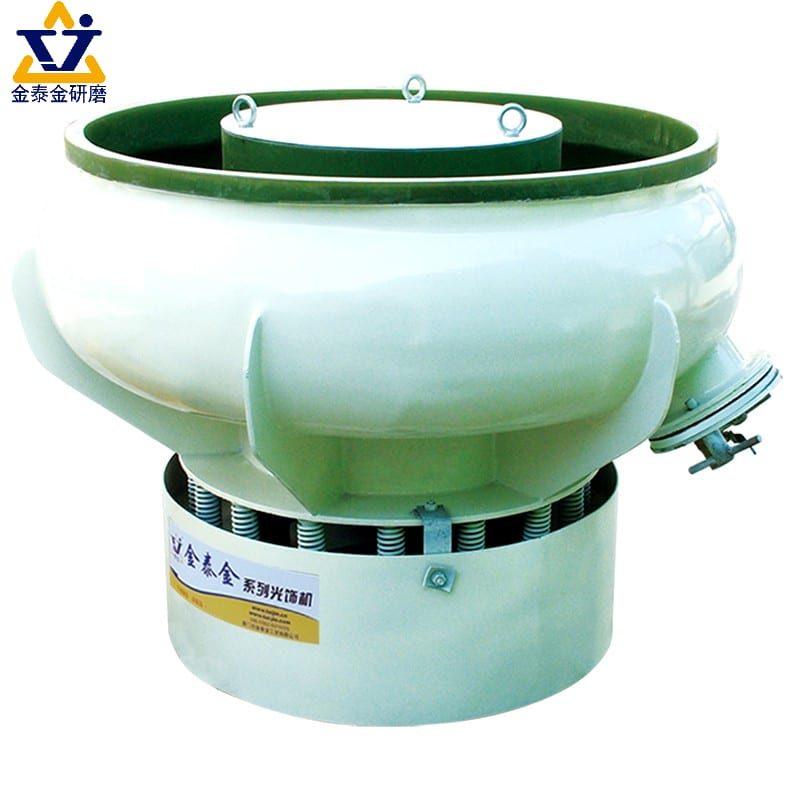
Polyurethane-Lined Vibratory Bowls for Compact Fittings
Small brass check valves, needle-valve stems, and compact stainless fittings circulate evenly in a vibratory grinder when media-to-part volume stays generous. Continuous compound flow flushes brass and stainless fines away so bodies emerge clean and bright.
Rectangular Vibratory Troughs With Dividers for Heavy Valve Bodies
When valve bodies are heavy enough to dent each other during free tumbling, a rectangular vibratory trough fitted with removable polyurethane dividers isolates each valve—or small group of valves—inside its own cushioned compartment while letting media flow across the full trough.
Drag Finishing for High-Value Engine and Hydraulic Valves
For precision poppet valves, hydraulic spools, and aerospace fluid stems where zero part-on-part contact is mandatory, drag finishing clamps each stem in a rotating planetary spindle and pulls it smoothly through fine media. Stems stay dead-straight while heads and fillets reach uniform smoothness.
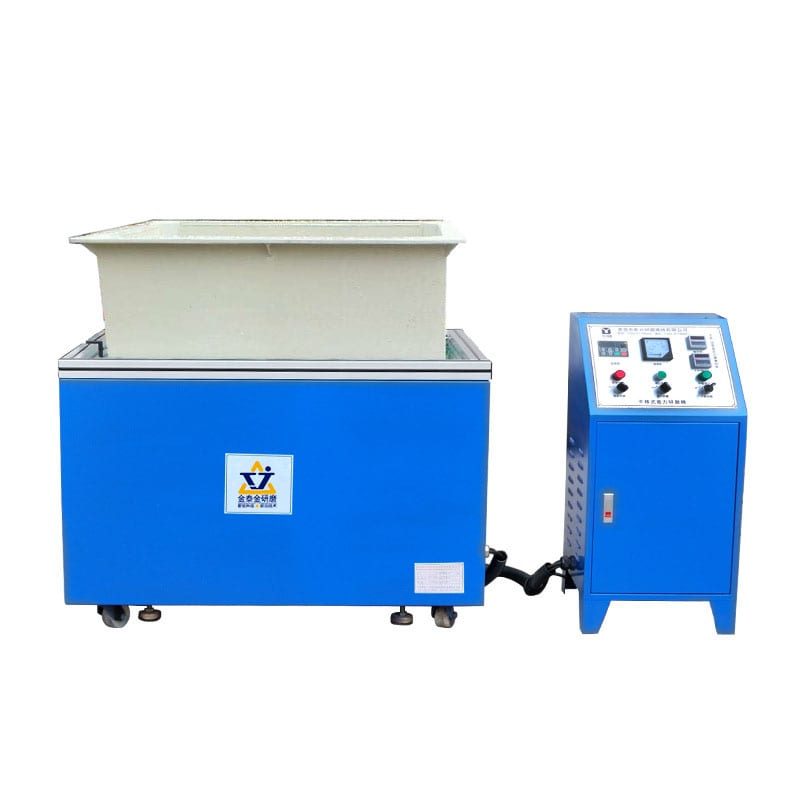
Wide-Table OBD Magnetic Polishers for Internal Valve Bores
When burrs hide inside cross-drilled fluid ports and valve seats that ceramic stones cannot reach, a magnetic tumbler drives fine stainless steel pins directly through internal bores, stripping machining fuzz without touching outer threads aggressively.
Choosing Media and Chemistry for Brass, Stainless, and Steel Valves
Matching abrasive body and liquid compound to the valve alloy prevents tarnishing, smearing, and hydrogen or chemical staining.
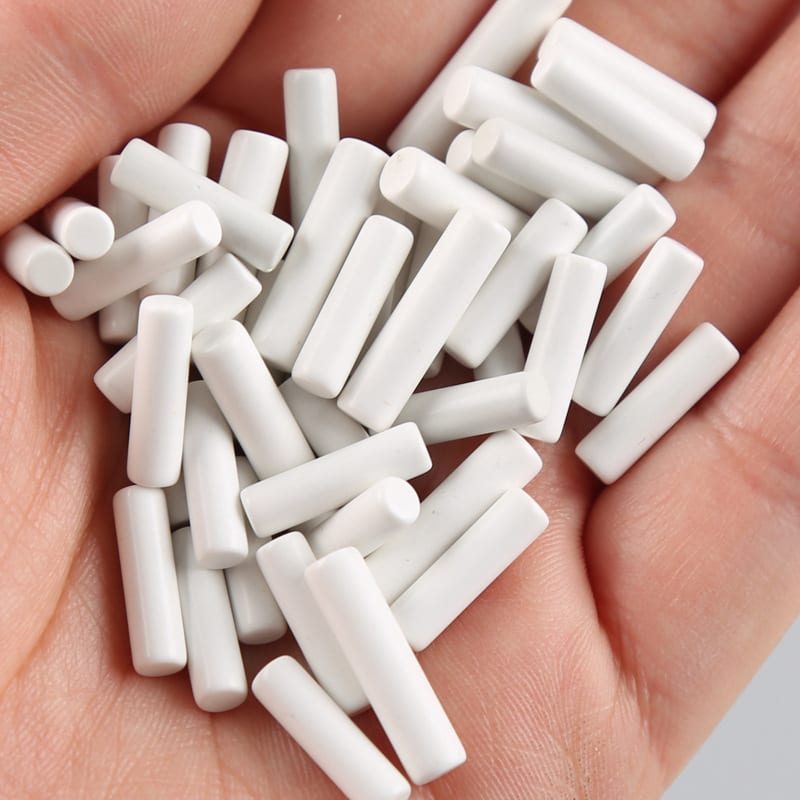
Preformed Ceramic vs. Plastic Media for Deburring Valve Bodies
On hard stainless steel and carbon steel valve forgings, preformed ceramic triangles or angle-cut cylinders with LC10 deburring compound remove forging flash and CNC burrs cleanly. On softer brass and bronze valve bodies, resin-bonded plastic cones smooth tool marks without bruising external hex flats or threads. Compare media behavior in our tumbler media selection matrix.
High-Alumina Porcelain and Stainless Burnishing for Brightening
After deburring, brass and stainless valve bodies move into smooth high-alumina spheres or stainless steel burnishing media with JTJ50 or JTS5 brightening compound to close surface pores and build a clean commercial shine. Always keep seating faces protected or finish-lap seats after mass finishing if tight sealing tolerances apply.
Removing Heat-Treat Scale With MC8 Before Polishing
Forged steel and heat-treated stainless valve stems often arrive with dark oxide scale. Pre-clean scale using MC8 derusting chemistry and dense ceramic media before moving parts to brightening stages—see our mill scale on steel guide for scale-removal staging.
When Seat Masking or Post-Tumble Lapping Is Required
If a valve seat is already precision-ground to final flatness before deburring, cap the port with a fitted urethane plug or schedule final seat lapping after body tumbling. Mass finishing excels at body deburring, fillet blending, and bore cleaning, not maintaining sub-micron flat lapped seats exposed to open stone impact.
[DESIGN: Four-stage valve finishing sequence: degrease/descale, wet deburr, magnetic bore clean, and heated spin-dry]
Post-Tumble Rinsing, Spin-Drying, and Corrosion Control
Valve bodies carry deep internal cavities and threads that trap dirty rinse water. Incomplete drying causes immediate brass tarnish or stainless water spotting.
High-Flow Rinsing to Flush Threads and Ports
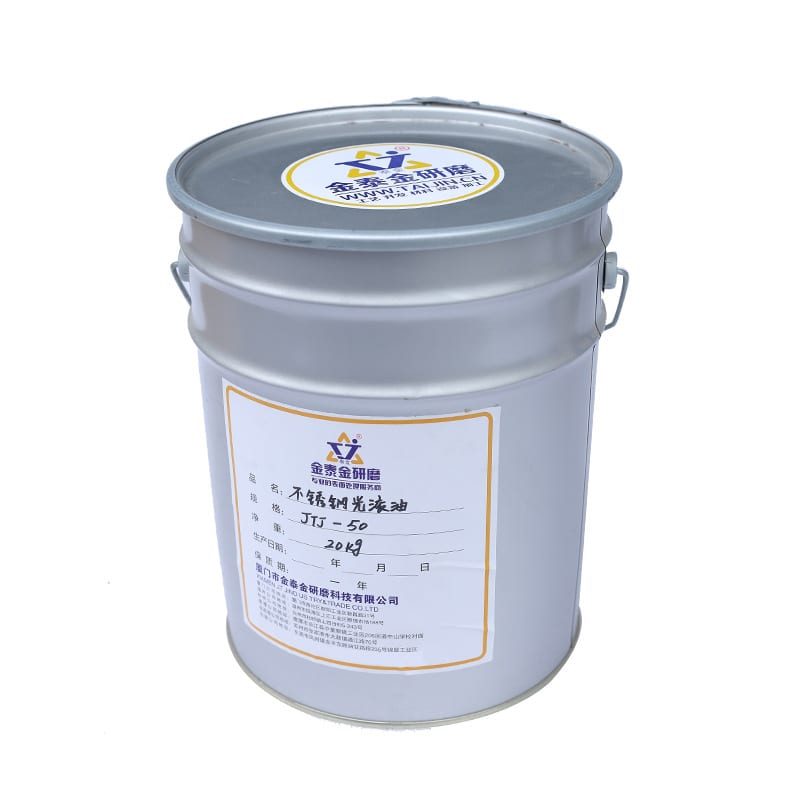
Never let compound foam dry inside valve threads. Flush finished valves thoroughly in clean water immediately after unloading from the vibratory bowl or magnetic tumbler.
Centrifugal Spin-Drying for Cavity Drainage
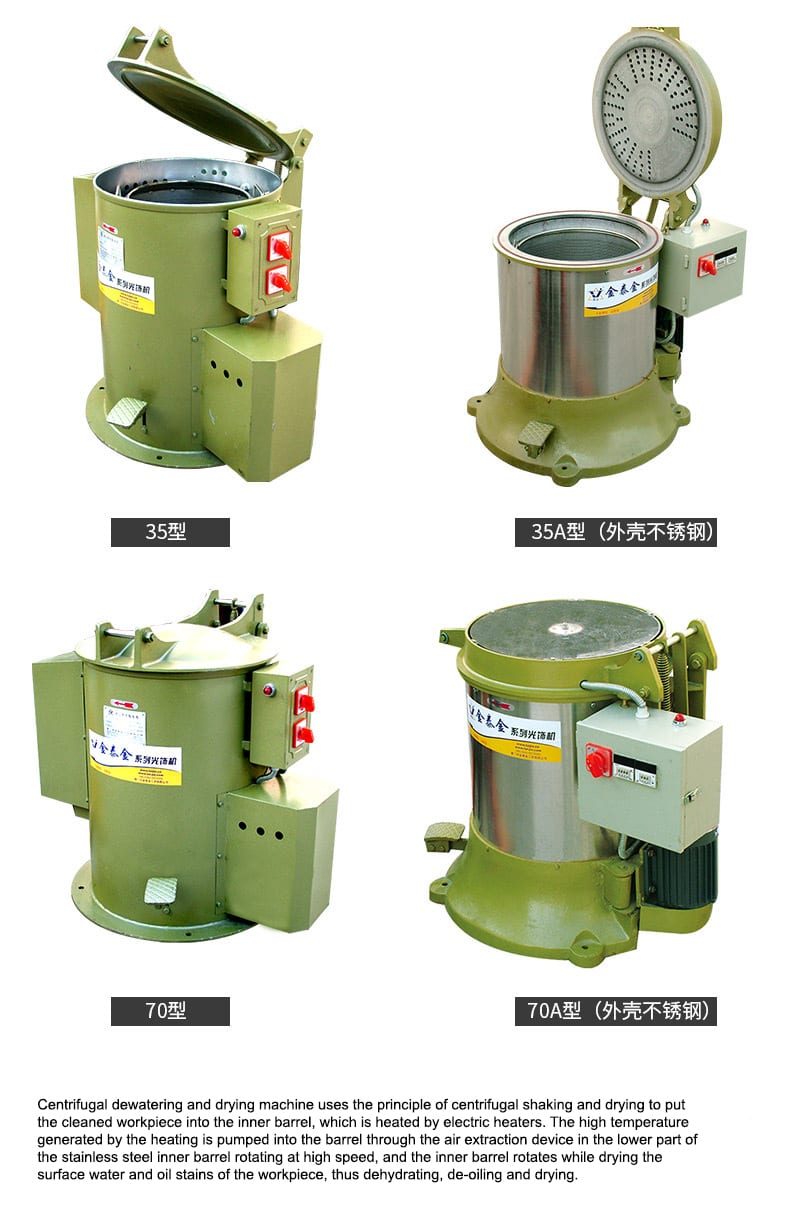
Loading rinsed valves into a heated centrifugal spin dryer spins water out of threaded ports and blind seats while warm air evaporates residual film cleanly.
Dry Corncob Wiping for Spot-Free Brass Hardware
For decorative brass plumbing valves and exposed fittings, passing spin-dried parts briefly through warm corncob media lifts water-spot rings from polished wrench flats. Always inspect internal seats and blow out ports afterward if using fine organic granules.
Post-Tumble Inspection and Packaging for Valve Assemblies
Once spun dry, store finished brass and stainless valve bodies in compartmentalized trays rather than dumping heavy castings loose into bulk bins, where sharp hex corners can still nick adjacent threads during forklift transport. Clean packaging protects both the cosmetic sheen and the thread integrity built during mass finishing.
Protecting Carbon Steel Valves From Flash Rust
Carbon steel valve bodies rust rapidly in open shop air after wet finishing. Include a rust-inhibiting rinse step immediately before spin-drying and seal dry parts promptly. Never leave wet carbon steel valves sitting in open wire baskets between shifts, because even light ambient humidity triggers orange flash rust across freshly smoothed wrench flats and sealing chamfers.
Application Workflows by Valve Type: Plumbing, Engine, and Hydraulic
Not every valve enters the finishing room with the same alloy, wall thickness, or surface target. Separating polishing valves by valve family prevents expensive trial-and-error.
Brass Plumbing Valves, Gas Cocks, and Ball-Valve Bodies
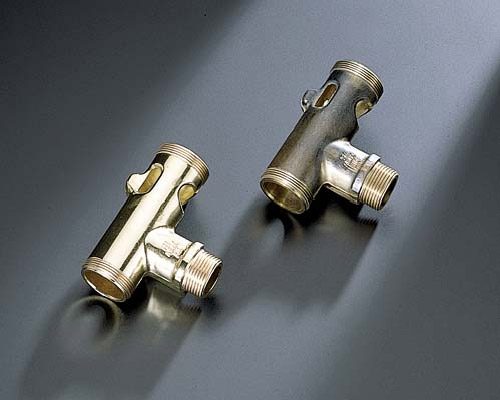
Brass plumbing and gas valves require clean external wrench flats, burr-free NPT threads, and bright retail presentation without rounding sealing faces. Start with a brief resin-bonded plastic cone cut in a divided vibratory trough or polyurethane-lined bowl using neutral compound, then transition to high-alumina porcelain spheres or warm corncob media after centrifugal spin-drying.
Stainless Steel Sanitary Valves and Flush Sleeves
Sanitary food, beverage, and medical fluid valves machined from 304 or 316 stainless steel demand smooth, crevice-free surfaces that rinse cleanly and resist bacterial entrapment. Run preformed ceramic media with LC10 deburring compound to erase CNC turning ridges, followed by JTJ50 wet brightening in high-alumina spheres or stainless burnishing media. Keeping sanitary stainless batches strictly separated from brass or carbon steel media charges prevents embedded iron particles from causing rust spots later in service.
Poppet Engine Valves and Hydraulic Spools
Engine intake/exhaust valves and hydraulic spool valves carry tight stem straightness and concentricity tolerances. Never tumble long valve stems loose inside an open rotary barrel where stems can bend or peen against each other. Instead, clamp stems in rotating planetary fixtures inside a drag finishing unit or isolate individual stems inside padded trough dividers so heads and fillets smooth uniformly with zero stem runout.
High-Pressure Needle Valves and Check-Valve Cartridges
Compact needle valves and check-valve cartridges combine fine external threads with small internal ball seats. Because these parts are light enough to cushion easily in a generous media bed, they run well in circular vibratory bowls using small, non-wedging plastic pyramids followed by wide-table OBD magnetic pin cleaning to clear micro-burrs from cross-drilled fluid ports without dulling sharp metering edges.
| Valve Family | Primary Alloy | Recommended Media Sequence | Key Quality Check |
|---|---|---|---|
| Brass plumbing & gas valves | Forged / cast brass | Plastic cones → porcelain spheres → spin-dry | Thread gauge fit & zero seat nicks |
| Sanitary stainless valves | 304 / 316 stainless | Preformed ceramic + LC10 → JTJ50 brighten |
Uniform smooth skin & crevice-free bores |
| Engine poppet & hydraulic valves | Alloy steel / stainless | Fixtured drag finish in fine porcelain/plastic | Stem straightness & unrounded seat margin |
Media-to-Part Ratio and Load Density Control
Heavy valve bodies punish under-filled chambers. When operators overload a vibratory bowl with too many brass or stainless castings relative to media volume, parts sink to the bottom polyurethane liner and grind against neighboring wrench flats. Maintain a generous media bed around every valve body, keep flow-through compound water clean so suspended metallic fines flush out continuously, and screen worn media fragments on a regular deck check so chipped ceramic tips never reach cross-drilled ports.
Managing Flow-Through Chemistry and Foam Cushioning
Liquid compound does more than clean metal—it builds a lubricating foam cushion that absorbs impact between heavy valve bodies and hard ceramic stones. Running too lean a compound mixture strips away that cushion, increasing edge peening on threads and leaving dull, smeared flats. Conversely, dumping excessive soap into a closed sump builds heavy sludge that dries inside internal valve cavities. Meter compound steadily into clean flow-through water so the bath stays bright, lubricated, and free of suspended grit.
Separating Mixed-Alloy Valve Batches
Many valve plants machine brass bodies, 304 stainless stems, and carbon steel retainers under one roof. Never run brass and stainless or carbon steel parts in the same media charge or rinse basket. Dissolved copper ions from brass can plate onto steel, while iron dust from carbon steel embeds into softer brass and triggers corrosion spots during storage. Dedicate separate media charges, screen decks, and drying baskets to each alloy family.
Inspecting Cross-Drilled Ports and O-Ring Grooves Before Assembly
Visual inspection of the outer wrench flats never guarantees that internal valve passages are ready for pressure assembly. Set up a dedicated inspection station next to the centrifugal spin dryer with bright task lighting, a calibrated pin-gauge check for critical cross-bores, and clean dry compressed air or vacuum extraction to verify zero residual ceramic fines or stainless magnetic pins remain inside O-ring grooves or blind pilot seats. Catching a single lodged particle at discharge costs seconds; finding it during final hydraulic bench testing costs an entire teardown.
When Vibratory Deburring Must Precede Final Seat Grinding
For high-pressure hydraulic manifold blocks and precision control valves, schedule wet mass finishing before final CNC seat honing or cylindrical stem grinding. Running the rough deburr and cross-bore pin clean first removes casting flash, thread burrs, and machining fuzz across the whole body without risking micro-dings on finished sealing lands. Once the body is clean and burr-free, final precision grinding or lapping produces crisp, leak-free seats that never see open stone impact. Separating rough deburring from final seat finishing also gives production engineers clear accountability across machining and finishing cells, cutting scrap rates on expensive alloy-steel and stainless valve bodies across high-mix batches.
[DESIGN: Jings Polish equipment bay with vibratory bowls, divided troughs, and centrifugal dryers for valve production]
Four Common Valve Finishing Failures and How to Diagnose Them
Failure Mode 1: Pressure-Test Leaks From Nicked Valve Seats
Valves pass dimensional checks before tumbling, then fail seat-leak tests afterward.
Diagnostic rule: If leak failures trace to tiny edge dings on seating lands, heavy parts collided in the chamber or unmasked seats contacted coarse stones—mask ports, isolate heavy bodies in trough dividers, or move final seat lapping after body tumbling.
Failure Mode 2: Peened or Rolled External Threads
Nuts bind on valve threads even though thread gauges passed prior to finishing.
Diagnostic rule: If thread crests show flattened bright spots, parts struck each other or heavy steel/ceramic media hit unmasked threads—raise media-to-part ratio, switch to lower-density plastic cones, or cap delicate threads.
Failure Mode 3: Lodged Media Stones Inside Cross-Bores
Assembly operators find stuck triangle tips inside valve ports during final fitment.
Diagnostic rule: Size every ceramic or plastic shape noticeably larger than the widest port opening or smaller than one-third of the narrowest bore; use magnetic pins rather than loose stones for internal cross-drilling.
Failure Mode 4: Tarnished Brass or Spotted Stainless Bodies
Valves look bright leaving the bowl, then turn dull or spotted within hours on the drying rack.
Diagnostic rule: If tarnish or spots appear after unloading rather than during tumbling, rinse water is dirty or parts sat wet too long—add a clean flush and immediate heated centrifugal spin-drying.
| Symptom on Valve | Root Cause | Immediate Fix |
|---|---|---|
| Seat-leak test failure | Unmasked seat struck by stone/part | Mask seats, use trough dividers, or lap after tumbling |
| Binding external threads | Part-on-part or heavy media peening | Raise media cushion, use plastic media, cap threads |
| Stuck media in cross-ports | Media size matches bore diameter | Resize media larger than port; clean bores with pins |
| Spotted brass / dull stainless | Delayed rinsing or slow air-drying | Immediate clean flush + heated centrifugal spin-dry |
Honest Capability Boundaries and Production Standards
What Mass Finishing Does and Does Not Do for Valves
Mass finishing chambers excel at batch deburring of valve castings, smoothing wrench flats and fillets, cleaning internal cross-bores with magnetic pins, and brightening brass or stainless bodies uniformly. However, mass finishing does not replace precision CNC seat boring, cylindrical stem grinding, or optical-flat seat lapping, and it cannot repair porous castings or crooked threads. For super-smooth stem surface refinement on machined components, see our isotropic finishing guide and tumble deburr guide.
What We Supply and What We Do Not Supply
At Xiamen Jin Tai Jin Grinding Technology Co.,Ltd. (brand: Jings Polish), our workshop roots date back to 1996 and our company was formally established in 2009, delivering over 200,000+ sets of grinding and polishing solutions worldwide. Across our catalogue, we manufacture 21 machine platforms backed by 24 granted Chinese IP rights (1 invention patent, 15 utility model patents, and 8 design patents), under ISO 9001 certification 00726Q01571R001 (valid 2026-06-03 to 2029-06-02) and CE certifications M.2023.206.C88121 (Vertical, 8 models) and M.2023.206.C88120 (Horizontal, 13 models), valid until 2028-07-24.
To keep boundaries clear: we supply industrial mass finishing machines (vibratory bowls, divided troughs, drag finishers, rotary barrels, wide-table OBD magnetic tumblers, centrifugal spin dryers), tumbling media (ceramic, plastic, porcelain, stainless pins, organic media), and liquid compounds (LC10, MC8, JTJ50, JTS5); we do NOT supply electroplating, passivation/pickling lines, sandblasting cabinets, handheld grinders, or contract job-shop polishing services.
Honest Lead Times and Engineering Review
Standard machines ship in 25–35 days, while custom divided troughs, drag-finishing fixtures, and multi-stage valve lines require 45–60 days. Because valve alloy, port diameters, and seat sensitivity vary widely, we do not promise free sample trials by mail or guarantee cycle times before inspecting your workpiece—send clear photos of your valves, port/thread sizes, and target finish via our custom polishing solution page for an engineering assessment.
Frequently Asked Questions
Can vibratory tumbling polish valve bodies without damaging sealing seats?
Yes, provided sealing seats are either capped with protective plugs, isolated in divided troughs/drag fixtures, or precision-lapped after body tumbling. Never tumble precision lapped seats unprotected against coarse ceramic or heavy parts.
How do you remove burrs inside cross-drilled valve ports?
Use a wide-table OBD or circular magnetic tumbler with fine stainless steel pins and water-based compound. The magnetic field drives pins through internal bores and intersecting ports without bruising outer flats.
What media is best for brass valves versus stainless steel valves?
Brass valve bodies respond best to resin-bonded plastic cones for gentle deburring followed by high-alumina porcelain or magnetic pins for brightening. Hard stainless steel valves handle preformed ceramic media with LC10 for deburring, followed by JTJ50 brightening.
Why do valve threads get nicked in a rotary or vibratory tumbler?
Thread nicking happens when heavy valve bodies collide with each other due to a low media-to-part ratio or oversized open compartments. Increase the media cushion, switch to lower-density plastic media, or use trough dividers.
How do I keep brass valves from tarnishing after wet tumbling?
Flush valves immediately in clean water after unloading and run them through a heated centrifugal spin dryer. Optional warm corncob wiping removes remaining water-spot rings cleanly.
What information should I send before requesting a quote for a valve polishing line?
Send clear photos of your valve bodies showing port openings, threads, and sealing seats, along with alloy grade, part weight, and hourly batch target. Our engineers can recommend the right chamber, media, and protection setup from photos and drawings.
[DESIGN: Annotated buyer enquiry checklist showing valve photos, port/thread dimensions, seat protection notes, and hourly throughput]
 +86-592-2381506


 IPv6 network supported
