
Propeller Polishing, Turbo Housings, and Carburetor Bodies: Mass Finishing Without Distorting Flow
Marine props, cast turbocharger housings, and intricate carburettor bodies all share one unforgiving rule: a surface finish that looks shiny on the outside means scrap if thin trailing edges warp, mating flanges round over, or internal fuel passages trap abrasive chips. Yet buyers searching for propeller polishing, polishing turbo housings, or polishing carburetor castings often get steered toward aggressive handheld flap wheels, soda-blasting cabinets, or generic rock tumblers that ruin tolerances in minutes.
The central thesis of this guide is simple: cast aluminium, bronze, and stainless flow-path hardware must be routed by geometry and edge sensitivity—separating external vane smoothing (drag finishing and divided troughs) from blind internal passage cleanup (plastic media sizing and magnetic pins). This guide explains how industrial mass-finishing chambers handle propeller polishing, polishing turbo parts, and polishing carburetor castings without losing blade pitch, flange flatness, or jet accuracy. For broader equipment naming, see finishing machine names and vibratory finishing.
Why Flow-Path Castings Fail Under Generic Tumbling
Marine propellers, turbo compressor housings, and carburettor bodies are complex thin-walled castings where surface roughness directly affects fluid flow, cavitation, and gasket sealing.

Thin trailing edges versus thick hub roots
On a stainless steel or nibral marine propeller, the hub root carries heavy cross-section while the outer blade tips taper down to thin, sharp trailing edges. Loose-tumbling multiple heavy props together in an undivided bowl lets thick hubs hammer thin blade tips into bent, chipped scrap. High-weight castings with thin outer blades require clamped drag-finishing spindles or divided troughs rather than loose bulk tumbling.
Gasket flanges and V-band grooves on turbo housings
Turbocharger compressor covers and turbine housings carry precision-machined V-band grooves, oil-return flanges, and tight volute clearances. Dumping cast housings into coarse steel-cutting ceramic chips rounds sharp gasket lands and peens soft aluminium compressor housings into an orange-peel skin. One simple workshop criterion settles the route: if sealing flanges must stay razor-flat, keep cycle time short and use resin-bonded plastic cones or clamped fixtures.
Blind fuel jets and internal passages on carburettors
Carburettor bodies combine soft zinc or aluminium die-castings with tiny cross-drilled emulsion passages, needle seats, and throttle-shaft bores. Running standard ceramic triangles inside a carburettor batch packs broken chips permanently inside fuel galleries—and harsh alkaline soap turns zinc-aluminium castings dark grey within minutes. If a casting has small blind fuel ports, media sizing and neutral compound chemistry matter more than chamber speed.
Separating mechanical smoothing from vapour blasting and cloth wheels
Restoration shops often compare mass finishing against wet vapour blasting, walnut-shell air blasting, or stationary cloth buffing wheels. Blasting etches a matte surface with loose grit, while cloth wheels polish only open outer curves and burn operator wrists around blade roots. We do not build sandblasting cabinets, vapour-blasting machines, cloth buffing wheels, handheld buffers, or solid wheel wax bars—we manufacture chamber-based mass-finishing systems.
Choosing the Right Chamber for Props, Turbos, and Carburettors
Across our machines portfolio, four distinct chamber architectures match casting weight, alloy softness, and internal passage access.
| Component Type | Recommended Chamber | Why This Architecture Fits | Collision & Edge Guardrail |
|---|---|---|---|
| Stainless & Bronze Propellers | High-speed drag finisher or divided trough (L1300–L1800) |
Zero blade-to-blade contact; symmetric leading/trailing finish | Clamp hub on drag spindle or isolate in divided bay |
| Aluminium Turbo Compressor Housings | Vibratory bowl (ZL) or divided trough with plastic cones |
Smooths cast volute skin without peening thin flanges | Cushion with resin-bonded plastic cones and neutral compound |
| Zinc & Aluminium Carburettor Bodies | Circular vibratory bowl (ZL) + magnetic polisher (OBD) |
Gentle exterior smoothing + pin cleanup of non-magnetic bores | Verify every jet bore against worn media & pin sizes |
| Small Impellers, Turbine Blades & Fuel Fittings | Centrifugal disc (LLF120) or drag finisher |
Rapid, uniform cut on compact precision vanes | Keep cycle timers fixed to protect sharp blade tips |
[DESIGN: Four-panel equipment overview showing high-speed drag finisher for propellers, divided rectangular trough for turbo housings, ZL vibratory bowl for carburettors, and OBD magnetic polisher]
High-speed drag finishers for zero-collision propeller polishing
For stainless steel or bronze marine propellers and cast impellers, a high-speed drag finishing machine mounts each prop on a rotating spindle and sweeps it through stationary high-density media. Because every prop stays clamped on its own arbor, heavy hubs never smash against neighbouring blade tips. Bi-directional spindle rotation polishes both pressure and suction blade faces evenly without rounding trailing edges.
Divided rectangular troughs for large turbo housings
Cast aluminium compressor covers and heavy iron turbine housings are too bulky and collision-sensitive for standard circular bowls. Long rectangular vibratory troughs (L1300, L1500, L1800) fitted with removable polyurethane-lined dividers hold each housing inside its own cushioned bay. Dividers prevent heavy housings from banging flange-to-flange while media smooths outer casting skin.
Circular vibratory bowls for carburettor batches
When finishing batches of die-cast carburettor bowls, throttle bodies, and cast brackets, a vibratory finishing machine (ZL series) lined with smooth cast polyurethane keeps parts suspended inside resin-bonded plastic cones. Models with integrated separation screens (ZL100C through ZL900C) divide finished castings from plastic media cleanly without manual sorting. See our vibratory finishing guide for spiral bowl flow control.
Magnetic precision polishers for non-magnetic carburettor bores
Because zinc and aluminium carburettor castings are non-magnetic, a magnetic precision polisher (OBD-30 through OBD-100 or OBD-HBPG series) drives fine stainless steel pins directly inside internal throttle bores and open ports without battering outer gasket faces. Keep cycles brief and well-lubricated with neutral compound—and always test pin clearance against narrow emulsion jets so zero pins lodge inside blind galleries.

Cast vs Billet vs Welded Flow-Path Components
Different manufacturing routes leave completely different surface states on propellers, turbocharger covers, and carburettor bodies. Matching your finishing stage to how the part was made prevents over-cutting thin walls.
| Manufacturing Route | Typical Incoming Surface | Recommended Chamber & Media | Key Caution |
|---|---|---|---|
| Investment-Cast Stainless Props | Matte cast skin + weld repair marks | Drag finisher with ceramic cut-down, then high-alumina | Keep blade tips protected from neighbouring hubs |
| Sand-Cast Aluminium Turbo Covers | Coarse grainy cast texture + parting flash | Divided trough (L series) with resin-bonded plastic cones |
Knock off heavy gate stubs upstream before loading |
| Billet CNC Impellers & Compressor Wheels | Fine ball-nose milling cusps + sharp vane edges | High-speed drag finisher or centrifugal disc (LLF120) |
Use short timed cycles to preserve sharp vane tips |
| High-Pressure Die-Cast Carburettors | Smooth dense skin + flash along parting lines | Vibratory bowl (ZL) with gentle plastic cones |
Never over-cut dense skin into porous core metal |
Investment-cast stainless and bronze marine propellers
Marine propellers cast in stainless steel or nibral bronze arrive with coarse investment skin, riser stubs, and hand-ground weld repair patches. After grinding gate stubs flush upstream, a two-stage drag-finishing cycle—ceramic cut-down followed by high-alumina burnishing—blends repair zones seamlessly into a uniform satin or bright sheen. Uniform blade smoothness reduces hydrodynamic drag without thinning trailing edges.
Sand-cast aluminium turbocharger compressor housings
Sand-cast aluminium covers carry coarse grain texture across the scroll and sharp parting-line flash around bolt bosses. Load cast covers into a divided rectangular trough (L1300, L1500, L1800) with resin-bonded plastic cones and neutral compound-JTJ60, keeping heavy housings isolated so V-band flanges never dent. Smooth internal scrolls and clean external castings require zero hand-scraping.
Billet-machined compressor wheels and impellers
CNC-milled billet aluminium or titanium compressor wheels carry fine step-over cusps along curved vanes and razor-sharp blade tips. Loose tumbling bends thin billet tips within minutes, whereas clamped drag finishing or controlled centrifugal disc runs with small plastic cones smooth milling cusps evenly. Always test a single billet wheel first to confirm thin vane survival.
High-pressure die-cast zinc and aluminium carburettors
Die-cast carburettor bodies already carry a dense, relatively smooth surface skin interrupted by parting-line flash and drilled exit burrs. Brief wet tumbling in a polyurethane-lined vibratory bowl with lightweight plastic cones removes exit burrs cleanly while keeping the dense cast skin intact. Avoid long ceramic runs that break through cast skin into spongy core porosity.

Media and Compounds for Aluminium, Zinc, Bronze, and Stainless
Picking the wrong abrasive media or pH ruins soft castings faster than steel. Match consumables from our grinding media and dry finishing media lines strictly to alloy hardness.

Resin-bonded plastic cones for aluminium turbos and zinc carburettors
Cast aluminium turbo housings and zinc carburettors dent and turn porous if hit by heavy ceramic triangles. Load lightweight resin-bonded plastic cones or pyramids that match soft non-ferrous alloys, smoothing rough die-cast skin and parting lines cleanly without peening flat sealing flanges. See our aluminum finishes and aluminum polishing machine guides for avoiding orange-peel bruising.
Ceramic and high-alumina media for stainless and bronze propellers
Hard 304/316 stainless steel and nibral bronze propellers resist soft plastic media when removing cast surface roughness or weld repair marks. Start with dense ceramic media or angle-cut cylinders to level casting skin, then switch to smooth high-alumina ceramic spheres for non-abrasive burnishing. Check our copper alloy finishing and stainless steel finishes guides for alloy-specific stage control.
Verified Jings Polish compounds without dark staining
Running aluminium or zinc carburettors in high-alkaline steel soap etches the metal dark grey within minutes, while running stainless props in plain tap water glazes media pores. Match our verified liquid compounds directly to your alloy:
compound-JTJ60&compound-JTS5: Neutral fine metal polishing and delicate thin-section support ideal for aluminium turbos and zinc carburettors.compound-HM3: Final polishing support for clean, uniform non-ferrous and stainless sheen.compound-LC10&compound-JTJ20: Heavy deburring and coarse cutting on stainless steel propellers and ferrous manifolds.compound-JTJ50: Brightening and lustre development on stainless steel props and hardware.compound-MC8: Rust and scale removal strictly on ferrous iron turbine housings (never on aluminium or zinc).
We supply liquid compounds for wet media systems and select pastes for dry tumbling, while never designing custom chemical cleaning formulas.
Dry walnut shell and corn cob for final presentation gloss
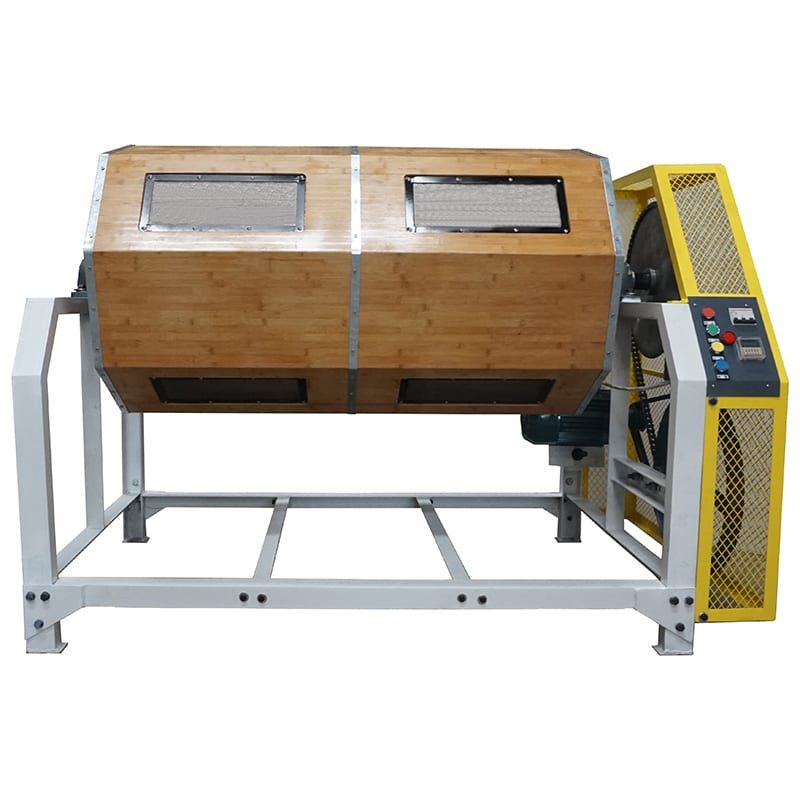
For show-grade polishing turbo compressor covers or custom propeller polishing batches wanting a warm dry sheen after wet smoothing, dry rotary barrels or dry drag tubs use conditioned walnut shell and corn cob dressed with polishing cream. Confirm parts are completely bone-dry before entering dry organic media, and confirm corn cob mesh grade when ordering.
Step-by-Step Workflow for Flow-Path Castings
Follow this four-stage production routine to smooth propellers, turbo covers, and carburettors without damaging sealing surfaces or plugging fuel ports.
| Stage | Objective | Media & Compound Choice | Inspection Gate Before Next Step |
|---|---|---|---|
| 1. Degrease & Plug/Screen Check | Strip oil, carbon soot, and heavy casting flash | Pre-wash + upstream flash trim; verify hole vs worn chip size | Zero heavy gate stubs or oily sludge on casting |
| 2. Alloy-Matched Cut-Down | Level cast skin and smooth rough vane/volute faces | Plastic cones (Al/Zn) or ceramic (SS/bronze) + matched liquid | Uniform smooth matte finish; zero flange rounding |
| 3. Brightening / Bore Pass | Lift lustre on props/turbos or clean internal ports | High-alumina balls (JTJ50/JTJ60) or dry cob / magnetic pins |
Even sheen across vanes; zero lodged chips in bores |
| 4. Clean Rinse & Spin Dry | Flush fines from passages and stop water spotting | Clean rinse + heat centrifugal spin dryer (35/70) + air blow |
Bone-dry, spot-free, debris-free internal galleries |
[DESIGN: Four-stage casting finishing sequence showing raw cast turbo/propeller part moving through degrease, plastic/ceramic smoothing, clean rinse, and centrifugal spin drying]
Upstream flash removal and oil/soot degreasing
Used polishing carburetor and polishing turbo rebuilds carry baked carbon soot, oil varnish, and gasket glue, while new castings carry heavy parting-line risers. Degrease soot and oil completely and grind heavy casting risers upstream—just as outlined in grinding and sanding marks—so tumbling media stays clean and focuses strictly on surface refinement.
Protecting gasket flanges, threads, and jet seats
Never tumble precision-machined V-band grooves or carburettor float-bowl flanges in coarse ceramic chips for extended hours. Establish short, timed cut-down cycles and verify flange flatness during initial setup. Remember our honest boundary: we do not supply custom nylon expansion plugs or specialized masking jigs—confirm whether sensitive threads need upstream masking on your own shop floor.
Checking internal passages with worn-media dimensions
Two small plastic cones or ceramic fragments wedged inside a turbo oil feed or carburettor idle passage can destroy an engine on startup. Always size media against worn chip dimensions so chips either stay far larger than every port or pass straight through effortlessly, and inspect every internal passage under bright light after unloading.
Flushing and rapid drying out of blind pockets
Water trapped inside blind carburettor bowls or hollow propeller hubs leaves white aluminium hydroxide spots or rust rings. Flush finished castings thoroughly with clean water, run them through a heat centrifugal spin dryer (35, 35A, 70, or 70A models), and follow with clean compressed air across blind fuel ports. See our post-finishing separate wash and dry guide for clean cell layout.

Failure Modes and How to Diagnose Them Early
When a batch of propellers, turbo housings, or carburettors fails inspection, use these four failure patterns to pinpoint the root cause immediately.
[DESIGN: Troubleshooting matrix showing four casting finishing failures: bent/nicked propeller blade tip, dark alkaline-stained aluminium carburettor, wedged plastic cone in a fuel port, and rounded V-band flange]
Blade-tip nicking on propellers and impellers
If defects cluster strictly along thin outer blade tips while hub roots look clean, parts are colliding inside an undivided chamber. Move heavy propellers immediately from loose bowls to clamped drag-finishing spindles or divided rectangular troughs (L1300, L1500, L1800).
Dark grey or black blotches on aluminium and zinc castings
If an entire batch of aluminium turbo covers or zinc carburettors turns dull charcoal grey, the liquid compound is too alkaline (compound-MC8 or ferrous steel soap) or dirty aluminium mud is recirculating through a clogged drain. Switch to neutral JTJ60 / JTS5 / HM3 chemistry and flush drains cleanly.
Lodged media chips inside carburettor ports
If a chip wedges inside a fuel or vacuum port, do not blame the separation screen—a separator only divides loose parts from loose media outside the part. Resize the media charge against worn-chip dimensions so chips stay safely larger than the widest port opening.
Spongy pitted skin on high-pressure die-castings
Die-cast aluminium and zinc parts have a thin, dense outer skin over porous core metal. Running cut-down cycles too long wears straight through that dense skin into subsurface gas pores. Shorten wet cut-down timers and switch earlier to gentle burnishing or dry corn cob brightening.
How Xiamen Jin Tai Jin Builds Casting Finishing Systems
At Xiamen Jin Tai Jin Grinding Technology Co.,Ltd. (brand: Jings Polish), our workshop started in 1992 and our company was formally established in 2002, delivering over 200,000+ sets of grinding and polishing solutions to customers worldwide. Across our catalogue, we manufacture 21 machine platforms backed by 24 granted Chinese IP rights—including 1 invention patent, 17 utility model patents, and 6 design patents—under ISO 9001 certification 00726Q01571R001 (valid 2026-06-03 to 2029-06-02) and CE certifications M.2023.206.C88121 (Vertical, 8 models) and M.2023.206.C88120 (Horizontal, 13 models), valid until 2028-07-24.

Equipment, plastic/ceramic media, and compounds we manufacture
We build high-speed drag finishing machines, long rectangular vibratory troughs (L1300, L1500, L1800), circular vibratory bowls (ZL series), barrel finishing machines, centrifugal disc and barrel units (LLF120, LX series), magnetic precision polishers (OBD and HBPG series), heat centrifugal spin dryers (35, 35A, 70, 70A), and media cleaners. We also manufacture plastic, ceramic, high-alumina, steel, walnut shell, and corn cob media alongside our verified MC8, LC10, JTJ20, JTJ25, JTJ50, JTJ60, JTS5, and HM3 compounds.
Honest boundaries on what we do not supply
In line with our choosing a mass finishing supplier and job shop finishing standards, we state our boundaries plainly. We do not operate a contract job shop or accept customer propellers, turbos, or carburettors for paid polishing; we do not supply sandblasting, vapour-blasting, or walnut-air-blasting cabinets or loose blasting grit; we do not sell cloth buffing wheels, handheld buffers, or solid wheel wax bars; we do not supply custom thread-masking plugs or offer plating, anodizing, or clear-coat sealing; and we do not design custom chemical cleaning formulas.
Standard and custom build lead times
Standard vibratory, barrel, centrifugal, magnetic, and spin-drying equipment ships within a 25 to 35 day production lead time. Custom-engineered drag-finishing fixtures, divided rectangular troughs, and integrated multi-stage lines carry a 45 to 60 day build lead time.
Requesting an initial assessment from part photos
We do not promise free mail-in sample trials or guarantee cycle times before inspecting your workpiece. Send clear close-up photos of your propellers, turbo housings, or carburettors showing casting texture, blade edges, smallest port diameters, alloy grade, and daily batch volume via our custom polishing solution page—our engineers can evaluate your photos and drawings to recommend the right chamber and media workflow.
Frequently Asked Questions
What is the safest machine for propeller polishing without bending blade tips?
A high-speed drag finishing machine or a divided rectangular vibratory trough (L1300–L1800) is the safest choice for propeller polishing, because individual spindle clamping or bay dividers guarantee zero blade-on-blade collision during smoothing and burnishing.
Can you use ceramic tumbling media when polishing turbo aluminium housings?
No—heavy steel-grade ceramic triangles peen soft cast aluminium into an orange-peel skin and round V-band sealing flanges. Use lightweight resin-bonded plastic cones with neutral liquid compound (JTJ60 or JTS5) to smooth cast aluminium housings cleanly.
How do I avoid lodging media inside fuel ports when polishing carburetor bodies?
Measure the widest fuel or vacuum port on your carburettor drawing and select plastic media whose worn-chip dimensions stay safely larger than that opening—or rely on clean air-blow and visual bore checks after unloading.
Why did my zinc or aluminium carburettor turn dark grey in the tumbler?
Dark staining happens when non-ferrous zinc or aluminium castings run in high-alkaline steel compounds (MC8 or ferrous soaps) or dirty recirculated water. Switch to neutral fine-metal compound (JTJ60, JTS5, or HM3) and keep bowl drains flushing cleanly.
Will mass finishing strip baked carbon soot off used turbochargers or carburettors?
No—baked carbon oil soot and gasket residue contaminate tumbling media rapidly. Degrease and clean heavy carbon deposits upstream before loading castings into a mass-finishing chamber for surface smoothing.
What details should I send before ordering equipment for props, turbos, or carburettors?
Send clear close-up photos showing current casting skin, thin edges, and smallest internal ports, along with overall dimensions, part weight, alloy type, target finish, and daily batch volume. Our engineers can recommend the right chamber architecture and media grade from photos and drawings.
[DESIGN: Annotated buyer enquiry checklist showing casting photo angles, port diameters, and daily batch target]
 +86-592-2381506


 IPv6 network supported
