
Tumble Deburr in Production: Practical Burr Technology, Tumbling How-To, and Surface Finish Control
Removing sharp edges one piece at a time with a hand scraper or abrasive wheel is the fastest way to bottleneck a machine shop. When stamping presses, laser cutters, and CNC lathes turn out hundreds of brackets, sleeves, and fasteners per shift, tumble deburr systems replace manual bench work with repeatable batch processing. Yet buyers looking into burr technology or searching tumbling how to guides often discover that dumping parts into a drum with random stones either leaves heavy burrs untouched or rounds critical dimensions out of print.
This guide explains how industrial tumble deburr chambers work, how to match media and liquid compound to burr thickness, and how to control tumbling surface finish without damaging precision tolerances. For machine naming, see finishing machine names and vibratory finishing.
What Burrs Actually Are—and Why Tumble Deburr Beats Hand Scraping
Modern burr technology starts by recognizing that not all burrs behave the same way inside a tumbling chamber.

Roll-over burrs, breakout burrs, and thermal laser dross
Stamping and blanking fold ductile metal into a sharp roll-over edge, milling and drilling push thin breakout feathers out of exit holes, and laser cutting leaves brittle oxide dross along bottom kerfs. Ductile roll-over burrs shear off cleanly under steady media rubbing, whereas hard thermal slag requires dense cutting ceramic media to fracture away. Identifying your burr type first prevents under-sizing your media and wasting shift hours.
Why hand deburring fails consistency and safety audits
Manual deburring knives and handheld flap wheels depend entirely on operator eyesight, hand pressure, and wrist fatigue. Workers routinely skip internal cross-holes, gouge flat faces, or leave sharp burrs that slice assembly O-rings and gloves. Batch tumble deburr lines apply identical mechanical pressure to every accessible edge across the entire lot without operator-to-operator drift.
How edge radiusing improves coating and fatigue life
Paint and powder coat pull back from razor-sharp 90-degree corners during curing, leaving thin bare edges that rust first in salt-spray testing. Equally, sharp machining burrs act as stress risers that initiate fatigue cracks on springs and dynamic brackets. Controlled tumbling surface finish rounds sharp corners smoothly so coatings wrap evenly and parts last longer under cyclic load.
Honest scope: heavy weld beads vs batch burrs
Batch mass finishing removes stamping burrs, machining feathers, laser dross, and sharp sheared edges cleanly across hundreds of parts per cycle. However, thick weld beads, massive casting risers, and heavy saw tabs should still be knocked off mechanically upstream before loading the chamber—see grinding and sanding marks.
Four Chamber Architectures for Tumble Deburr Production
Across our machines portfolio, four chamber types handle tumble deburr workloads depending on part weight, length, and collision sensitivity.
| Machine Architecture | How Parts & Media Move | Best Burr & Part Families | Key Operational Benefit |
|---|---|---|---|
Vibratory Bowl / Trough (ZL & L Series) |
Continuous helical or linear vibration in open polyurethane tub | Stamped brackets, laser-cut plates, valve sleeves, long bars | Separates flat stampings; built-in screen unload |
| Rotary Barrel Tumbler | Smooth cascading slide inside rotating octagonal/double drum | Heavy forgings, fasteners, thick hardware | Quiet cascading pressure; tight uniform edge radius |
Centrifugal Disc / Barrel (LLF / LX) |
High-G rotation inside sealed drum or spinning disc | Small precision gears, chains, buckles, connectors | Compresses tough deburring cycles on compact parts |
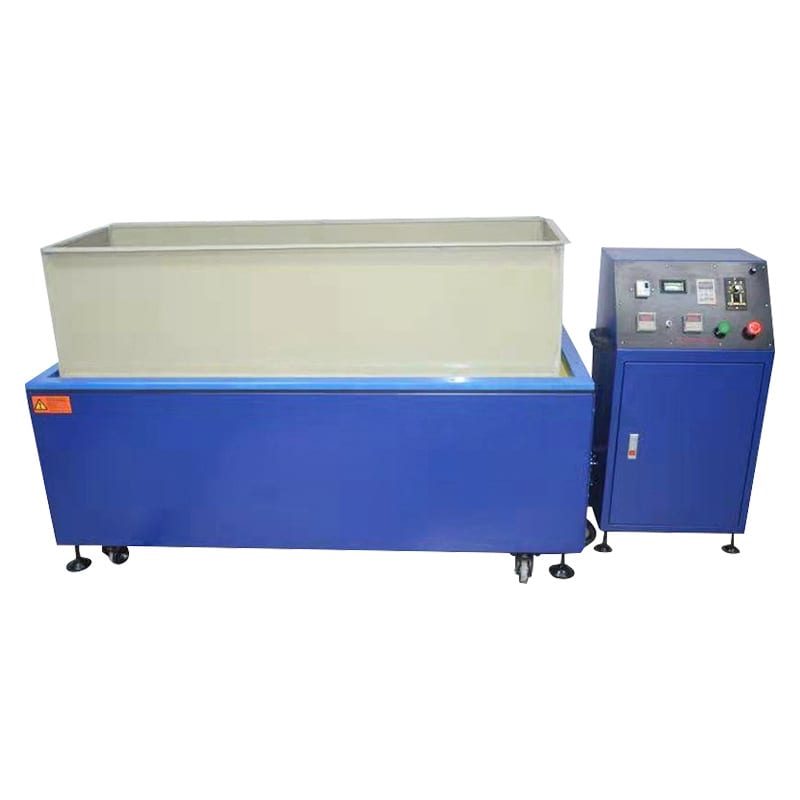
Magnetic Precision Polisher (OBD / HBPG) |
Rotating magnetic field drives stainless pins in water | Non-magnetic threads, blind cross-holes, intricate slots | Deburrs internal bores without rounding outer edges |
[DESIGN: Four-panel equipment overview showing a ZL circular vibratory bowl, octagonal rotary barrel, LLF120 centrifugal disc, and OBD magnetic polisher]
Vibratory bowls and troughs for high-volume stampings
A vibratory finishing machine (ZL series) keeps thin stamped brackets and laser-cut gussets separated in a lively spiral of media, preventing flat plates from sticking together face-to-face. Models with integrated separation decks (ZL100C, ZL200C, ZL300C, ZL600C, ZL900C) divide deburred parts from media automatically at cycle end without manual hand-sorting. Long shafts and bars fit cleanly inside rectangular troughs (L1300, L1500, L1800) with removable dividers. High-volume stamping plants rely on vibratory separation decks to run unattended shifts.
Rotary barrel tumblers for quiet, tight-tolerance edge breaking
When thick fasteners, castings, or tough hardware need quiet, steady edge breaking without high-frequency vibration, a drum from our barrel finishing machines line delivers smooth cascading pressure. Because parts slide beneath the media load rather than bouncing, rotary barrels produce tight, predictable edge radii across long shifts with minimal surface peening. Double-barrel and double-deck units let operators run two deburring or brightening stages side by side.
Centrifugal disc and barrel machines for small precision parts
Tiny precision components—such as connector pins, chain links, and miniature gears—lack enough individual weight to cut quickly in a gravity barrel or standard bowl. Centrifugal disc units (LLF120) and centrifugal barrel machines multiply effective media pressure inside compact chambers, clearing tough stainless burrs rapidly without tangling delicate small hardware. Centrifugal action cuts stubborn precision burrs in compact batches.
Magnetic polishers for internal threads and blind bores
Standard ceramic chips bridge across narrow internal holes and threads without touching exit burrs inside. For non-magnetic 304/316 stainless, brass, and aluminium fittings, a magnetic precision polisher (OBD and HBPG series) spins fine stainless steel pins inside internal passages to shear away micro-burrs without battering outer threads. Magnetic finishing cleans internal cross-ports in minutes while preserving sharp thread pitch.
Tumbling How To: Media, Compound, and Load Ratio Rules
Mastering tumbling how to fundamentals comes down to three variables: media body, chip geometry, and liquid compound dosing.
Choosing ceramic versus plastic media for burr removal
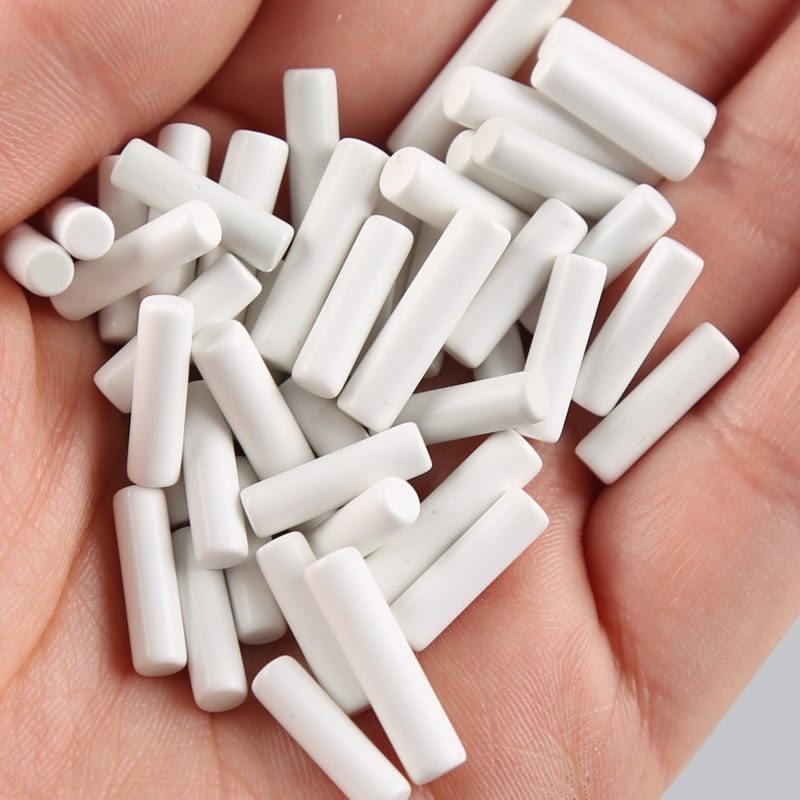
Heavy carbon steel, cast iron, and stainless steel burrs require dense ceramic triangles or angle-cut cylinders from our grinding media line to shear off tough metal cleanly. Soft aluminium, brass, and zinc die-castings bruise under heavy ceramic impact, so route them to lighter resin-bonded plastic cones that cushion soft edges while removing parting flash. See aluminum finishes and copper alloy finishing for alloy-safe media pairing. Matching media density to alloy hardness prevents surface bruising.
Sizing media against worn chips so holes stay clear
Every cutting chip shrinks steadily as it deburrs metal. A ceramic triangle that clears a mounting hole cleanly when brand new can shrink within weeks to wedge tightly inside that exact hole, jamming assembly bolts downstream and forcing manual pin-picking. Always size deburring media against worn chip dimensions rather than fresh-out-of-the-box sizes, and screen out broken fragments regularly.
[DESIGN: Gauge check comparing worn ceramic triangles against narrow stamped bracket slots and mounting holes]
Verified Jings Polish compounds for deburring (LC10, MC8, JTJ20)
Never run wet tumble deburr cycles in plain tap water, which rusts ferrous parts and glazes ceramic pores with metal mud. Match our verified liquid compounds directly to your job:
compound-LC10: Dedicated heavy deburring and rapid edge-breaking compound.compound-MC8: Strips surface rust and hot-rolled mill scale alongside ceramic descaling.compound-JTJ20&compound-JTJ25: Coarse stainless and general metal cutting support.compound-JTJ50,compound-JTJ60,compound-JTS5,compound-HM3: Post-deburr brightening and fine polishing support.
We supply liquid compounds for wet media systems and select pastes for dry tumbling, while never designing custom chemical cleaning formulas.
Maintaining proper media-to-part cushion
Loading too many parts into a chamber to boost shift output lets metal edges slam against each other, trading sharp burrs for ugly crescent dings across flat faces. Keep a generous cushion of media around every workpiece so parts only contact abrasive chips, never adjacent parts, throughout the entire tumbling cycle. Conservative batch loading delivers faster, cleaner edge consistency than overfilled chambers.
Controlling Tumbling Surface Finish and Dimensional Tolerances
A common concern in burr technology is how tumble deburr affects flat faces, thread pitch, and overall tumbling surface finish.
| Target Tumbling Surface Finish | Media & Compound Setup | Edge Radius Effect | Typical Next Step |
|---|---|---|---|
| Uniform Matte Deburred | Cutting ceramic triangles + LC10 / JTJ20 |
Strong edge break; uniform non-directional matte | Powder coating, painting, or assembly |
| Smooth Non-Ferrous Pre-Plate | Resin-bonded plastic cones + JTJ60 / JTS5 |
Gentle corner rounding; metal smooth satin base | Anodizing, plating (by vendor), or dry cob shine |
| Bright Burnished Hardware | High-alumina balls or steel media + JTJ50 / HM3 |
Minimal extra edge rounding (after deburr stage) | Clean rinse, centrifugal spin dry, final assembly |
| Crisp Threads & Internal Bores | Magnetic stainless pins + JTJ50 / JTJ60 |
Cleans micro-burrs while keeping outer threads sharp | Pin separation, rinse, air-blow, and spin dry |

Why aggressive deburring leaves a matte finish—and how to brighten it
Cutting ceramic chips remove burrs by shearing microscopic peaks across every exposed surface, leaving a clean, uniform matte tumbling surface finish. If your drawing requires bright lustre after deburring, run a second stage with non-abrasive high-alumina balls, steel media, or dry walnut shell and corn cob from our dry finishing media line. Never ask rough cutting ceramic to both strip heavy burrs and mirror-polish the surface.
Protecting precision bores, sealing lands, and sharp chamfers
Because media rubs exposed outer corners slightly faster than recessed flats, overly long ceramic cycles can shrink thin bosses or round critical sealing lands. Establish fixed cycle timers during initial validation and switch to finer media or magnetic pin finishing wherever tight edge geometry must stay crisp on hydraulic valves or precision fittings. Timed process discipline protects dimensional print tolerances.
Preventing part-on-part nicking on heavy machined components
Heavy forged connecting rods, gear blanks, and thick hydraulic blocks cannot tumble loose in an undivided bowl without denting each other. Route heavy collision-sensitive parts to divided rectangular troughs (L1300, L1500, L1800) or clamped high-speed drag finishers so zero part-on-part contact occurs during aggressive deburring. Zero-collision fixturing saves high-value machined parts from scrap.
Rinsing and centrifugal spin drying to lock in clean edges
Freshly deburred carbon steel and stainless parts spot or flash-rust rapidly if left wet in baskets after unloading. Rinse batches promptly with clean water and dry them inside a heat centrifugal spin dryer (35, 35A, 70, or 70A models) so warm airflow clears moisture out of bolt holes and threads before rust can start. See our post-finishing separate wash and dry guide for clean cell flow.

Step-by-Step Tumbling How-To Workflow for New Batches
Follow this four-step tumbling how to checklist whenever launching a new deburring part family.
[DESIGN: Four-step tumble deburr production sequence showing degreased parts entering a vibratory bowl, separating over a screen, rinsing, and spin-drying]
Step 1: Degrease oil and knock down oversized flash
Stamping oil and CNC coolant coat ceramic pores immediately, turning cutting media into slick stones that skate over sharp burrs. Wash oily parts clean first and trim heavy saw tabs or massive weld blobs upstream so your tumble deburr charge stays fast, open, and consistent from shift to shift.
Step 2: Run timed sample checks to set cycle length
Never guess deburr cycle length blindly on a full shift load. Run a small test batch with periodic visual checks until burrs clear cleanly, then lock that timer into standard shop work instructions so operators never over-tumble critical tolerances or shrink thin bosses.
Step 3: Screen media and separate parts cleanly
Unload finished batches over a properly sized separation deck or screen, confirming worn media chips fall away cleanly rather than hiding inside slots or blind bores. Screen out broken undersized media fragments regularly so they never wedge in future batches or scratch bright surfaces.
Step 4: Flush, spin-dry, and inspect critical holes
Rinse loose oxide silt off parts immediately, run through a heat centrifugal spin dryer (35 or 70 series), and spot-check blind holes and threads under bright light before moving parts to assembly or coating.

Common Tumble Deburr Mistakes—and How to Fix Them
Avoid these four shop-floor traps when running tumble deburr lines across mixed production.
[DESIGN: Troubleshooting matrix showing four tumble deburr errors: wedged ceramic triangles in a slot, peened aluminium corners from ceramic media, orange flash rust, and mixed-alloy iron contamination]
Using steel-cutting ceramic on soft aluminium or brass
Dumping soft aluminium brackets into heavy ceramic triangles peens flat faces into an orange-peel texture and bends thin tabs, leaving permanent dimples that plastic media cannot lift out later. Always match resin-bonded plastic cones to soft non-ferrous alloys so edges round smoothly without bruising flat surfaces or delicate mounting bosses.
Mixing carbon steel and stainless steel in one media bed
Running carbon steel stampings in a bowl and then loading 304 stainless parts into the same ceramic charge embeds free iron into the stainless steel, causing orange rust spots days later. Keep ferrous and stainless media bins strictly separated—a core rule in job shop finishing and stainless steel finishes.
Running plain water instead of deburring compound
Plain tap water lets sheared metal dust glaze ceramic pores and triggers instant flash rust on carbon steel, slowing cut rates every hour. Always meter compound-LC10, compound-MC8, or alloy-matched liquid compound continuously to keep swarf suspended, prevent corrosion, and flush bowl drains cleanly.
Ignoring worn-media replacement and drain hygiene
Blocked bowl drains trap dirty abrasive mud inside the chamber, scratching parts and slowing burr removal, while worn-down chips wedge in mounting holes and blind slots. Keep drains clear, wash glazed media periodically, and refresh worn media charges on schedule before undersized fragments lodge.
How Xiamen Jin Tai Jin Builds Deburring & Finishing Systems
At Xiamen Jin Tai Jin Grinding Technology Co.,Ltd. (brand: Jings Polish), our workshop started in 1992 and our company was formally established in 2002, delivering over 200,000+ sets of grinding and polishing solutions to customers worldwide. Across our catalogue, we manufacture 21 machine platforms backed by 24 granted Chinese IP rights—including 1 invention patent, 17 utility model patents, and 6 design patents—under ISO 9001 certification 00726Q01571R001 (valid 2026-06-03 to 2029-06-02) and CE certifications M.2023.206.C88121 (Vertical, 8 models) and M.2023.206.C88120 (Horizontal, 13 models), valid until 2028-07-24.

Deburring chambers, media, and compounds we manufacture
We manufacture circular vibratory bowls (ZL series with separation options), rectangular troughs (L1300, L1500, L1800), barrel finishing machines, centrifugal disc and barrel units (LLF120, LX series), drag finishers, magnetic precision polishers (OBD and HBPG series), heat centrifugal spin dryers (35, 35A, 70, 70A), and media cleaners for automated shop cells. We also manufacture ceramic, plastic, high-alumina, steel, walnut shell, and corn cob media alongside our verified LC10, MC8, JTJ20, JTJ25, JTJ50, JTJ60, JTS5, and HM3 compounds for wet and dry finishing lines.
Honest boundaries on what we do not supply
In line with our choosing a mass finishing supplier checklist, we state our scope plainly before quoting any equipment or consumables. We do not operate a contract job shop or accept parts for paid deburring; we do not sell handheld deburring knives, angle grinders, belt sanders, cloth buffing wheels, or blasting abrasives; we do not offer plating, anodizing, passivation, or heat treatment; and we do not design custom chemical cleaning formulas.
Standard and custom build lead times
Standard tumble deburr machines, vibratory bowls, and spin dryers ship within a 25 to 35 day production lead time once specifications are confirmed. Custom-engineered rectangular troughs, compartmented dividers, and integrated separation and drying lines carry a 45 to 60 day build lead time.
Requesting an initial assessment from part photos
We do not promise free mail-in sample trials or guarantee cycle times before inspecting your workpiece. Send clear close-up photos of your parts showing burr thickness, hole sizes, overall dimensions, part weight, alloy grade, target edge finish, and daily batch volume via our custom polishing solution page—our engineers can evaluate your photos and drawings to recommend the right machine, media, and compound setup before quoting.
Frequently Asked Questions
What is the best machine to tumble deburr stamped metal brackets?
A circular vibratory bowl (ZL series) with an integrated separation deck is the standard choice for stamped metal brackets, because continuous vibration keeps flat plates from sticking together face-to-face and separates finished parts from media automatically at cycle end without manual sorting.
How do I choose the right media for tumbling surface finish control?
Use dense ceramic triangles or angle-cut cylinders for hard steel burrs, resin-bonded plastic cones for soft aluminium or brass, and non-abrasive high-alumina balls or steel media when you need a bright burnished tumbling surface finish after deburring. Always check worn-chip size against part holes.
Can tumble deburr remove burrs inside threaded holes?
Standard ceramic chips clean outer chamfer entrances yet cannot enter fine internal threads. For non-magnetic stainless, brass, or aluminium parts with internal threads, a magnetic precision polisher (OBD or HBPG series) drives fine stainless pins inside threads cleanly without rounding outer pitch or damaging sealing lands.
Why did my parts get dented during tumbling?
Part-on-part denting happens when the media-to-part ratio is too low, heavy forgings collide inside an undivided bowl, or oversized ceramic chips hit thin soft aluminium tabs. Increase media volume, use softer plastic media for non-ferrous parts, or switch to divided rectangular troughs (L1300, L1500, L1800).
How do I prevent carbon steel parts from rusting after wet deburring?
Never run plain tap water. Meter rust-inhibiting deburring compound (LC10, MC8, or JTJ25), rinse cleanly to remove black oxide silt, and dry parts immediately inside a heat centrifugal spin dryer (35 or 70 series) before storage, assembly, or powder coating.
What photos should I send before ordering a tumble deburr system?
Send clear close-up photos showing current burrs, smallest slots or holes, overall part dimensions, part weight, alloy type, target edge radius, and daily batch volume. Our engineers can recommend the right chamber architecture and media charge from photos and drawings before quoting.
[DESIGN: Annotated buyer enquiry checklist showing burr close-ups, smallest slot dimensions, and daily batch volume notes]
 +86-592-2381506


 IPv6 network supported
