
Motorsport Isotropic Finishing: Lowering Friction, Heat, and Fatigue Failures Across Drivetrain and Billet Parts
Race teams, transmission builders, and performance machine shops researching motorsport isotropic finishing are rarely chasing cosmetic shine—they are chasing cooler gearbox oil temperatures, quieter ring-and-pinion gearboxes, and longer fatigue life across dog rings, sequential shift forks, camshaft lobes, and billet suspension uprights.
The central thesis of this guide is clear: true motorsport isotropic finishing replaces directional grinding peaks that puncture oil films and nucleate fatigue cracks with a flat, non-directional plateau surface—using chemically accelerated conversion-plus-porcelain wiping for hardened drivetrain steels, and strictly neutral plastic-to-porcelain mechanical leveling for billet aluminum alloys. Treating steel gears and billet aluminum uprights with the same chemistry ruins soft alloys, while skipping uniform peak leveling leaves micro-asperities that spike drivetrain drag. For related drivetrain workflows, see our isotropic finishing guide, gear and crankshaft polishing guide, and aluminum isotropic finishing guide.
Why Ground Motorsport Parts Still Fail Under Extreme Load
Even high-precision CNC-ground gears and billet-milled suspension components carry microscopic surface valleys and sharp directional peaks left by grinding wheels and ball-nose end mills.

Asperity Contact Punctures Thin Synthetic Oil Films
Under high-load endurance racing, oil viscosity drops as gearbox temperatures climb. Sharp grinding ridges on hypoid ring-and-pinion teeth poke straight through the boundary oil layer, causing localized metal-to-metal scuffing, micro-pitting, and parasitic frictional heat that steals wheel horsepower.
Directional Tool Marks Act as Fatigue Crack Starters
Connecting rods, stub axles, and suspension uprights experience millions of cyclic bending and torsion reversals. Parallel grinding lines or CNC step-over cusps perpendicular to principal stress act as microscopic stress-concentration notches where fatigue cracks initiate early under curb strikes and launch loads.
Why Standard Abrasive Tumbling Rounds Gear Tooth Profiles
Shops sometimes try running precision gears inside heavy ceramic cutting triangles to smooth tooth flanks. Aggressive ceramic cutting removes bulk stock unevenly—rounding sharp involute tooth tips, eroding bearing journal fits, and degrading backlash tolerances. Isotropic finishing uses non-abrasive high-alumina porcelain or smooth spheres so peaks flatten without altering macro gear geometry.
| Motorsport Component | Typical Alloy | Primary Surface Goal | Recommended Isotropic Route |
|---|---|---|---|
| Sequential gears & ring-and-pinion | Case-hardened alloy steel | Non-directional plateau flanks, zero tooth rounding | Accelerated steel conversion + non-abrasive porcelain |
| Crankshafts & camshaft lobes | Forged 4340 / billet steel |
Low journal friction & smooth lobe oil film | Fixtured drag finishing or divided trough |
| Connecting rods & wrist pins | Forged steel / titanium | Eliminate longitudinal stress risers | Divided vibratory trough + fine ceramic/porcelain |
| Billet uprights & brake calipers | 6061 / 7075 aluminum |
Erase CNC cusps without etching or bruising | Neutral chemistry + resin plastic cones + porcelain |
[DESIGN: Four-panel comparison of ground gear flanks, micro-pitted teeth, etched aluminum billet, and clean isotropic plateau surfaces]
How Chemically Accelerated Steel Isotropic Finishing Works
For hardened steel transmission gears, differential carriers, and axle shafts, mechanical porcelain alone would take far too long to wear down case-hardened peaks.

Stage 1: Forming a Soft Microscopic Conversion Film on Steel Peaks
Inside a polyurethane-lined vibratory grinder or divided trough, controlled acidic accelerator chemistry reacts lightly with the outer steel skin—forming a fragile, soft phosphate or oxalate conversion coating strictly a few atomic layers thick.
Stage 2: Non-Abrasive Porcelain Wipes Peaks Flat Without Cutting Valleys
As thousands of smooth, high-density non-abrasive porcelain spheres or cylinders rub continuously against the rotating gears, they wipe the soft conversion film off high asperity peaks while leaving deep valley floors untouched. Fresh exposed peak metal immediately re-coats and wipes flat again until the surface converges into a mirror-bright, non-directional plateau.
Stage 3: Burnishing Neutralization to Lock In Bright Luster
Once surface peaks are fully leveled, operators flush the acidic accelerator completely and run a brief neutralizing burnish using alkaline brightening compound (LC10 / PL10 neutralization rinse). Skipping thorough neutralization leaves a dull dark gray oxide film that looks blotchy and attracts shop rust.
Why Surface Roughness Drops Without Destroying Oil-Retention Valleys
Unlike heavy abrasive polishing that smears metal across valleys, chemically accelerated motorsport isotropic finishing wipes only the protruding asperity peaks flat. The remaining microscopic valleys act as tiny hydrodynamic oil pockets along hypoid ring teeth, dog-ring engagement faces, and camshaft lobes—improving boundary lubrication while cutting parasitic friction and gearbox heat buildup during long endurance stints.
[DESIGN: Surface profile diagram contrasting raw ground peaks, smeared abrasive polishing, and flat isotropic plateau with oil-retention valleys]
Equipment Platforms for Motorsport Isotropic Finishing
Component mass, gear fragility, and batch size dictate which machine chamber delivers repeatable motorsport results without tooth-on-tooth chipping.
Divided Rectangular Vibratory Troughs for Ring Gears, Pinions, and Axles
Dropping two heavy ring gears or forged crankshafts loose into an open circular bowl causes catastrophic tooth-on-tooth chipping. A rectangular vibratory trough fitted with removable polyurethane-lined dividers isolates one heavy gear or axle shaft per compartment—letting porcelain media circulate intensely around every tooth root with zero part-on-part collision.
Fixtured Drag Finishing for Dog Rings, Camshafts, and Billet Hubs
When cycle speed and absolute zero-nick protection matter most—such as CNC-machined dog rings, titanium valve retainers, and pistons or manifolds—drag finishing clamps each part onto a planetary spindle and sweeps it through stationary porcelain media. Fixtured drag finishing cuts cycle duration sharply compared to standard bowls while protecting precision spline fits.
Circular Polyurethane-Lined Vibratory Bowls for Fasteners and Small Gears
For small motorcycle transmission gears, planetary sun gears, shift detents, and ARP-style hardware, a compact PU-lined vibratory tumbler with high media-to-part ratio keeps small hardened parts cushioned inside rolling porcelain spheres, complete with an integrated screen deck for fast separation.
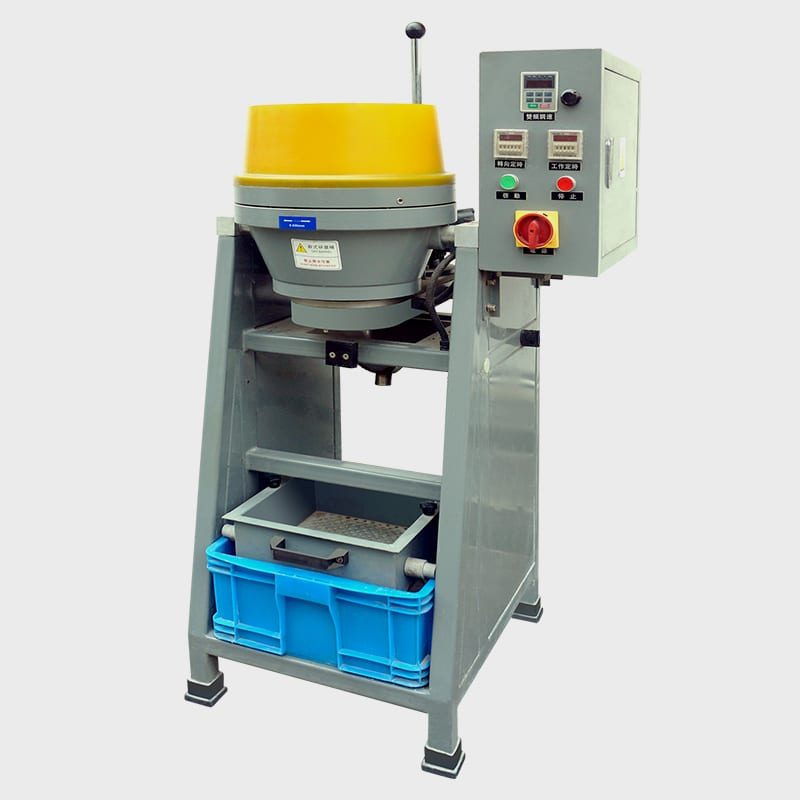
Centrifugal Disc Finishers for High-Volume Small Steel Retainers
Rigid, compact parts like stamped shift plates, clutch spacers, and small hardened collars process rapidly inside a centrifugal disc finisher, where high-energy toroidal shear compresses processing cycles—provided parts are sturdy enough not to dent on contact.
| Machine Platform | Best Motorsport Parts | Collision Protection | Typical Batch Flexibility |
|---|---|---|---|
| Divided Rectangular Trough | Ring-and-pinion sets, axles, crankshafts, con-rods | High (one part per PU bay) | Removable dividers fit varied lengths |
| Fixtured Drag Finisher | Dog rings, camshafts, billet hubs, impellers | Maximum (spindle-clamped) | Fast cycle times on high-value parts |
| Circular Vibratory Bowl | Small gears, hardware, shift forks, brackets | Medium (relies on media cushion) | Continuous flow-through + screen deck |
| Centrifugal Disc Finisher | Small rigid collars, spacers, valve keepers | Low-Medium (high-energy shear) | Ultra-fast cut for compact sturdy parts |
[DESIGN: Decision flowchart matching motorsport part mass, tooth fragility, and batch count to divided troughs, drag finishers, or bowls]
Protecting Critical Bearing Journals, Splines, and Aluminum Alloys
Motorsport components rarely have uniform tolerances across the entire part—some zones need mirror smoothness while neighboring bores must stay within tight press-fit limits.

Masking Precision Bearing Races and Tight Press-Fit Bores
Never assume isotropic finishing leaves every press-fit bore untouched if abrasive cutting media precedes the porcelain stage. Cap critical oil galleries with snug plugs, mask ground bearing races when pre-deburring with ceramic, and avoid oversized media shapes that wedge inside oil holes or bolt threads.
Why Billet Aluminum Uprights Must Never Enter Steel Chemistry
Teams frequently machine 6061 or 7075 suspension uprights, bellhousings, and brake calipers alongside steel gears. Running aluminum inside acidic steel conversion chemistry etches alloy grain boundaries black and pits sealing O-ring grooves. Keep aluminum strictly in dedicated neutral LC10 or JTS5 runs using resin-bonded plastic cones followed by clean porcelain spheres.
Titanium Connecting Rods and Exhaust Hardware Considerations
Titanium alloys work-harden and resist mild burnishing unless sharp ceramic or fine plastic media removes machining cusps first. Always isolate titanium hardware from carbon-steel media charges so free iron particles do not embed into hot titanium exhaust or valvetrain components.
Post-Finish Rinsing, Spot-Free Drying, and Storage Protection
Motorsport gears and forged steel rods emerge from wet isotropic lines completely bare and chemically active.

Immediate Neutralization and Rust-Inhibited Rinse
Right after the porcelain plateau stage, flush steel gears thoroughly with alkaline neutralizing wash and fresh water so zero residual accelerator remains trapped inside spline roots or blind bolt holes. For carbon and alloy steels, follow immediately with a light rust-inhibiting rinse before parts ever hit ambient shop air.
Heated Centrifugal Spin-Drying for Complex Oil Passages
Leaving wet crankshafts or hollow-drilled transmission shafts to air-dry causes orange flash rust inside cross-drilled oil galleys within an hour. Move small-to-medium gears straight into a heated centrifugal dryer or warm forced-air drying tunnel, then apply clean assembly oil immediately upon cooling.
Post-Dry Inspection Under Low-Angle Shop Light
Inspect gear tooth roots, dog engagement faces, and billet radii under bright task lighting to confirm uniform matte-to-mirror plateau consistency, zero dark chemical streaks, and zero broken porcelain fragments lodged inside oil feed holes.
Common Failure Modes in Motorsport Isotropic Finishing
Most ruined race-part batches stem from three avoidable shop-floor shortcuts.
[DESIGN: Defect comparison showing un-neutralized gray gear teeth, chipped tooth tips from overloading, and pitted aluminum billet]
Dark Gray Smut From Incomplete Neutralization
If hardened steel gears emerge looking uniform matte charcoal instead of bright silver mirror, the acidic conversion film was never wiped clean or neutralized thoroughly before unloading. Re-run the parts briefly in clean porcelain with fresh alkaline neutralizing compound to restore bright metallic luster.
Tooth-Edge Chipping From Overcrowding Open Bowls
Trying to save cycle time by tossing multiple heavy ring gears into one open circular bowl guarantees chipped gear teeth and bruised spline corners. Always segregate heavy drivetrain hardware using divided rectangular troughs or spindle fixtures.
Orange-Peel Bruising on Soft Aluminum Valve Covers and Brackets
Dropping dense stainless steel burnishing balls onto thin-walled 6061 aluminum brackets creates microscopic dimples across flat sealing flanges. Reserve heavy steel shot for tough stainless and carbon steels, and smooth aluminum strictly with lightweight plastic cones and gentle porcelain.
Honest Boundaries: What We Do and Do Not Supply
At Xiamen Jin Tai Jin Grinding Technology Co.,Ltd. (brand: Jings Polish), our workshop roots date back to 1996 and our company was formally established in 2009, delivering over 200,000+ sets of grinding and polishing solutions worldwide. Across our catalogue, we manufacture 21 machine platforms backed by 24 granted Chinese IP rights (1 invention patent, 15 utility model patents, and 8 design patents), under ISO 9001 certification 00726Q01571R001 (valid 2026-06-03 to 2029-06-02) and CE certifications M.2023.206.C88121 (Vertical, 8 models) and M.2023.206.C88120 (Horizontal, 13 models), valid until 2028-07-24.
Equipment, Media, and Compounds—No Contract Race-Part Job Shop
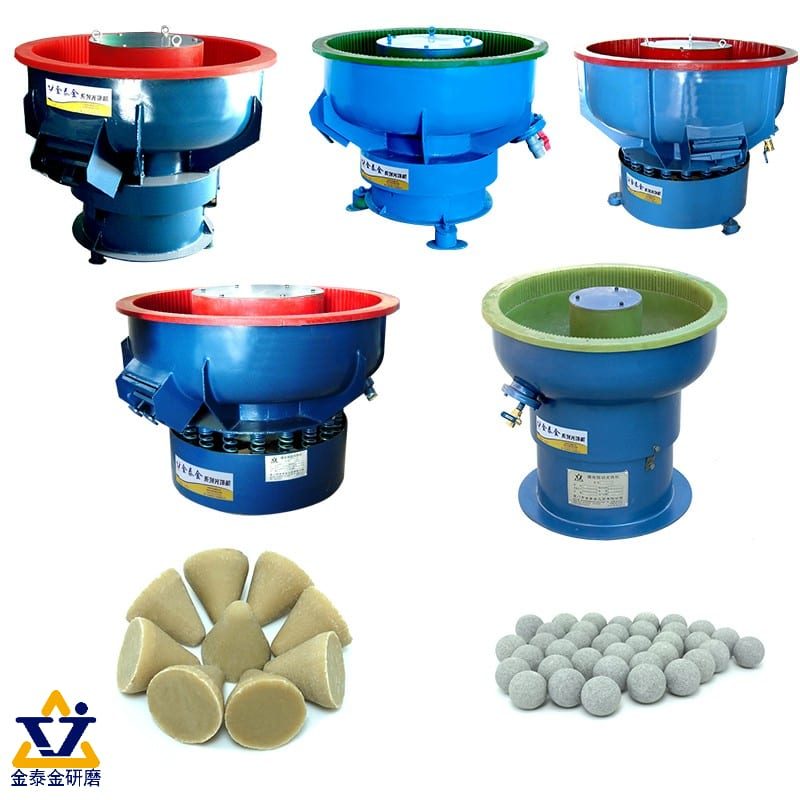
We engineer and supply vibratory bowls, divided rectangular troughs, drag finishers, centrifugal disc finishers, heated dryers, porcelain/ceramic/plastic media, and finishing compounds for customers to run inside their own machine shops and motorsport facilities. We do not operate a contract job-shop polishing service where teams mail in individual gearsets for processing. Standard machines ship in 25–35 days, while custom drag-finishing fixtures and divided troughs require 45–60 days.
No Shot Peening, Cryogenic Treatment, DLC Coating, or Heat Treating
Isotropic mass finishing lowers surface roughness and removes directional stress risers mechanically—it does not replace controlled fatigue shot peening, cryogenic stress relief, PVD/DLC surface coatings, or case hardening. If your drivetrain build requires shot peening or DLC coating, complete isotropic finishing cleanly before downstream coating or peening per your transmission engineer's sequence. For rough-casting and non-motorsport prep workflows, see our superfinishing guide and metal edge finishing guide.
Engineering Review Before Equipment Recommendation
Because gear module, alloy steel vs. billet aluminum, and oil-hole clearances determine media geometry and fixture design, we do not promise free mail-in sample trials or guarantee cycle times before inspecting your part photos and dimensions—submit clear photos and envelope specs via our custom polishing solution page for an engineering assessment.
Buyer Checklist & FAQ for Motorsport Isotropic Finishing
Use these benchmarks when planning an in-house motorsport finishing cell.
[DESIGN: Annotated motorsport finishing enquiry checklist covering gear diameter, alloy type, oil-hole width, and batch volume]
Does isotropic finishing change gear backlash or tooth profile tolerances?
When run exclusively with non-abrasive porcelain media and controlled conversion chemistry, stock removal stays strictly at the micro-asperity peak level—preserving involute tooth geometry and bearing journal fits. Avoid coarse abrasive ceramic cutting on precision-ground gear teeth.
Can one divided vibratory trough finish both steel gears and billet aluminum uprights?
Only if you maintain completely separate labeled media charges, clean the polyurethane dividers thoroughly between runs, and never mix steel conversion chemistry with neutral aluminum compounds (LC10/JTS5). Dedicated chambers eliminate cross-contamination risk completely.
Should motorsport gears be shot-peened before or after isotropic finishing?
Consult your drivetrain metallurgist, though in many performance builds gentle isotropic smoothing follows precision grinding and precedes final inspection or specialized coatings—while aggressive shot peening after mirror finishing will re-texture the smooth plateau into a dimpled matte skin.
Why did porcelain spheres lodge inside my crankshaft oil holes?
Media sizing matched the exact diameter of the chamfered oil feed hole. Cap cross-drilled oil galleries with snug removable plugs beforehand or choose non-lodging media strictly larger than every unmasked bore.
Can a compact magnetic tumbler isotropically finish hardened steel transmission gears?
No. Magnetic tumblers drive fine stainless pins only for light burr removal and non-ferrous brightening—they cannot level hardened alloy-steel gear grinding marks or carry heavy drivetrain mass.
How does isotropic finishing affect hypoid ring-and-pinion break-in and gearbox oil temperatures?
Standard ground ring-and-pinion gears shed sharp metallic wear particles during initial break-in laps, spiking differential oil temperatures and requiring early fluid drains. Leveling directional grinding peaks beforehand through motorsport isotropic finishing allows mating teeth to ride cleanly on a smooth plateau surface from the very first session—reducing initial break-in wear debris, lowering peak oil temperatures, and letting transmission builders verify tooth contact patterns more cleanly under gear-marking compound.
Can forged steel connecting rods and billet steel crankshafts share the same divided trough?
Yes, provided each connecting rod or crankshaft sits inside its own polyurethane-lined compartment and you use the same compatible porcelain or fine ceramic media charge. Keep crankshaft bearing journals masked if heavy pre-deburring ceramic media is used before the non-abrasive isotropic plateau stage, and always inspect cross-drilled oil holes carefully after spin-drying so zero media fragments remain inside oil passages.
What happens if you skip pre-degreasing oily motorsport parts before isotropic conversion?
Machining coolant, quenching oil, and gear assembly lube coat porcelain spheres and block the acidic accelerator from wetting steel peaks uniformly. That uneven wetting leaves patchy dull spots across gear flanks while turning the neutralizing bath cloudy. Always pre-wash parts in hot alkaline cleaner so clean metal enters the chamber evenly.
How do race shops handle small-batch custom prototype runs versus full-team season inventory?
A small race-prep shop building a few sequential gearboxes per month often runs a versatile divided rectangular vibratory trough with removable partitions, switching between porcelain media for steel gears and plastic cones for billet aluminum brackets. High-volume motorsport OEMs producing hundreds of identical dog rings, shift forks, or suspension uprights step up to fixtured drag finishers to slash cycle times while maintaining strict zero-collision repeatability.
What inspection method confirms isotropic finishing succeeded before gearbox assembly?
Measure surface roughness across multiple gear flanks or billet ribs with a calibrated stylus profilometer to confirm peak height reduction, then inspect tooth roots, dog engagement corners, and oil passages under bright low-angle task lighting. The finish should display a uniform, non-directional satin-to-mirror plateau free of dark smut, edge chips, or lodged porcelain.
How does isotropic finishing benefit sequential dog-ring shift engagement and synchro life?
Sharp grinding crests along dog engagement ramps and selector forks increase shift-fork drag and accelerate localized galling under rapid flat-shift loads. Smoothing those engagement surfaces through controlled isotropic plateauing reduces sliding friction between mating sleeves and forks, lowers shift effort, and extends component service intervals across endurance and sprint racing classes.
Can cast iron differential housings or ductile iron carriers run in the same isotropic line?
Cast iron and ductile iron housings carry free graphite and heavy surface scale that contaminate clean porcelain charges and stain non-ferrous parts. If you finish cast iron differential housings, run them in a dedicated descaling and deburring cycle with MC8 and ceramic triangles first, then isolate clean alloy-steel gearsets in their own dedicated porcelain chamber.
Why do billet aluminum suspension uprights need different compound chemistry than steel gears?
Hardened steel requires mild acidic conversion chemistry to soften surface peaks so non-abrasive porcelain can wipe them flat, whereas 6061 and 7075 aluminum are amphoteric and pit rapidly in reactive acidic or high-pH baths. Aluminum uprights must run exclusively with neutral lubricating compounds (JTS5 or neutral LC10) and soft resin-bonded plastic cones followed by clean porcelain spheres.
How should a race team store and handle isotropically finished gears between rebuilds?
Once drivetrain components emerge from the heated centrifugal dryer, coat bare alloy steel gears immediately with clean synthetic assembly lube or rust-preventive oil and store them in sealed individual VCI bags or padded compartment trays. Leaving dry, hyper-clean isotropic steel sitting uncovered in humid paddock trailers invites overnight surface flash rust that ruins the low-friction plateau finish before installation.
What details should I share before requesting a quote for motorsport finishing equipment?
Send clear photos of your gears, dog rings, crankshafts, or billet uprights along with alloy family, overall part dimensions and weight, smallest oil-hole or spline slot width, target surface roughness, and weekly batch volume. Also let us know whether parts arrive directly off precision CNC grinding or carry heat-treat scale that requires light pre-cleaning first. Our engineers can recommend the right divided trough, fixtured drag finisher, or polyurethane-lined vibratory bowl along with exact porcelain or plastic media grades and neutral or conversion chemistry for your shop floor.

 +86-592-2381506


 IPv6 network supported
