
Surface Finishing Process in Manufacturing: How Mechanical Mass Finishing Fits Between Machining and Downstream Coating
Manufacturing engineers and procurement leads mapping out a surface finishing process often lump completely different industrial technologies under one umbrella—confusing mechanical mass finishing (vibratory bowls, centrifugal discs, drag finishers, rotary barrels, magnetic tumblers) with chemical electroplating, anodizing, acid passivation, and abrasive sandblasting.
The central thesis of this guide is clear: mechanical mass finishing is the repeatable intermediate stage in the broader surface finishing process—sitting directly between primary cutting/forming (CNC, stamping, laser, casting) and downstream protective coating (anodizing, powder coat, plating, passivation) to strip burrs, round sharp corners, remove light scale, and lower surface roughness uniformly in batches. Understanding what mechanical tumbling solves—and what belongs strictly to upstream machining or downstream chemical/thermal lines—prevents costly capital mismatches. For related process guides, see our metal edge finishing guide, superfinishing guide, and risks of mass finishing investment guide.
Where Mechanical Mass Finishing Sits in the End-to-End Manufacturing Flow
Every precision metal or polymer component passes through three distinct manufacturing phases before final assembly.

Phase 1: Primary Shaping (CNC, Stamping, Laser Cutting, Die Casting)
Primary shaping creates macro-geometry, holes, and tolerances—yet inevitably leaves behind sharp 90-degree corners, exit burrs, stamping rollover fringes, laser oxide dross, or parallel tool-path cusps.
Phase 2: Mechanical Mass Finishing (Deburring, Edge Rounding, Smoothing, Burnishing)
Automated mass finishing chambers take rough, freshly formed parts and perform 360-degree mechanical conditioning across external faces, slots, and cross-holes—using tumbling media (ceramic, plastic, porcelain, steel, organic) and specialized compounds (LC10, MC8, PL10, JTJ50, JTS5) to deliver burr-free, uniform surfaces ready for inspection or coating.
Phase 3: Downstream Chemical, Thermal, or Assembly Operations
Once parts leave mass finishing clean, dry, and burr-free, they move smoothly into powder coating, Type-II/Type-III anodizing, electroplating, ASTM acid passivation, or precision mechanical assembly. Smooth, scale-free corners prevent powder-coat pull-back and eliminate burrs that would otherwise flake off inside hydraulic or drivetrain assemblies.
| Process Category | Physical Mechanism | What It Achieves | Belongs to Mechanical Mass Finishing? |
|---|---|---|---|
| Vibratory / Centrifugal / Drag / Barrel | Mechanical sliding, impact & fluid media shear | Deburring, edge radiusing, descaling, Ra reduction, burnishing | Yes (core scope) |
| Translating OBD Magnetic Tumbling | Magnetic-flux-driven 304 stainless pins |
Internal cross-bore deburring & non-ferrous brightening | Yes (core scope) |
| Heated Centrifugal & Corncob Drying | Heated centrifugal spin + moisture-wicking cob | Spot-free, flash-rust-free part discharge | Yes (core scope) |
| Anodizing / Electroplating / Passivation | Electrochemical or strong acid bath conversion | Oxide conversion layer, chrome/zinc plate, passive film | No (downstream chemical line) |
| Sandblasting / Shot Peening / Heat Treat | High-velocity dry grit, peen media, or furnace | Anchor-profile matte texture, compressive stress, hardening | No (separate specialty process) |
[DESIGN: Four-quadrant process map separating mechanical mass finishing from upstream machining, abrasive blasting, and downstream electroplating]
The Five Core Mechanical Stages Inside a Mass Finishing Cell
Not every workpiece needs all five stages, yet understanding each step prevents skipping critical prep work.
Stage 1: Pre-Degreasing Oily Machining or Stamping Parts
Heavy CNC coolant, tapping oil, and stamping grease coat ceramic and plastic stones on contact, killing cutting friction and turning compound water into dark sludge. Pre-washing oily batches before loading keeps media sharp and cycle times predictable.
Stage 2: Abrasive Cutting, Deburring, and Descaling
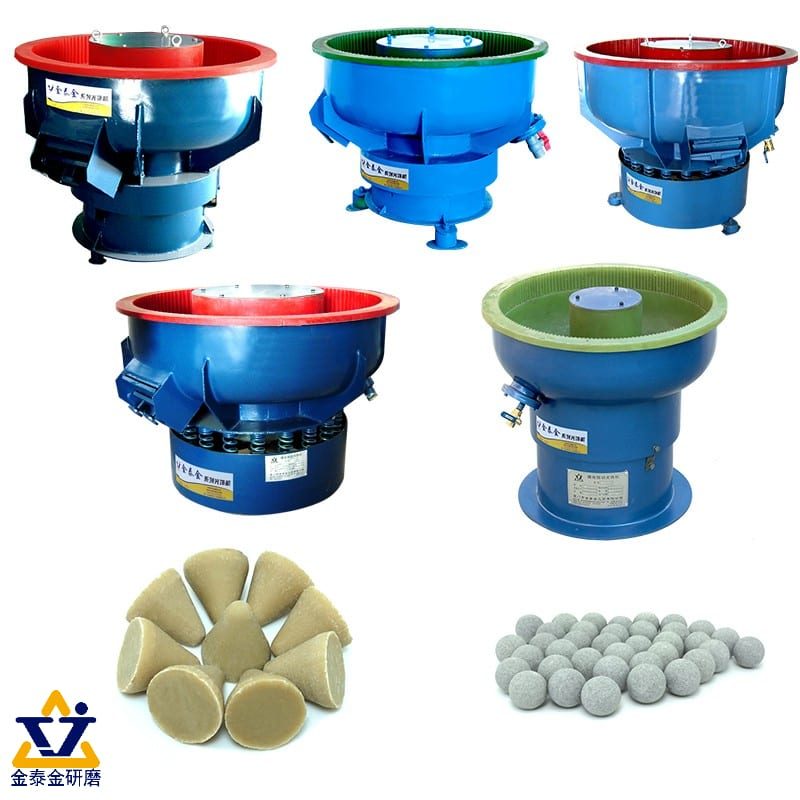
Using preformed ceramic triangles, angle-cut cylinders, or lightweight resin-bonded plastic cones paired with LC10 (or MC8 for heavy mill scale and weld heat tint), this stage shears off sharp burrs, rounds 90-degree edges, and levels directional tool marks into a uniform matte plateau.
Stage 3: Non-Abrasive Smoothing or Mirror Burnishing
Once rough defects are completely erased, parts transition into either non-abrasive high-alumina porcelain spheres (for isotropic plateauing) or stainless steel burnishing balls with PL10 (for bright cold-worked mirror compression on stainless, brass, and copper).
Stage 4: Clean-Water Flushing and Rust-Inhibited Rinsing
Residual compound foam carrying suspended metallic fines must be flushed off immediately upon unload. Carbon and alloy steel batches require a dedicated rust-inhibiting rinse (JTJ50 / inhibitor dip) so freshly exposed bare metal does not flash-rust during transfer.
Stage 5: Heated Centrifugal or Corncob Drying
Wet parts still risk water-spotting or overnight corrosion if left to air-dry in shop baskets. Immediate spin-drying inside a heated centrifugal dryer—or moisture-wicking inside a heated corncob media bowl—discharges clean, dry, packaging-ready components.
Matching Equipment Physics to Part Geometry and Throughput
Choosing the right machine inside your surface finishing process depends on part size, wall fragility, internal bore access, and hourly volume.

Circular Vibratory Bowls for General Batch Production
PU-lined vibratory grinders with integrated pneumatic separation flaps and screening decks serve as the versatile backbone for stamped brackets, cast housings, and machined fasteners.
Divided Rectangular Vibratory Troughs for Long or Collision-Sensitive Parts
Long aerospace ribs, forged connecting rods, and heavy stainless rims collide violently in open circular bowls. Divided rectangular troughs isolate one part per polyurethane-lined compartment for uniform finishing with zero impact nicks.
Fixtured Drag Finishers for High-Value Precision Components
For CNC billet impellers, sequential dog rings, and motorsport drivetrain gears, drag finishing clamps every workpiece on a planetary spindle and sweeps it through stationary media at high speed with zero part-on-part contact.
Centrifugal Disc Finishers for High-Energy Compact Throughput
Compact, rigid parts process dramatically faster in a centrifugal disc finisher, where high-pressure toroidal vortex motion compresses heavy deburring cycles for small floor footprints.
Octagonal Rotary Barrels and OBD Magnetic Tumblers
Octagonal rotary barrels handle rugged heavy steel batching and dry organic wood/walnut polishing (eyewear, acrylic, brass), while wide-table OBD magnetic tumblers sweep 304 stainless pins into deep internal cross-bores on non-ferrous and 304 stainless parts.
| Machine Platform | Primary Process Role | Part Collision Risk | Ideal Workpiece Fit |
|---|---|---|---|
| Circular Vibratory Bowl | Continuous wet cut, burnish & separation | Low-Medium | Medium stampings, castings, hardware |
| Divided Rectangular Trough | Zero-collision bulk processing | Zero (compartmentalized) | Long rails, heavy wheels, rods, shafts |
| Fixtured Drag Finisher | High-speed precision smoothing | Zero (spindle-clamped) | High-value gears, impellers, billet hubs |
| Centrifugal Disc Finisher | Rapid high-energy deburring | Medium-High (rigid parts) | Compact thick stampings & sintered parts |
| Octagonal Rotary Barrel | Heavy cascade cut & dry organic gloss | Medium (wet) / Low (dry) | Heavy steel forgings; dry acrylic/brass/gold |
| OBD Magnetic Tumbler | Internal cross-bore deburr & brighten | Low | Non-ferrous & 304 blocks with tight bores |
[DESIGN: Equipment selection matrix mapping part size, bore access, alloy, and fragility across six industrial machine platforms]
Alloy-Specific Rules Across the Surface Finishing Process
Treating aluminum, carbon steel, stainless steel, and brass with identical media and soaps causes immediate cosmetic and metallurgical failures.

Carbon Steel and Cast Iron
Requires sharp ceramic media, LC10 or MC8 descaling flow-through, mandatory rust-inhibiting rinse protection, and immediate heated spin-drying to prevent orange flash rust.
Austenitic 304 Stainless Steel
Work-hardens under dry manual buffing yet responds cleanly to wet ceramic cutting (LC10/MC8) followed by PL10 stainless steel ball burnishing for a compressed mirror finish.
Aluminum 6061 / 7075 and Die-Cast A380
Amphoteric aluminum etches dark gray in strong acids or high-pH alkaline cleaners and bruises under heavy ceramic or steel balls. Always use lightweight resin-bonded plastic cones, neutral LC10/JTS5 chemistry, softened rinse water, and alloy-segregated media charges free of carbon-steel iron dust.
Brass, Copper, and Precious Metals
Soft non-ferrous alloys polish bright in dry walnut shell or corncob media charged with fine cream, or wet-burnish rapidly with 304 stainless pins inside magnetic tumblers and vibratory bowls using neutral PL10 lubrication.
Common Process Failures When Steps Are Skipped or Misordered
Most scrap batches trace back to putting steps in the wrong order or skipping basic process hygiene.
[DESIGN: Troubleshooting gallery showing flash-rusted steel, etched aluminum, lodged media in slots, and over-rounded precision edges]
Anodizing or Powder Coating Over Un-Stripped Scale and Soap Film
Applying powder coating over laser oxide dross or dried LC10 soap residue guarantees blistering and flaking adhesion failures in the curing oven. Ensure complete scale removal (MC8 + ceramic) and clean fresh-water flushing before coating.
Running Aggressive Mass Finishing After Precision Bore Honing
Always schedule bulk ceramic deburring before final precision bore honing or thread tapping whenever possible—or mask critical bores with snug plugs and use fixtured drag spindles so abrasive stones never erode tight bearing fits.
Mixing Alloy Media Charges in One Shared Tub
Using the same ceramic stones on carbon steel in the morning and 6061 aluminum in the afternoon embeds rust-prone iron particles directly into soft aluminum skins. Maintain strictly segregated media bins per alloy family.
Skipping Undersize Media Screening
Worn-down ceramic triangles gradually shrink to the exact width of mounting holes and cooling slots, wedging tightly inside finished parts. Screen working media charges periodically to purge undersized fragments.

Wastewater Settling, Compound Flow-Through, and Shop-Floor Readiness
Every wet mechanical finishing line depends on clean water flow and simple effluent settling to maintain consistent cut rates shift after shift.
[DESIGN: Closed-loop vs flow-through compound management diagram showing settling baffles and clean drain discharge]
Why Flow-Through Compound Dosing Outperforms Static Recirculating Sumps
Running a vibratory bowl with a closed recirculating water tank quickly loads the liquid with oily machining residue and fine metallic wear mud—glazing ceramic stones smooth and staining aluminum or brass parts gray. Steady fresh-water and LC10 (or MC8) flow-through carries suspended debris straight out of the chamber so media stays crisp and parts emerge clean.
Multi-Baffle Settling Tanks Before Floor Drain Discharge
Before discharging wet vibratory rinse water into shop drains, route the drain hose through a simple multi-baffle settling tank. Heavy worn ceramic sediment and metallic fines drop cleanly to the bottom of the settling chambers, protecting facility plumbing and simplifying periodic sludge cleanout.
Floor Slab, Compressed Air, and Electrical Utilities Planning
Before commissioning a new surface finishing process cell, confirm three-phase electrical supply matched to the drive motor, compressed air pressure for pneumatic separation flaps on vibratory bowls, clean water flow lines, and forklift or hoist access for loading heavy media bags safely.
Honest Boundaries: What We Do and Do Not Supply
At Xiamen Jin Tai Jin Grinding Technology Co.,Ltd. (brand: Jings Polish), our workshop roots date back to 1996 and our company was formally established in 2009, delivering over 200,000+ sets of grinding and polishing solutions worldwide. Across our catalogue, we manufacture 21 machine platforms backed by 24 granted Chinese IP rights (1 invention patent, 15 utility model patents, and 8 design patents), under ISO 9001 certification 00726Q01571R001 (valid 2026-06-03 to 2029-06-02) and CE certifications M.2023.206.C88121 (Vertical, 8 models) and M.2023.206.C88120 (Horizontal, 13 models), valid until 2028-07-24.

Mechanical Mass Finishing Machines, Media, and Compounds—Not Contract Job-Shop Finishing
We engineer and manufacture industrial mass finishing equipment (vibratory bowls, divided troughs, drag finishers, centrifugal disc finishers, rotary barrels, OBD magnetic tumblers, heated dryers), tumbling media, and liquid/dry compounds for your own production plant. We do not provide contract part-finishing job-shop services. Standard machines ship in 25–35 days, while custom divided troughs and fixtured drag lines require 45–60 days.
No Electroplating, Anodizing, Sandblasting, Heat Treating, or CNC Machining
We do not supply electroplating baths, anodizing tanks, ASTM acid passivation lines, dry sandblasting cabinets, heat-treatment furnaces, hand-held angle grinders, or CNC machine tools. Our equipment handles the mechanical mass finishing and drying portion of your surface finishing process cleanly—preparing parts for downstream coating or final assembly.
Candid Engineering Review Before Recommending a Line
Because alloy grade, worst-case burr size, narrowest slot/hole width, and hourly throughput determine chamber physics and media sizing, we do not promise free mail-in sample trials or guarantee cycle times before inspecting your workpiece—send clear photos of your parts and dimensional requirements via our custom polishing solution page for an engineering assessment.
Buyer Checklist & FAQ for Planning a Surface Finishing Process
Use these practical benchmarks when mapping or upgrading your production finishing line.
[DESIGN: Annotated surface finishing process enquiry checklist showing alloy, upstream cut method, downstream coating, and hourly batch target]
What is the difference between mechanical mass finishing and abrasive blasting?
Abrasive sandblasting shoots dry grit via compressed air to create a rough matte anchor profile line-of-sight, whereas mechanical mass finishing tumbles batches inside wet or dry media beds to deburr 360 degrees, round sharp corners uniformly, lower surface roughness, and burnish bright luster without silica dust. Compare media behavior in our glass bead vs aluminum oxide media guide.
Can one machine perform deburring, mirror polishing, and drying?
Deburring and mirror polishing require completely different media (ceramic/plastic vs. steel balls/porcelain/organic cob), while drying requires heated airflow or dry cob media. Splitting heavy production into dedicated cut, burnish, and drying stations eliminates daily media swaps and stray-grit scratching.
Should mass finishing happen before or after heat treatment?
Perform heavy burr removal before heat treatment while metal is softer, then run a light MC8/ceramic descaling or non-abrasive porcelain isotropic pass after heat treatment if scale or distortion cleanup is required.
How do I keep delicate external threads safe during batch deburring?
Either finish parts inside fixtured drag spindles or divided rectangular compartments, cap critical exposed threads with reusable plugs, or process non-ferrous and 304 parts gently in a wide-table OBD magnetic tumbler.
What is the best way to tell whether a burr problem is a media issue or a machine physics issue?
Check where the unfinished burr sits on the part. If flat outer faces look smooth while an internal cross-hole or tight corner notch still carries a burr, the media shape is too large to reach that feature. Conversely, if the entire part emerges bruised, bent, or unevenly battered along outer edges, the chamber physics is too aggressive or overcrowded for that part geometry.
How long does it take to transition from manual hand-deburring to an automated mass finishing line?
Standard vibratory bowls, rotary barrels, OBD magnetic tumblers, and heated dryers ship in 25–35 days, while custom divided rectangular troughs and fixtured drag-finishing spindles require 45–60 days. Preparing three-phase power, clean water supply, compressed air, and a simple settling tank ahead of delivery lets your team commission the cell immediately upon arrival.
Can the same mass finishing line process both 304 stainless steel and 6061 aluminum brackets?
Yes, provided you maintain completely separate labeled media charges (ceramic + steel balls for stainless vs. plastic cones + porcelain for aluminum), flush the polyurethane chamber thoroughly between alloy changes, and isolate neutral aluminum compounds (LC10/JTS5) from ferrous descaling runs.
Why do parts sometimes look great out of the vibratory bowl yet fail inspection the next morning?
Two post-unload errors cause overnight rejects: leaving carbon-steel parts damp without a rust-inhibiting rinse and heated spin-dry (causing flash rust), or letting hard tap water evaporate slowly inside aluminum or brass pockets (leaving powdery white mineral rings). Immediate clean flushing and heated centrifugal or cob drying prevent both failures completely.
How do I size media so it never wedges inside mounting holes or cooling slots?
Measure the narrowest slot, cross-bore, and thread pitch on your part drawing, then choose ceramic or plastic media shapes either comfortably larger than every unmasked opening or small enough to pass straight through freely—and screen out worn undersized media chips regularly.
When should a manufacturing plant choose fixtured drag finishing over a circular vibratory bowl?
Choose fixtured drag finishing when parts are high-value CNC components—such as sequential transmission gears, billet impellers, or orthopedic implants—where even a single part-on-part collision nick scraps the part, or when tight cycle-time quotas demand far higher media shear speed than a standard bowl can deliver. For everyday stamped brackets and cast housings that tolerate cushioned bulk flow, circular vibratory bowls provide lower tooling cost and faster batch loading.
How does mechanical mass finishing reduce manual labor without losing part-to-part consistency?
Hand deburring and manual flap-disc grinding depend entirely on operator fatigue and hand pressure, producing inconsistent chamfers from morning to evening shifts. Automated mass finishing subjects every part in the batch to identical media flow, compound chemistry, and dwell time—freeing skilled technicians for welding, CNC setup, and precision assembly.
What inspection benchmarks confirm a surface finishing process is ready for full production?
Verify four measurable checkpoints on initial setup batches: complete burr removal under bright task lighting, uniform edge radius across internal cutouts and outer corners, target surface roughness via stylus profilometer where specified, and zero residual media fragments or drying water spots inside blind pockets.
How does dry organic media finishing fit into a metal or polymer surface finishing process?
Dry organic media—such as hardwood pegs, bamboo pegs, walnut shell granules, and dry corncob—handles two distinct roles in modern finishing lines: gentle multi-stage dry barrel brightening for acrylic, eyewear, brass, and gold without water slurry, and heated vibratory moisture-wicking at the very end of wet metal burnishing lines to eliminate hard-water spots before packaging.
What details should I share before requesting a quote for a surface finishing process line?
Share clear photos of your parts showing raw burrs or scale, alloy grade, part envelope dimensions and weight, narrowest slot or hole size, downstream coating requirements (anodize, powder coat, plating, or bare assembly), and target hourly batch volume via our custom polishing solution page. Also note whether parts arrive coated in heavy CNC cutting oil or dry from laser/stamping presses, whether any critical bores or threads require masking, and what target surface roughness you must meet. Our engineers will map out the right vibratory, centrifugal, drag, or barrel machines, non-lodging media, liquid or dry compounds, and heated drying equipment for your shop floor so your finishing line runs reliably and repeatably from day one.

 +86-592-2381506


 IPv6 network supported
